3D Printer Filament Drying and Heated Chamber Electricity Cost Formula: 6 Essential kWh Calculations
When pricing standard PLA parts on an open-frame bed-slinger or enclosed CoreXY printer, electricity is a minor line item—averaging just 110W to 130W of continuous draw. However, the moment a commercial print farm transitions to high-margin engineering thermoplastics such asPAHT-CF (Carbon-Fiber Nylon), Polycarbonate (PC), ASA, or PETG-CF, thermal energy consumption spikes dramatically. Before the nozzle extrudes a single millimeter of Nylon, you must run a high-output blast dryer—such as the 330WSUNLU FilaDryer S4—at 70°C for 8 to 12 hours, and then maintain a 100°C–110°C build plate alongside a 60°C active PTC heated chamber throughout a 14-hour print cycle.
If your quoting spreadsheet still uses a flat $0.03/hour PLA electricity assumption, you are underbilling thermal energy overhead by350% to 480%on every engineering job. In this comprehensivefilament dryer electricity cost formulaguide, we derive the exact PID duty-cycle kilowatt-hour (kWh) equation, benchmark real wattage across PLA, PETG, ASA, and PAHT-CF, and prove how 4-spool batch drying slashes pre-dry energy overhead by 75%. To combine these thermal numbers with filament weight, AMS purge waste, and machine depreciation, plug your job into our3D Print Cost Estimator.
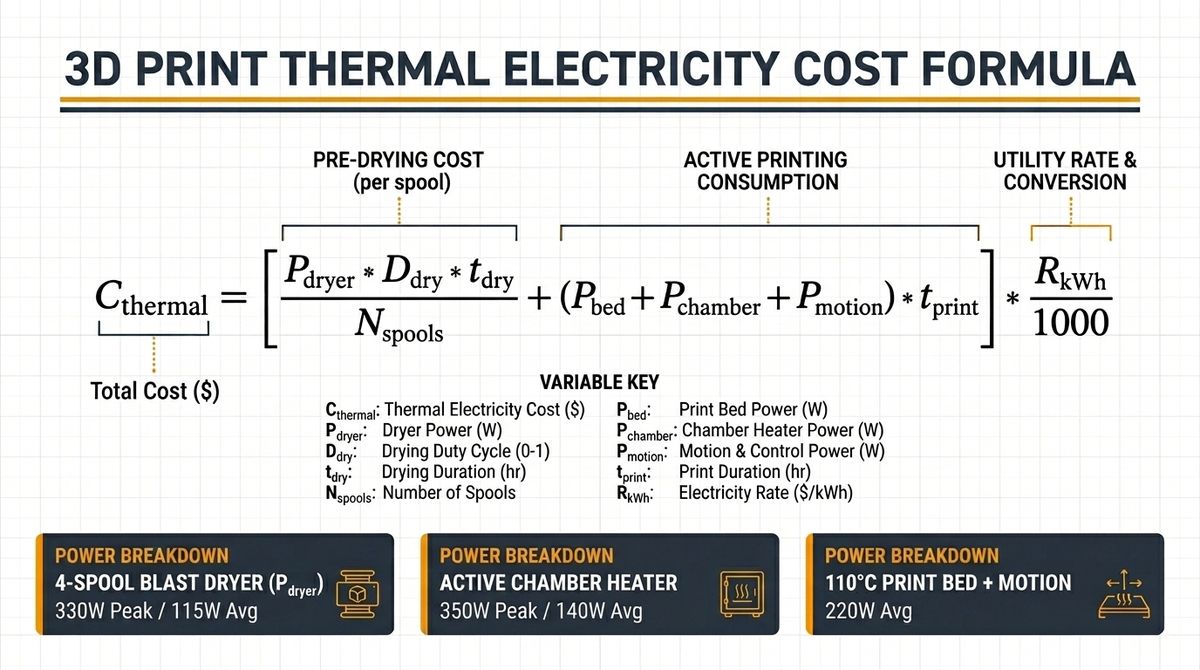
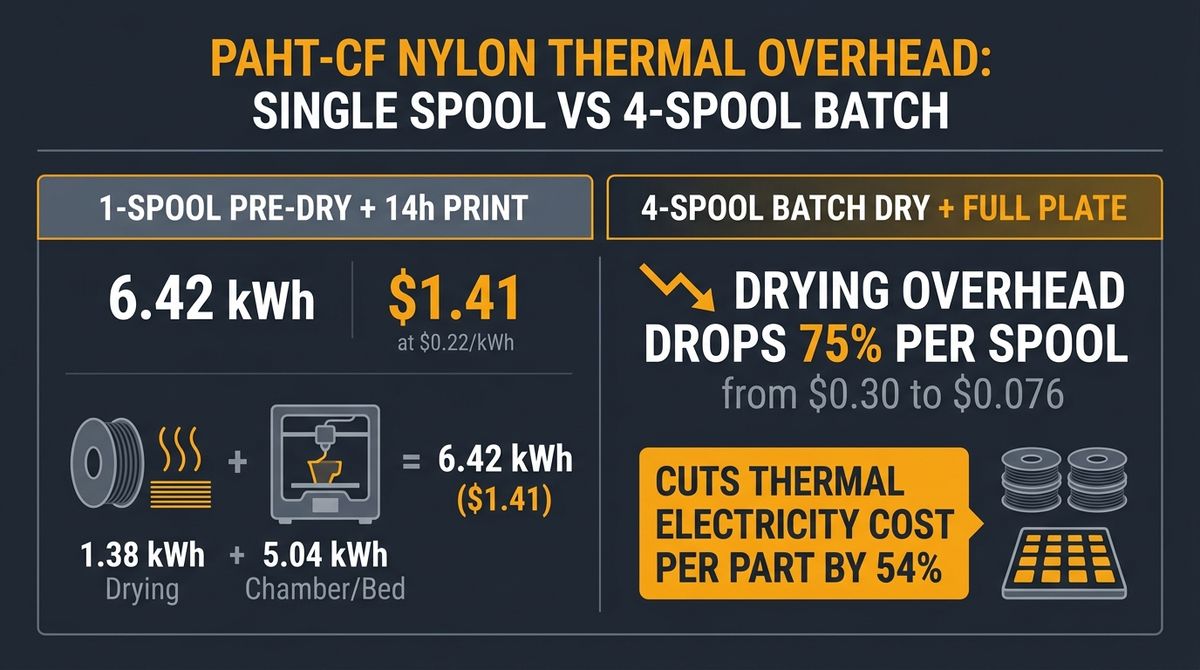
Quick Formula & Print Farm Thermal Takeaways The Master Thermal Electricity Formula: $$C_{\text{thermal}} = \left[ \frac{P_{\text{dryer}} \cdot D_{\text{dry}} \cdot t_{\text{dry}}}{N_{\text{spools}}} + \left( P_{\text{bed}} + P_{\text{chamber}} + P_{\text{motion}} \right) \cdot t_{\text{print}} + E_{\text{ramp}} \right] \times \frac{R_{\text{kWh}}}{1000}$$ Peak vs PID Duty-Cycle Wattage: A 330W PTC filament dryer does not draw 330W continuously; after its 10-minute ramp-up, its PID controller pulses at a 32% to 38% duty cycle (~115.5W average at 70°C) . The 4-Spool Batch Drying Rule: Pre-drying 4 spools simultaneously in a shared 4-spool chamber divides pre-dry kWh by (\(N_{\text{spools}} = 4\)), cutting per-spool drying cost by 75% (from $0.305 to $0.076 at $0.22/kWh).
1. Why Nameplate Wattage Lies: Understanding PID Heater Duty Cycles
Inr/3Dprinting energy consumption threadsandprint farm utility bill discussions, beginners often make one of two opposite errors: either they ignore filament dryer and chamber power completely, or they multiply the power supply's maximum nameplate rating (e.g., 330W dryer + 1,300W printer peak = 1,630W) by print duration and panic over a fictional $5.00 electricity cost.
In reality, every thermal subsystem on a modern 3D printer—the PTC filament dryer, the AC silicone or DC PCB print bed, the active PTC chamber heater, and the 300°C–320°C all-metal hotend—operates underProportional-Integral-Derivative (PID) pulse-width modulation:
- Phase 1 — Cold Ramp-Up (\((E_{\text{ramp}}), 5 to 15 Minutes\)): Heaters run at 80% to 100% duty cycle to bring thermal mass from ambient room temperature (\(20^\circ\text{C}\)) to target setpoint (\((70^\circ\text{C}) dryer, (110^\circ\text{C}) bed, (60^\circ\text{C}) chamber\)).
- Phase 2 — Steady-State Maintenance (\(D_{\text{steady}} \approx 0.25\text{ to }0.42\)): Once target temperature is reached, the heater only pulses enough electrical power to offset convective and radiative heat loss through the enclosure walls. For example, the SUNLU FilaDryer S4 features a 330W PTC heater (a 6.9× power increase over the 48W S2), which reaches 70°C rapidly and then settles to an average steady-state draw of ~115.5W (35% duty cycle) at 70°C, or ~65W (20% duty cycle) at 50°C for PLA.
2. The Master Filament Drying & Heated Chamber Electricity Formula
To price any FDM job accurately alongside ourMaster 3D Print Cost FormulaandMulti-Color AMS Purge Waste Cost Formula, we sum the pre-drying energy amortized across (\(N_{\text{spools}}\)) and the active printing energy across all three printer subsystems:
Where:
- (\(P_{\text{dryer\_peak}}\)): Rated heater wattage of the filament dryer in watts (\(e.g., (330\text{ W}) for a 4-spool blast dryer, or (48\text{–}80\text{ W}) for a single-spool dryer\)).
- (\(D_{\text{dry}}\)): Average PID duty cycle over the drying cycle ((0.20) at 50°C PLA; (0.28) at 60°C PETG; (0.35) at 70°C Nylon/PC).
- (\(t_{\text{dry}}\)): Total pre-drying + active feed-drying duration in hours.
- (\(N_{\text{spools}}\)): Number of spools dried simultaneously in the shared chamber (\(1\text{ to }4\)).
- (\(P_{\text{bed\_avg}}\)): Steady-state average print bed wattage (\((55\text{ W}) at 55°C PLA; (95\text{ W}) at 80°C PETG; (160\text{ W}) at 110°C ASA/Nylon/PC\)).
- (\(P_{\text{chamber\_avg}}\)): Steady-state average active PTC chamber heater wattage (\((0\text{ W}) for passive PLA/PETG; (140\text{ W}) average from a 350W PTC heater holding 60°C\)).
- (\(P_{\text{motion\_hotend}}\)): CoreXY stepper motors, mainboard, cooling fans, and 40W–60W ceramic hotend (\(averages (60\text{ W}) continuous\)).
- (\(R_{\text{kWh}}\)): Local commercial or residential electricity tariff in dollars per kilowatt-hour (e.g., \(\$0.16/\text{kWh}\) US average, \(\$0.22\text{--}\$0.32/\text{kWh}\) California/UK/EU).
3. Material-by-Material Thermal Wattage & kWh Benchmark Table
Compare the verified steady-state power draw and total energy cost for a14-hour print jobacross five common commercial materials (evaluated at a utility tariff of \(R_{\text{kWh}} = \$0.22/\text{kWh}\)):
Material Profile
Pre-Dry Spec (\((t_{\text{dry}}) @ Temp\))
1-Spool Dryer kWh
Printer Avg Draw (Bed + Chamber + Motion)
14h Print kWh
Total kWh (1-Spool vs 4-Spool Batch)
Electricity Cost (@ $0.22/kWh)
PLA / PLA+ (Open)
4h @ 50°C (Optional)
0.26 kWh
115 W (55W Bed + 0W Ch + 60W Mot)
1.61 kWh
1.87 kWh / 1.68 kWh
$0.35 – $0.41
PETG / PETG-CF
6h @ 65°C (92W Avg)
0.55 kWh
155 W (95W Bed + 0W Ch + 60W Mot)
2.17 kWh
2.72 kWh / 2.31 kWh
$0.51 – $0.60
ASA / ABS (Passive Ch)
6h @ 65°C (92W Avg)
0.55 kWh
210 W (150W Bed + 0W Ch + 60W Mot)
2.94 kWh
3.49 kWh / 3.08 kWh
$0.68 – $0.77
PAHT-CF / PA6-CF Nylon
12h @ 70°C (115.5W Avg)
1.39 kWh
360 W (160W Bed + 140W Ch + 60W Mot)
5.04 kWh
6.43 kWh / 5.39 kWh
$1.41 (1-Spool) / $1.18 (Batch)
Polycarbonate (PC)
12h @ 70°C + 14h Live Dry
3.00 kWh
380 W (170W Bed + 150W Ch + 60W Mot)
5.32 kWh
8.32 kWh / 6.07 kWh
$1.83 (1-Spool) / $1.34 (Batch)
Look closely at the bottom two rows: printing a single spool of Polycarbonate or PAHT-CF with dedicated pre-drying consumes6.43 to 8.32 kWh ($1.41 to $1.83 in pure electricity)—more than 4.5 times the energy of a PLA job of identical duration.
4. Step-by-Step Worked Example: Single-Part vs 4-Spool Batch PAHT-CF Job
Suppose a client orders four functional carbon-fiber Nylon (PAHT-CF) drone motor mounts, each requiring 45g of filament and 3.5 hours of print time (14.0 hours total for 4 mounts) in a shop where commercial electricity costs (\(R_{\text{kWh}} = \$0.22/\text{kWh}\)):
1. Scenario A — Unbatched Single-Spool Workflow (Pre-drying 1 spool for 12h + printing 4 mounts sequentially with 4 separate chamber heat-soaks): Pre-Dry Energy (\(N_{\text{spools}} = 1\)): \(330\text{ W} \times 0.35 \times 12\text{ h} = 1{,}386\text{ Wh} = 1.386\text{ kWh}\) ($0.305). 4 Separate Chamber + Bed Ramp-Ups (15 min each = 1.0h @ 650W): \(0.650\text{ kWh}\) ($0.143). 14h Active Chamber Printing (@ 360W steady): \(360\text{ W} \times 14\text{ h} = 5{,}040\text{ Wh} = 5.040\text{ kWh}\) ($1.109). Total Scenario A Energy: \(1.386 + 0.650 + 5.040 = \mathbf{7.076\text{ kWh}}\) ($1.56 total, or $0.39 per mount in electricity alone).
2. Scenario B — 4-Spool Batch Drying + Single Full-Plate Chamber Run: Amortized Pre-Dry Energy (\(N_{\text{spools}} = 4\)): (\(1.386\text{ kWh} / 4 = 0.3465\text{ kWh}\)) (\(\$0.076\) allocated to this spool—a 75% reduction). Single Chamber Heat-Soak + 12.8h Consolidated Plate Print: Because printing all 4 mounts on one build plate eliminates 3 thermal cooldown/reheat cycles and saves 1.2 hours of Z-homing and bed-leveling overhead, active print energy drops to (\(0.162\text{ kWh ramp} + (360\text{ W} \times 12.8\text{ h}) = 4.77\text{ kWh}\)). Total Scenario B Energy: (\(0.3465 + 4.77 = \mathbf{5.116\text{ kWh}}\)) (\(\mathbf{\$1.12\text{ total}}\), or \$0.28 per mount—and if you dry during off-peak overnight utility hours at \$0.11/kWh, cost per mount drops to \$0.14, a 64% total savings!).
5. How to Measure Your Exact Shop Duty Cycle with an Inline kWh Meter
Because ambient room temperature (\((16^\circ\text{C}) winter garage vs (26^\circ\text{C}) summer studio\)) shifts enclosure heat loss by up to 30%, every print farm should run a one-time calibration using a $15 inline plug-in Kill-A-Watt or smart energy-monitoring plug:
1. Measure Dryer (\(D_{\text{dry}}\)): Plug your filament dryer into the kWh meter, load 4 spools, set to 70°C for 10 hours, and divide total recorded watt-hours by (\(10 \times P_{\text{dryer\_peak}}\)).
2. Transfer Dried Spools to Passive Desiccant Polydryer / Cereal Boxes: Once a 4-spool batch finishes its 12-hour active heat soak, transfer 3 spools into airtight desiccant boxes with activated alumina (which consumes 0.00 watts ) while feeding the active printer through a sealed PTFE bowden tube.
3. Use High-Grip Build Plates When Chamber Heating Isn't Needed: For PLA and PETG jobs that do not require an enclosed heated chamber, switching from a 60°C textured PEI plate to a 35°C–45°C low-temp polyurea plate cuts bed power consumption by 55% to 70%.
Price Every Filament, Dryer & Chamber Job for Guaranteed Profit Plug your spool price, gram weight, dryer wattage, heated chamber draw, and machine depreciation into our free calculator to generate instant wholesale and retail quotes. Launch the 3D Print Cost Estimator →
Frequently Asked Questions
How many watts does a 4-spool filament dryer actually use per hour?
While a 4-spool dryer like the SUNLU FilaDryer S4 has a330W peak PTC heaterfor fast warm-up, its PID controller pulses the heater once target temperature is reached—averaging roughly65W (0.065 kWh/hr) at 50°Cfor PLA and115.5W (0.115 kWh/hr) at 70°Cfor Nylon and Polycarbonate.
Does running an active heated chamber double 3D printer electricity cost?
Yes, and often more than doubles it. An open-frame PLA print averages ~115W, whereas an enclosed high-temp print running a 110°C bed (~160W average) plus a 60°C active PTC chamber heater (~140W average) and motion system (~60W) draws roughly360W continuous—3.1× higher hourly power draw before adding filament pre-drying.
Should I leave my filament dryer turned on during the entire print?
For ultra-hygroscopic materials like PA6-CF, PPA-CF, and PVA in humid rooms (>50% RH), keeping the spool at a 50°C maintenance setting during printing prevents moisture reabsorption. However, once the initial 12-hour 70°C pre-dry is complete, feeding directly from a sealed desiccant dry-box with molecular sieve beads achieves identical print quality at zero ongoing wattage.
Run the Interactive Calculator: Use our 3D Print Cost Estimator to model your exact parameters and tolerances in real time.