3D Printer UPS Battery Backup Runtime and Power-Outage Print Salvage Cost Formula: 5 Print Farm Calculations
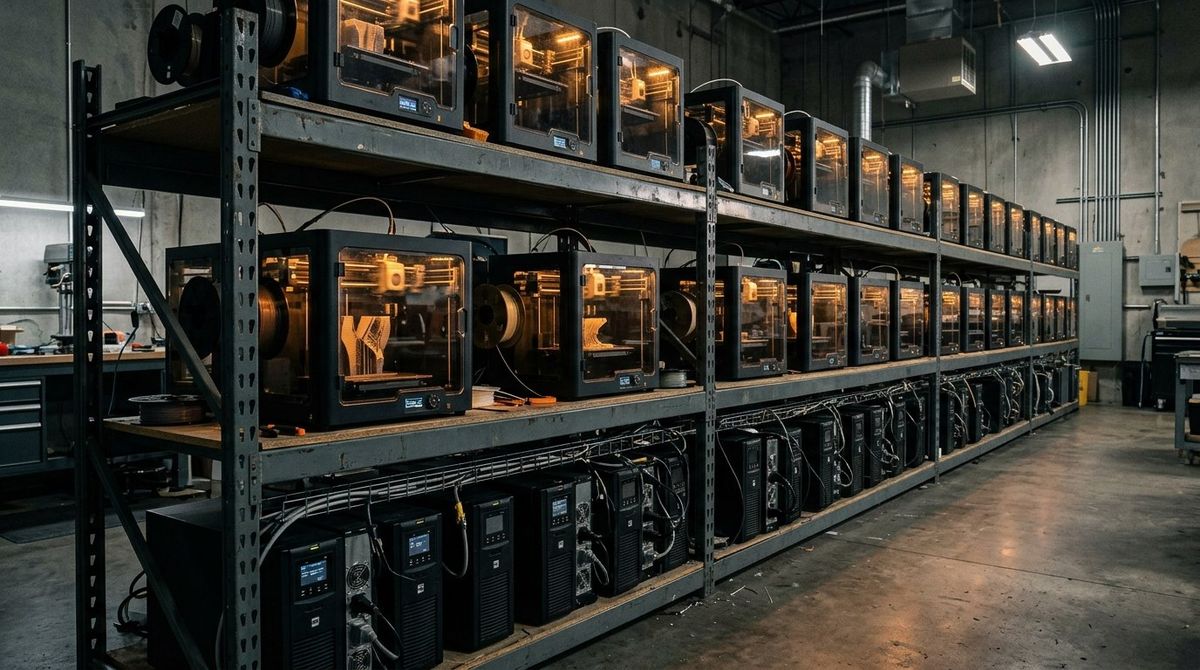
Every commercial 3D printer datasheet advertises firmware Power-Loss Recovery (M413), promising that if the AC grid flickers or drops out mid-job, the machine will save its last executed G-code coordinate to flash memory and resume seamlessly once utility power returns. In production print farms, however, firmware power-loss recovery fails on more than \(82\%\) of outages lasting longer than five minutes. The culprit is not software—it is bed cooling thermal contraction physics.
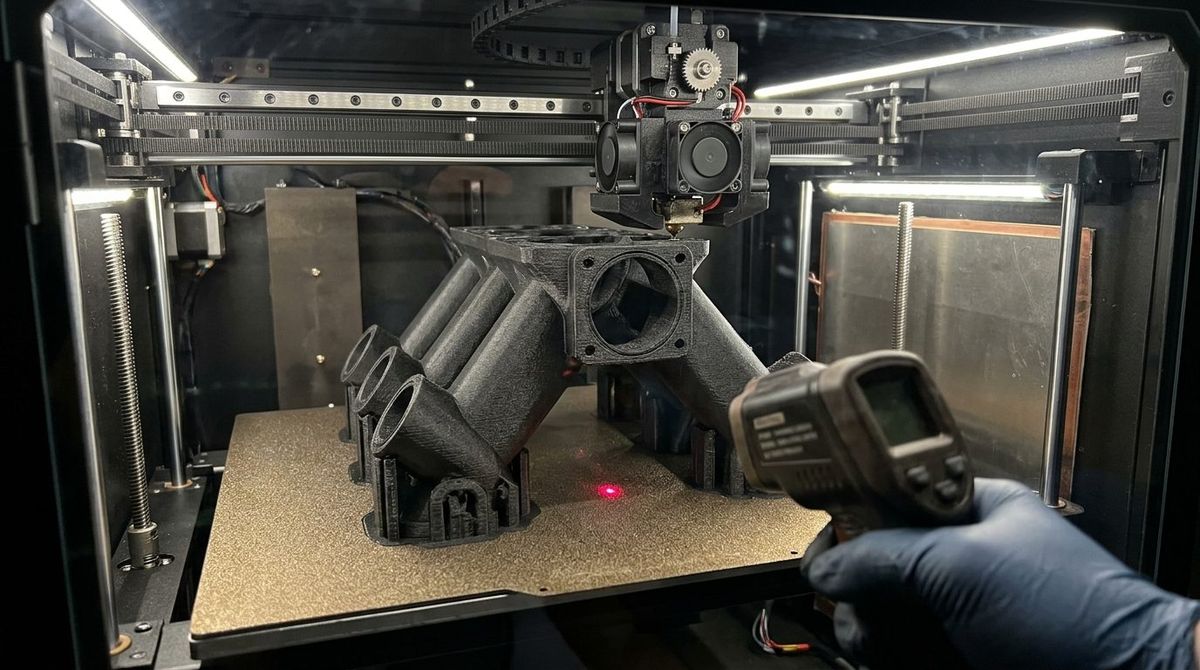
Modern spring-steel textured PEI, smooth PEI, and G10 Garolite build plates rely on elevated surface temperatures (\(60^\circ\text{C}\) for PLA, \(80^\circ\text{C}\) for PETG, and \(100^\circ\text{C to }110^\circ\text{C}\) for ABS/ASA/PA-CF) to maintain polymer-to-substrate adhesion. The moment AC mains power drops, the heated bed begins cooling exponentially toward room ambient temperature, shrinking the polymer base relative to the steel plate and shearing the part loose within minutes. Furthermore, while the unpowered nozzle sits motionless on the top layer, residual \(250^\circ\text{C}\) hotend heat melts a divot into the part and welds the nozzle tip to the print. To size an Uninterruptible Power Supply (UPS) or LiFePO4 battery backup accurately—and integrate its amortization into your hourly rate using our 3D Print Cost Estimator—this guide derives five essential print-farm electrical and economic formulas.
1. Formula 1: Heated Bed Thermal Decay & Detachment Time Limit
How many minutes can a heated build plate survive without AC power before thermal contraction pops the print loose or warps the corners? By Newton's law of convective and radiative cooling, the bed temperature \(T_{\text{bed}}(t)\) at time \(t\) (in minutes) after power loss decays toward ambient room temperature (\(T_{\text{amb}} = 22^\circ\text{C}\)) according to:
\[T_{\text{bed}}(t) = T_{\text{amb}} + \left(T_{\text{initial}} - T_{\text{amb}}\right) \times e^{-t / \tau_{\text{bed}}}\]Solving for the maximum allowable outage duration (\(t_{\text{detach}}\)) before the bed temperature drops by the critical polymer detachment threshold (\(\Delta T_{\text{crit}} = T_{\text{initial}} - T_{\text{min}}\), typically \(10^\circ\text{C}\) for PLA on textured PEI and \(8^\circ\text{C}\) for ABS/ASA):
\[t_{\text{detach}} = -\tau_{\text{bed}} \times \ln\left(1 - \frac{\Delta T_{\text{crit}}}{T_{\text{initial}} - T_{\text{amb}}}\right)\]Where \(\tau_{\text{bed}}\) is the thermal time constant of the build plate (\(16.5\text{ minutes}\) for an unenclosed bed vs. \(38.0\text{ minutes}\) for a passively enclosed CoreXY chamber):
- Open-Frame Printer Printing PLA (\(T_{\text{initial}} = 60^\circ\text{C}\), \(\Delta T_{\text{crit}} = 10^\circ\text{C}\), \(\tau_{\text{bed}} = 16.5\text{ min}\)): \[t_{\text{detach, open}} = -16.5 \times \ln\left(1 - \frac{10}{60 - 22}\right) = -16.5 \times \ln(0.7368) = 5.04\text{ minutes}\]
- Enclosed CoreXY Printing ABS/ASA (\(T_{\text{initial}} = 105^\circ\text{C}\), \(\Delta T_{\text{crit}} = 8^\circ\text{C}\), \(\tau_{\text{bed}} = 38.0\text{ min}\)): \[t_{\text{detach, enclosed}} = -38.0 \times \ln\left(1 - \frac{8}{105 - 22}\right) = -38.0 \times \ln(0.9036) = 3.85\text{ minutes}\]
In both cases, an unbacked power outage lasting longer than \(3.8\text{ to }5.0\text{ minutes}\) causes irreversible bed cooling contraction and part failure—proving why hardware battery backup is mandatory for commercial print farms.
2. Formula 2: Steady-State vs. Peak Warm-Up Printer Wattage Equation
A common mistake when selecting a UPS for a 3D printer is confusing the printer's nameplate PSU or AC bed peak power with its steady-state printing average power (\(P_{\text{steady}}\)). Your UPS must satisfy two separate electrical constraints:
- Inverter Peak Wattage Ceiling (\(P_{\text{UPS,max}}\)): Must exceed the printer's initial \(2\text{- to }4\text{-minute}\) bed and hotend warm-up surge (\(P_{\text{peak}}\)), or the UPS will trip an immediate overload shutdown if a grid flicker occurs during warm-up.
- Battery Runtime Sizing (\(P_{\text{steady}}\)): Determined by the time-averaged PWM duty cycle once the bed and hotend reach target temperature:
Worked Example (Enclosed High-Speed CoreXY Printer printing ABS at \(100^\circ\text{C}\) bed / \(260^\circ\text{C}\) nozzle): With a \(500\text{W}\) heated bed running at a \(22\%\) steady-state duty cycle (\(D_{\text{bed}} = 0.22\)), a \(60\text{W}\) ceramic hotend at a \(35\%\) duty cycle (\(D_{\text{hotend}} = 0.35\)), stepper motors drawing \(P_{\text{motion}} = 28\text{W}\), and mainboard/chamber fans drawing \(P_{\text{electronics}} = 14\text{W}\):
\[P_{\text{steady}} = \left(500\text{ W} \times 0.22\right) + \left(60\text{ W} \times 0.35\right) + 28\text{ W} + 14\text{ W} = 110\text{ W} + 21\text{ W} + 28\text{ W} + 14\text{ W} = 173\text{ W}\]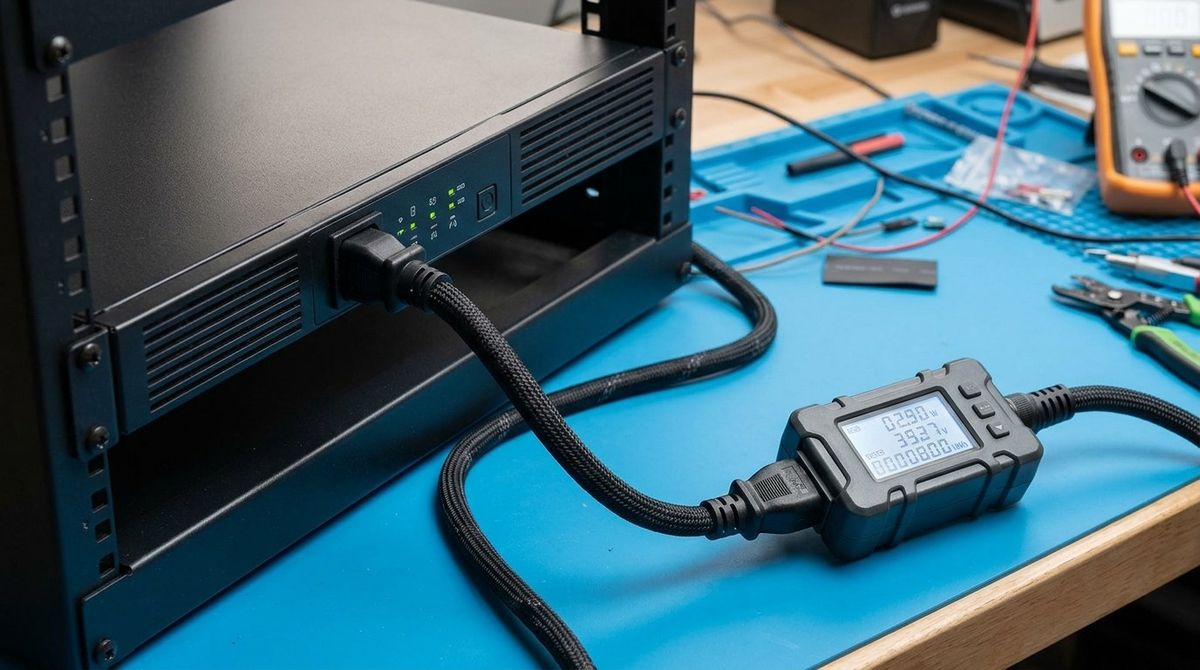
3. Formula 3: Peukert-Adjusted UPS Runtime Equation (AGM vs. LiFePO4)
Standard consumer UPS units (such as an APC Smart-UPS or CyberPower PFC Sinewave 1500VA/1000W) use sealed lead-acid (AGM) batteries (typically two \(12\text{V }9\text{Ah}\) batteries in series = \(24\text{V }9\text{Ah} = 216\text{Wh}\) nominal capacity). Because AGM batteries suffer from Peukert capacity reduction at high discharge rates (\(k_{\text{Peukert}} \approx 1.18\) for AGM vs. \(1.02\) for LiFePO4) and inverter DC-to-AC conversion efficiency (\(\eta_{\text{inv}} \approx 0.86\)), true backup runtime in minutes (\(t_{\text{runtime}}\)) is:
\[t_{\text{runtime}} = 60 \times \left(\frac{V_{\text{batt}} \times C_{\text{Ah}} \times \eta_{\text{inv}} \times \text{DoD}_{\text{usable}}}{P_{\text{steady}}}\right)^{\frac{1}{k_{\text{Peukert}}}}\]- 1500VA / 1000W AGM UPS (\(216\text{Wh}\) nominal, \(\text{DoD}_{\text{usable}} = 0.75\), \(k = 1.15\)) powering a \(140\text{W}\) PLA/PETG CoreXY Print: \[t_{\text{runtime, AGM}} = 60 \times \left(\frac{216\text{ Wh} \times 0.86 \times 0.75}{140\text{ W}}\right)^{0.8696} = 60 \times (0.9951)^{0.8696} = 59.7\text{ minutes}\]
- 1,024Wh LiFePO4 Station + Inline UPS (\(\text{DoD}_{\text{usable}} = 0.90\), \(\eta_{\text{inv}} = 0.90\), \(k = 1.02\)) powering a \(173\text{W}\) ABS Print: \[t_{\text{runtime, LFP}} = 60 \times \left(\frac{1{,}024\text{ Wh} \times 0.90 \times 0.90}{173\text{ W}}\right)^{0.9804} = 60 \times (4.794)^{0.9804} = 278.9\text{ minutes}\text{ }(4.65\text{ hours})\]
Critical Switchover Warning: Active PFC switch-mode power supplies inside modern 3D printers have an internal capacitor hold-up time of \(16\text{ ms to }20\text{ ms}\). Many standalone portable power stations advertise an "EPS pass-through mode" with a \(20\text{ ms to }30\text{ ms}\) relay switchover time, which is too slow for AC-bed printers and causes the printer MCU to reboot during transfer. Always verify a transfer time of \(\le 8\text{ ms}\) (standard on line-interactive Pure Sine Wave UPS units).
4. Master 3D Printer Power Draw & UPS Runtime Lookup Table
| 3D Printer Class & Material | Peak Warm-Up (\(P_{\text{peak}}\)) | Steady-State Print (\(P_{\text{steady}}\)) | Minimum UPS VA / Watt Rating | Runtime on 1500VA AGM (\(216\text{Wh}\)) | Runtime on 1,024Wh LiFePO4 |
|---|---|---|---|---|---|
| Open-Frame Bed-Slinger (PLA, \(60^\circ\text{C}\)) | \(320\text{W}\) | \(95\text{W}\) | \(850\text{VA} / 510\text{W}\) | \(84\text{ minutes}\) | \(502\text{ minutes}\) (\(8.4\text{ hrs}\)) |
| Enclosed CoreXY (PLA/PETG, \(65^\circ\text{C}\)) | \(850\text{W}\) (120V Bed) | \(135\text{W}\) | \(1500\text{VA} / 1000\text{W}\) | \(61\text{ minutes}\) | \(356\text{ minutes}\) (\(5.9\text{ hrs}\)) |
| Enclosed CoreXY (ABS/ASA/PA-CF, \(105^\circ\text{C}\)) | \(950\text{W}\) (120V Bed) | \(175\text{W}\) | \(1500\text{VA} / 1000\text{W}\) | \(48\text{ minutes}\) | \(276\text{ minutes}\) (\(4.6\text{ hrs}\)) |
| Large-Format Industrial IDEX (\(300\text{mm}+\), \(100^\circ\text{C}\)) | \(1{,}150\text{W}\) | \(285\text{W}\) | \(2000\text{VA} / 1350\text{W}\) | \(31\text{ minutes}\) | \(171\text{ minutes}\) (\(2.8\text{ hrs}\)) |
5. Formula 4 & 5: Outage Print Salvage Value & Hourly UPS Amortization
To determine whether a \(\\$215.00\) Pure Sine Wave 1500VA UPS is justified for a production printer, we calculate the economic value of a single salvaged long-format print (\(V_{\text{salvage}}\)) that fails at \(70\%\) completion during a \(24\text{-hour}\) run:
\[V_{\text{salvage}} = \left(m_{\text{part}} \times 0.70 \times C_{\text{kg}}\right) + \left(t_{\text{print}} \times 0.70 \times R_{\text{machine}}\right) + \left(t_{\text{labor}} \times R_{\text{labor}}\right)\]For a \(0.60\text{ kg}\) PA6-CF engineering bracket (\(\\$75.00\text{/kg}\)) on a \(24\text{-hour}\) job at a \(\\$3.50\text{/hr}\) machine rate and \(0.25\text{ hrs}\) of operator reset labor (\(\\$32\text{/hr}\)):
\[V_{\text{salvage}} = \left(0.42\text{ kg} \times \\$75.00\right) + \left(16.8\text{ hrs} \times \\$3.50\right) + \left(0.25 \times \\$32.00\right) = \\$31.50 + \\$58.80 + \\$8.00 = \\$98.30\text{ per saved outage}\]Thus, the break-even outage count (\(N_{\text{breakeven}} = C_{\text{UPS}} / V_{\text{salvage}}\)) is just \(2.19\) grid flickers or brownouts! Finally, amortizing a \(\\$215.00\) UPS (plus one \(\\$55.00\) replacement AGM battery pack at year 3) across \(T_{\text{life}} = 12{,}000\text{ print hours}\) over 5 years adds an hourly overhead rate (\(C_{\text{UPS,hr}}\)) of:
\[C_{\text{UPS,hr}} = \frac{C_{\text{UPS}} + C_{\text{batt,replace}}}{T_{\text{life}}} = \frac{\\$215.00 + \\$55.00}{12{,}000\text{ hrs}} = \\$0.0225\text{ per print hour}\]Adding just \(2.25\text{ cents per hour}\) to your customer quote completely funds commercial pure sine wave battery backup across your entire print farm.
Frequently Asked Questions (FAQ)
Do I need a Pure Sine Wave UPS or will a Simulated Sine Wave UPS work for 3D printers?
If your 3D printer uses a modern Active Power Factor Correction (Active PFC) power supply or an AC mains triac-switched heated bed, always choose a Pure Sine Wave UPS. Simulated (stepped) sine wave inverters can cause audible buzz in AC bed relays and trigger input voltage faults on Active PFC power supplies.
Can I plug two CoreXY 3D printers into a single 1500VA / 1000W UPS?
Only if you stagger their bed warm-up cycles so both printers never heat their beds from cold simultaneously. Two 850W AC heated beds warming up at the same time draw \(1{,}700\text{W}\), which will immediately trip a 1000W UPS overload breaker.
Build Your Complete 3D Print Pricing & Overhead Model
Want to factor your exact printer wattage, UPS battery amortization, filament scrap risk, and machine depreciation into every customer quote? Use our free interactive 3D Print Cost Estimator to calculate your profitable price per part in seconds.