3D Printer PTFE Bowden Tube Friction and Multi-Material Hub Replacement Cost Formula: 5 Print Farm Calculations
In high-speed CoreXY 3D print farms equipped with automated multi-material units—such as the Bambu Lab AMS, Bambu Lab AMS 2 Pro, or Original Prusa MMU3—polytetrafluoroethylene (PTFE) Bowden guide tubes are not permanent structural hardware; they are high-wear sacrificial consumables. During a single 1,200-swap multi-color production job, up to \(1.4\text{ kilometers}\) of rigid \(1.75\text{ mm}\) thermoplastic filament is pushed and retracted at \(300\text{ mm/s}\) through multiple curved fluoropolymer tubes.
As documented across r/BambuLab preventive tube replacement audits and 1,000-hour retraction stall troubleshooting threads, ignoring PTFE wall wear until a tube perforates triggers expensive mid-print Failed to pull back filament from extruder stalls, stripped feeder gears, and ruined multi-color plates. Below, we derive the five engineering and financial formulas that govern capstan bend friction, Archard abrasive wall wear, \(2.5\text{ mm}\) versus \(2.0\text{ mm}\) inner-diameter drag, and optimal replacement intervals. You can also plug these exact per-hour maintenance figures into the 3D Print Cost Estimator calculator.
Quick Print Farm PTFE Engineering & Cost Benchmarks:
- Capstan Friction Multiplier (\(F_{\text{pull}}\)): Governed by \(F_{\text{pull}} = F_{0} \cdot \exp\left(\mu \cdot \theta_{\text{total}}\right)\). Internal V-grooving raises \(\mu\) from \(0.08\) to \(0.36\), multiplying retraction force by \(3.73\times\) (from \(2.38\text{ N}\) to \(8.88\text{ N}\)) and stalling the \(8.5\text{ N}\) AMS assist motor.
- Mandatory Inner Diameter Specification: Multi-material hubs require \(2.5\text{ mm ID} \times 4.0\text{ mm OD}\) PTFE tubing (\(0.75\text{ mm}\) wall thickness); using standard \(2.0\text{ mm ID}\) Bowden tubing increases cut-tip binding drag by \(+165\%\).
- Abrasive Filament Wear Life (\(T_{\text{life}}\)): Virgin PLA/PETG achieves \(850\text{ to }1{,}100\text{ hours}\) per tube set; matte/TiO\(_2\) white PLA drops life to \(450\text{ hours}\); carbon-fiber/glow-in-the-dark filaments saw through a \(0.75\text{ mm}\) PTFE wall in \(160\text{ to }240\text{ hours}\).
- Amortized Replacement Cost (\(C_{\text{PTFE/hr}}\)): Replacing all \(2.2\text{ m}\) of internal and external AMS tubing (\(8\text{ segments}\)) every \(800\text{ hours}\) costs just \(\$0.0067/\text{print hour}\) while saving \(\$0.112/\text{hr}\) in avoided stall downtime.
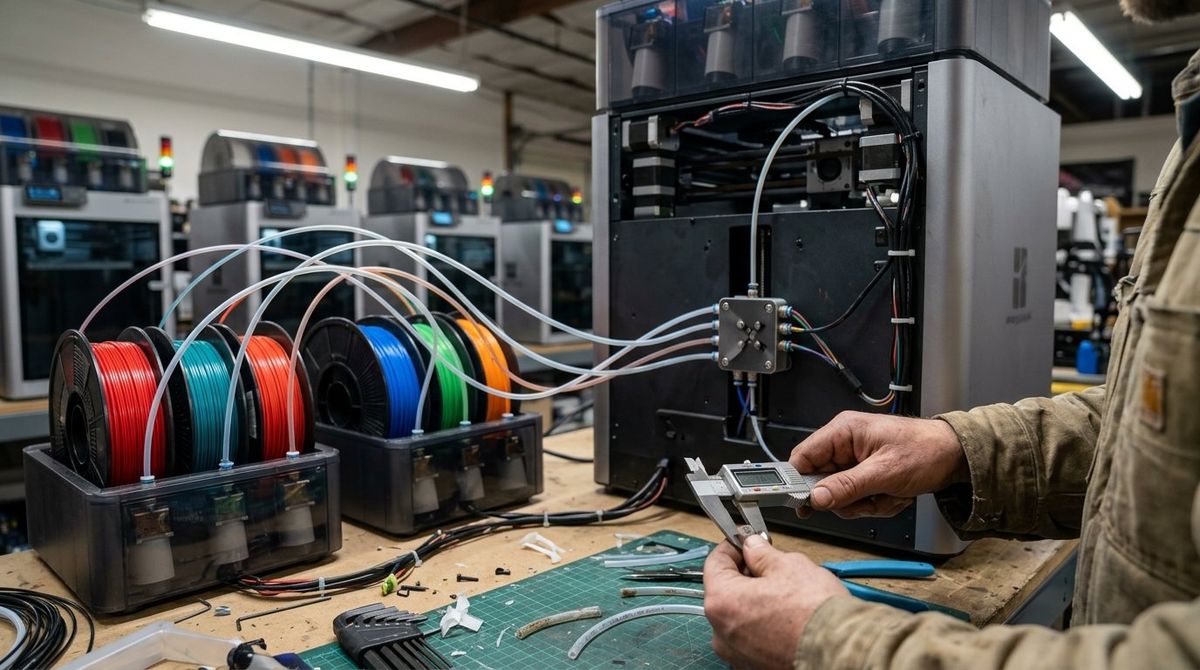
1. Calculation 1: The Euler-Eytelwein Capstan Friction Formula in Curved PTFE Paths
Why does a multi-material system retract filament effortlessly for \(750\text{ hours}\) and then suddenly stall on every color swap across all four ports, as reported in r/BambuLab four-port retraction threads? The answer lies in the Euler-Eytelwein Capstan Equation, which models the exponential growth of axial pulling force \(F_{\text{pull}}\) when a semi-rigid filament with baseline spool/hub entry tension \(F_{0}\) is drawn through a series of curved tubes with cumulative bend angle \(\theta_{\text{total}}\) (in radians) and kinetic friction coefficient \(\mu\):
\[ F_{\text{pull}} = F_{0} \cdot \exp\left( \mu \cdot \theta_{\text{total}} \right) \quad \text{where} \quad \theta_{\text{total}} = \sum_{i=1}^{n} \theta_{i}\text{ (in radians)} \]
In a standard enclosed CoreXY + AMS routing path, the filament negotiates four primary curves: (1) the internal AMS tray-to-hub S-bend (\(\theta_1 = 0.95\text{ rad}\)), (2) the rear exit into the spring buffer (\(\theta_2 = 0.85\text{ rad}\)), (3) the vertical climb up the rear chassis (\(\theta_3 = 0.65\text{ rad}\)), and (4) the tight \(90^\circ\) entry bend into the toolhead extruder beneath the glass lid (\(\theta_4 = 1.05\text{ rad}\)), totaling \(\theta_{\text{total}} = 3.50\text{ radians}\) (\(200.5^\circ\)):
- New Virgin PTFE Tubing (\(\mu_{\text{new}} = 0.08\), \(F_{0} = 1.80\text{ N}\)): \[ F_{\text{pull,new}} = 1.80\text{ N} \cdot \exp\left( 0.08 \times 3.50 \right) = 1.80 \cdot e^{0.28} = 1.80 \times 1.323 = 2.38\text{ N} \] At \(2.38\text{ N}\), the AMS feeder motor (\(F_{\text{stall}} = 8.50\text{ N}\)) operates at just \(28\%\) of its torque ceiling.
- Worn V-Grooved PTFE Tubing (\(\mu_{\text{worn}} = 0.36\), \(F_{0} = 2.52\text{ N}\) from cut-tip snagging): Once the filament carves a narrow V-shaped groove into the outer radius of the PTFE wall, the round \(1.75\text{ mm}\) strand wedges into the groove, multiplying normal contact pressure by \(\csc(\alpha/2)\) and raising the effective friction coefficient to \(\mu_{\text{worn}} = 0.36\): \[ F_{\text{pull,worn}} = 2.52\text{ N} \cdot \exp\left( 0.36 \times 3.50 \right) = 2.52 \cdot e^{1.26} = 2.52 \times 3.525 = 8.88\text{ N} > F_{\text{stall}}\text{ } \left(8.50\text{ N}\right) \] Because \(8.88\text{ N}\) exceeds the \(8.50\text{ N}\) motor slip threshold, the feeder rollers spin against the filament and trigger a mid-print pause.
2. Calculation 2: Inner Diameter Clearance Math (\(2.5\text{ mm ID}\) vs \(2.0\text{ mm ID}\))
A frequent mistake when restocking print farm spares is purchasing standard \(2.0\text{ mm ID} \times 4.0\text{ mm OD}\) Bowden tubing (designed for older single-extruder printers to constrain retraction hysteresis) instead of the Bambu Lab 2.5 mm ID x 4.0 mm OD PTFE Tube specification required for multi-material hubs. When a stiff \(d_{\text{fil}} = 1.75\text{ mm}\) filament (plus a slightly mushroomed \(1.84\text{ mm}\) cutter tip) passes through a tube of inner diameter \(D_{\text{ID}}\) bent to a radius of curvature \(R_{\text{bend}}\), the minimum non-binding bend radius \(R_{\text{min}}\) for a rigid chord length \(L_{\text{tip}} = 18.0\text{ mm}\) is:
\[ R_{\text{min}} = \frac{L_{\text{tip}}^2}{8 \cdot \left( D_{\text{ID}} - d_{\text{tip}} \right)} \]
Comparing \(D_{\text{ID}} = 2.00\text{ mm}\) against \(D_{\text{ID}} = 2.50\text{ mm}\) for a \(d_{\text{tip}} = 1.84\text{ mm}\) cut filament end:
\[ R_{\text{min (2.0 mm ID)}} = \frac{18.0^2}{8 \times \left( 2.00 - 1.84 \right)} = \frac{324}{1.28} = 253.1\text{ mm minimum bend radius} \]
\[ R_{\text{min (2.5 mm ID)}} = \frac{18.0^2}{8 \times \left( 2.50 - 1.84 \right)} = \frac{324}{5.28} = 61.4\text{ mm minimum bend radius} \]
Because the internal curves inside an AMS and above the toolhead measure \(R_{\text{bend}} \approx 85\text{ to }110\text{ mm}\), a \(2.0\text{ mm ID}\) tube mechanically pinches the cut filament tip (\(110\text{ mm} < 253.1\text{ mm}\)), whereas a \(2.5\text{ mm ID}\) tube provides ample radial clearance (\(110\text{ mm} > 61.4\text{ mm}\)).
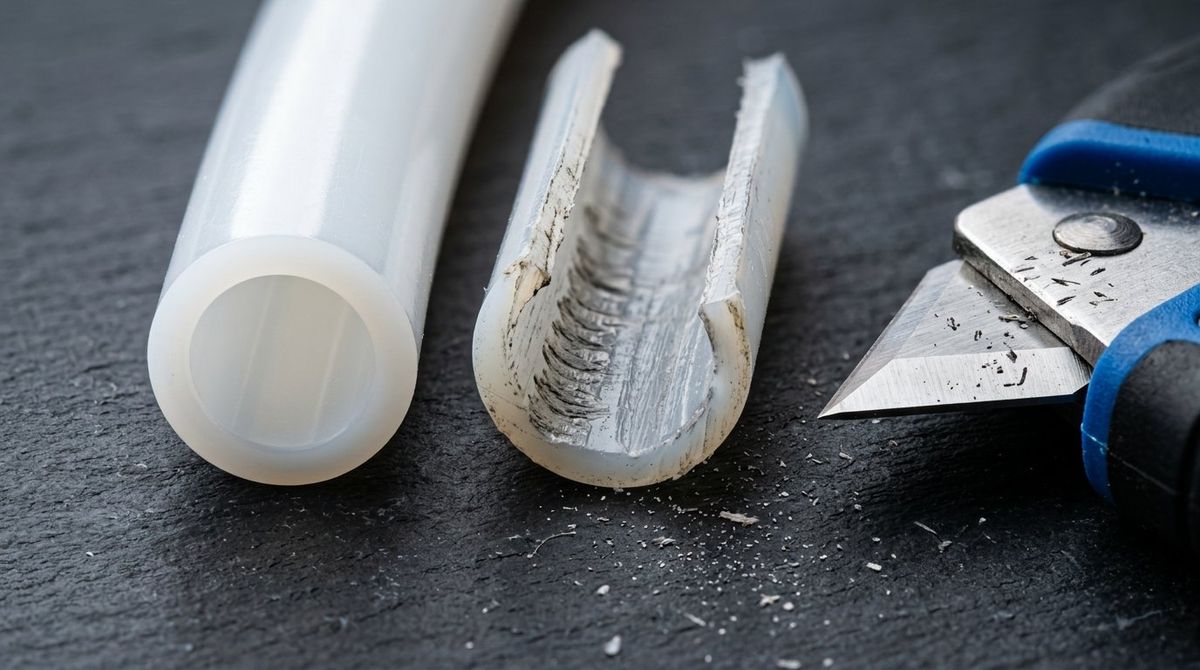
3. Calculation 3: Archard Abrasive Wall Wear Rate and Tube Lifespan Formula (\(T_{\text{life}}\))
On a \(2.5\text{ mm ID} \times 4.0\text{ mm OD}\) PTFE tube, total wall thickness is \(w_{\text{wall}} = (4.0 - 2.5)/2 = 0.75\text{ mm}\). However, V-groove wedging and pneumatic collet teeth failure occur once radial wear depth reaches the critical threshold \(w_{\text{crit}} = 0.45\text{ mm}\). Using the Archard abrasive wear relationship, the operating lifespan in print hours \(T_{\text{life}}\) before reaching \(w_{\text{crit}}\) is:
\[ T_{\text{life}} = \frac{w_{\text{crit}}}{k_{\text{wear}} \cdot \left( v_{\text{print}} + N_{\text{swaps/hr}} \cdot 2 L_{\text{stroke}} \right)} \]
where \(k_{\text{wear}}\) is the filament-specific radial wear rate per kilometer of sliding travel, \(v_{\text{print}}\) is average extrusion feed speed (\(\approx 0.025\text{ km/hr}\)), and \(N_{\text{swaps/hr}} \cdot 2 L_{\text{stroke}}\) is bidirectional AMS swap travel (\(12\text{ swaps/hr} \times 1.6\text{ m} = 0.0192\text{ km/hr}\), or \(0.0442\text{ km/hr}\) total sliding distance):
- Standard Gloss PLA / PETG (\(k_{\text{wear}} = 0.0105\text{ mm/km}\)): \(T_{\text{life}} = \frac{0.45}{0.0105 \times 0.0442} = 969.6\text{ print hours}\) (replace every \(800\text{ to }1{,}000\text{ hours}\)).
- Matte PLA / Titanium-Dioxide White PLA (\(k_{\text{wear}} = 0.0225\text{ mm/km}\)): \(T_{\text{life}} = \frac{0.45}{0.0225 \times 0.0442} = 452.5\text{ print hours}\) (replace every \(400\text{ to }450\text{ hours}\)).
- Carbon-Fiber (PLA-CF / PETG-CF) & Strontium-Aluminate Glow PLA (\(k_{\text{wear}} = 0.0520\text{ mm/km}\)): \(T_{\text{life}} = \frac{0.45}{0.0520 \times 0.0442} = 195.8\text{ print hours}\) (replace every \(160\text{ to }200\text{ hours}\)).
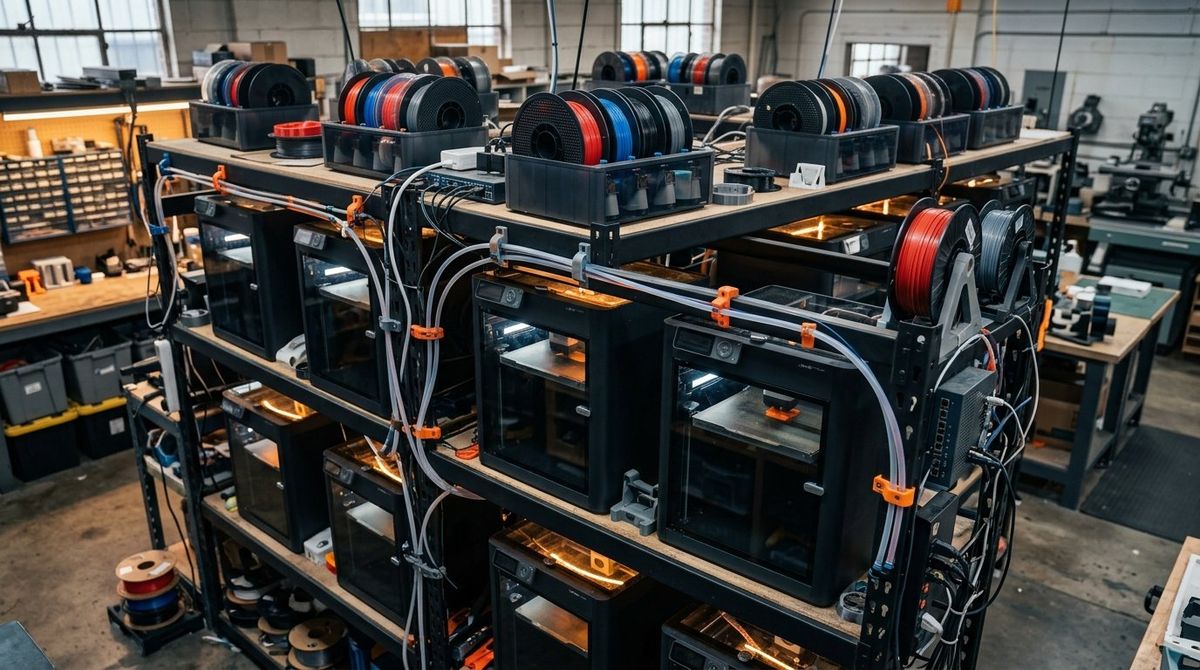
4. Calculation 4: Preventive PTFE Overhaul Cost vs Reactive Stall Scrap Cost
A complete multi-material PTFE overhaul for a single printer + 1x AMS requires replacing 8 distinct tube segments totaling \(L_{\text{total}} = 2.20\text{ meters}\) (\(4 \times 210\text{ mm}\) internal AMS lower tubes + \(1 \times 370\text{ mm}\) AMS exit tube + \(1 \times 440\text{ mm}\) buffer-to-coupler tube + \(1 \times 550\text{ mm}\) coupler-to-toolhead tube). At a bulk OEM tubing cost of \(c_{\text{m}} = \$1.30/\text{meter}\) and \(t_{\text{maint}} = 0.167\text{ hr}\) (\(10\text{ minutes}\)) of technician labor at \(R_{\text{labor}} = \$15.00/\text{hr}\), the amortized hourly maintenance cost \(C_{\text{PTFE/hr}}\) across an \(800\text{-hour}\) interval is:
\[ C_{\text{PTFE/hr}} = \frac{\left( L_{\text{total}} \cdot c_{\text{m}} \right) + \left( t_{\text{maint}} \cdot R_{\text{labor}} \right)}{T_{\text{interval}}} = \frac{\left( 2.20\text{ m} \times \$1.30/\text{m} \right) + \left( 0.167\text{ hr} \times \$15.00/\text{hr} \right)}{800\text{ hrs}} = \frac{\$2.86 + \$2.50}{800} = \$0.0067/\text{print hour} \]
Contrast that \(\$0.0067/\text{hr}\) preventive cost with the reactive cost of running tubes past \(1{,}000\text{ hours}\), where just 5 overnight retraction stalls (\(5 \times \$17.90\) in lost machine utilization, nozzle heat soak, and scrapped multi-color parts = \(\$89.50\)) add \(\$0.112/\text{print hour}\) in hidden waste—a \(16.7\times\) higher cost than scheduled replacement.
5. Calculation 5: Master Print Farm PTFE Tube Cut-Length & Replacement Schedule Table
| PTFE Tube Segment Location | Exact Cut Length & Spec | Primary Wear Choke Point | Standard PLA Interval | Matte / CF / Glow Interval | Material Cost per Swap |
|---|---|---|---|---|---|
| AMS Internal Slots 1–4 (x4) | \(4 \times 210\text{ mm}\) (\(2.5\text{ mm ID} \times 4.0\text{ mm OD}\)) | Bottom curve entering 4-into-1 internal AMS hub | \(900\text{ hours}\) | \(200\text{ to }400\text{ hours}\) | \(\$1.09\) (all 4 tubes) |
| AMS Rear Exit to Buffer | \(1 \times 370\text{ mm}\) (\(2.5\text{ mm ID} \times 4.0\text{ mm OD}\)) | Rubber grommet bend exiting back of AMS housing | \(1{,}000\text{ hours}\) | \(350\text{ to }500\text{ hours}\) | \(\$0.48\) |
| Filament Buffer to Coupler | \(1 \times 440\text{ mm}\) (\(2.5\text{ mm ID} \times 4.0\text{ mm OD}\)) | Spring buffer exit collet during rapid retraction | \(1{,}000\text{ hours}\) | \(350\text{ to }500\text{ hours}\) | \(\$0.57\) |
| Coupler to Toolhead Extruder | \(1 \times 550\text{ mm}\) (\(2.5\text{ mm ID} \times 4.0\text{ mm OD}\)) | Top glass lid rub + \(90^\circ\) entry bend into extruder | \(700\text{ hours}\) | \(160\text{ to }300\text{ hours}\) | \(\$0.72\) |
| Full 8-Segment Overhaul Kit | \(2{,}200\text{ mm}\) total (\(2.20\text{ meters}\)) | Resets \(\mu\) to \(0.08\) (\(F_{\text{pull}} = 2.38\text{ N}\)) | \(800\text{ hours}\) | \(200\text{ to }350\text{ hours}\) | \(\$2.86\) (\(\mathbf{\$0.0067/\text{hr}}\)) |
Conclusion: Protecting Multi-Color Print Farm Uptime for Less Than a Penny Per Hour
By treating \(2.5\text{ mm ID} \times 4.0\text{ mm OD}\) PTFE Bowden tubing as a scheduled consumable, installing a \(110\text{ mm}\) minimum-radius guide bracket at the toolhead entry to minimize cumulative capstan angle \(\theta_{\text{total}}\), and cutting square, burr-free tube ends with a rotary shear cutter every \(800\text{ hours}\) (\(200\text{ hours}\) for carbon-fiber or glow jobs), you can eliminate AMS retraction stalls for just \(\$0.0067\) per print hour.
Calculate Your Exact 3D Print Job Cost & Consumable Amortization
Add your filament mass, AMS purge multipliers, electricity rate, and hourly PTFE/nozzle wear directly into our interactive print farm pricing calculator.
Launch the 3D Print Cost Estimator Calculator