3D Printer Nozzle Wear and Abrasive Filament Cost Formula: Brass vs Hardened Steel vs ObXidian ROI
3D Printer Nozzle Wear and Abrasive Filament Cost Formula: Brass vs Hardened Steel vs ObXidian ROI
When quoting commercial 3D printing jobs using engineering composites—such as chopped carbon-fiber nylon (PAHT-CF, PA6-CF), PETG-CF, glass-fiber ABS-GF, metal-filled bronze/steel PLA, or phosphorescent glow-in-the-dark strontium aluminate—treating your hotend nozzle as a “fixed machine overhead” is a guaranteed margin leak. Most print farm operators calculate filament weight and electricity to the penny, yet completely omit abrasive tooling amortization, hotend swap downtime, and bore-drift over-extrusion waste.
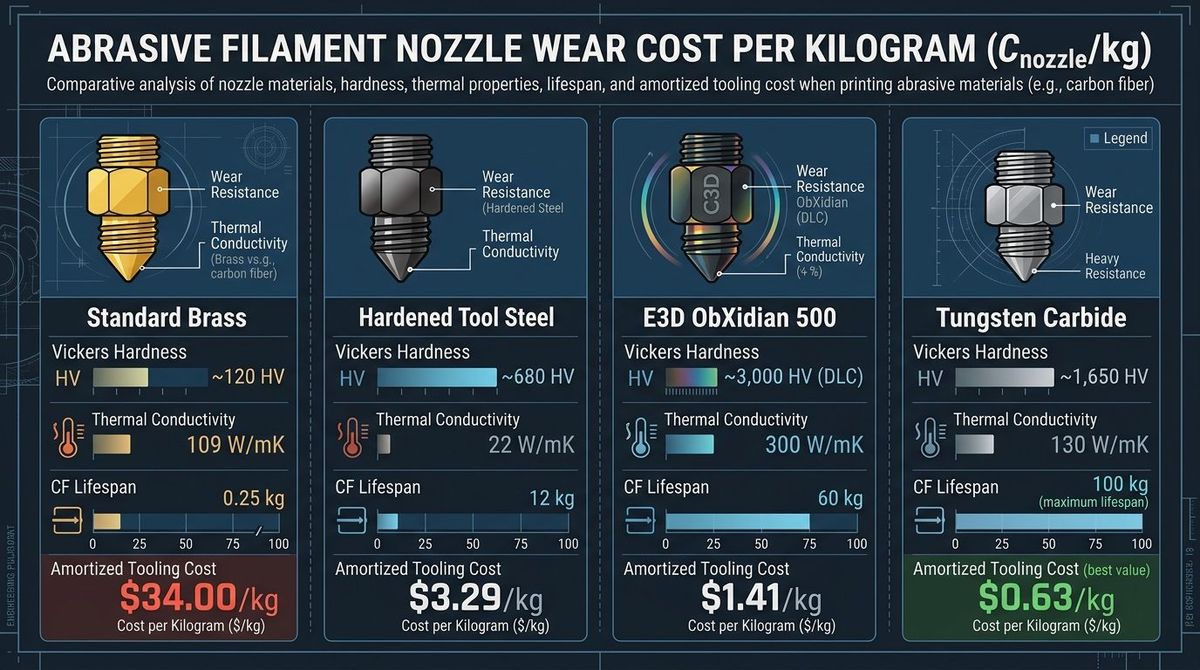
In this engineering cost analysis, we derive the 3D Printer Nozzle Wear & Abrasive Tooling Cost Formula (), compare Vickers hardness and thermal conductivity () across Brass, Hardened Tool Steel (HRC 55–60), Tungsten Carbide, and E3D High Flow ObXidian 500 hotends, and calculate the exact breakeven spool volume for upgrading your fleet. You can plug these per-kilogram tooling surcharges directly into our 3D Print Cost Estimator, and if an abrasive filament swap ever jams your toolhead cutter lever, consult our diagnostic guide at 3DErrorFix.
Quick Verdict: Tooling Surcharge per Kilogram of Carbon-Fiber Filament
________________
The Physics of Orifice Bore Drift & Cross-Sectional Area Expansion
________________
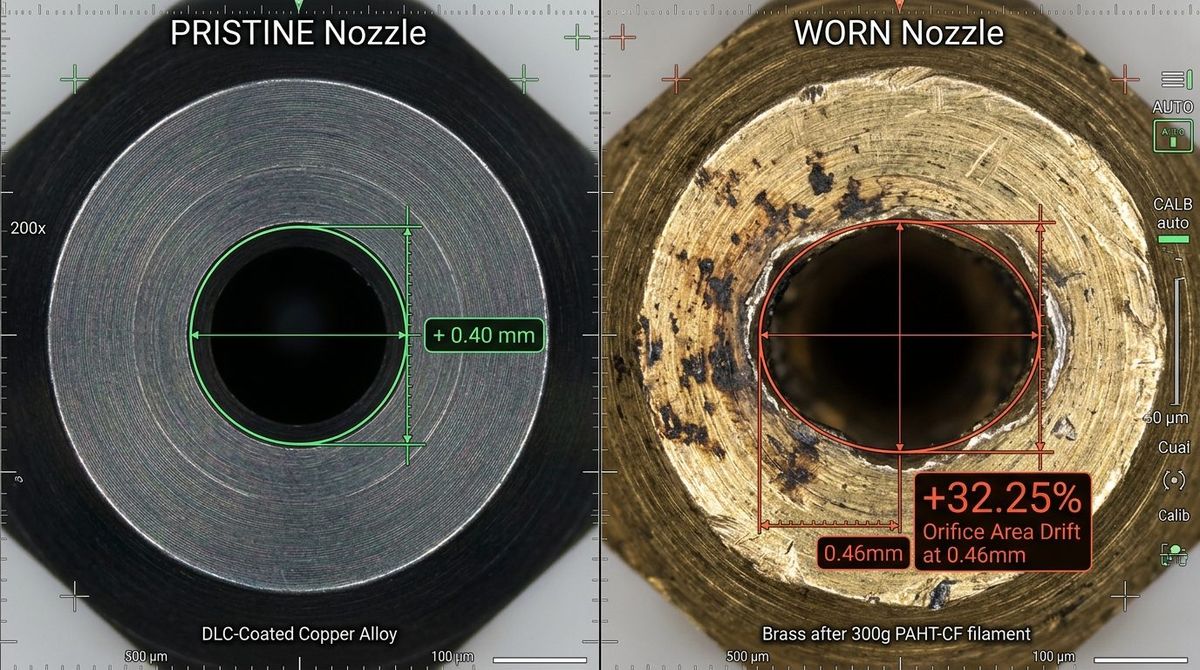
Why does a 0.40mm nozzle become unusable long before the tip physically snaps off? As documented in r/3Dprinting 1,400-hour hardened steel nozzle wear teardowns and community macro-microscope inspections, chopped carbon fibers ( diameter, hardness) and strontium aluminate glow crystals () act like a high-pressure lapping compound inside the nozzle taper.
Because the cross-sectional area () of a circular nozzle orifice scales with the square of its diameter (), even a seemingly tiny diameter enlargement from to causes a massive jump in orifice area:
\(\Delta A_{\%} = \left(\left( \frac{d_1}{d_0} \right)^2 - 1 \right) \times 100 = \left(\left( \frac{0.46}{0.40} \right)^2 - 1 \right) \times 100 = \mathbf{+32.25\%}\)
Once your nozzle bore expands by \(+15\%\) in diameter () and the flat annular "ironing land" around the tip abrades into a bell-mouth funnel, pressure advance calibration breaks down: corner seams bulge, arachne thin walls under-bond, and dimensional clearances on press-fit bearing bores fail QA inspection.
The Master 3D Printer Nozzle Wear Cost Formula ()
________________
To price any abrasive or filled 3D print accurately, add the Per-Kilogram Nozzle Tooling Surcharge () directly to your raw filament spool price ():
$$C_{\text{nozzle/kg}} = \frac{P_{\text{nozzle}} + \left(T_{\text{swap}} \times R_{\text{labor}} \right)}{L_{\text{kg}}} + \left(\delta_{\text{scrap}} \times C_{\text{filament/kg}} \right)$$
Where:
Nozzle / Hotend Material
Vickers Hardness (HV)
Thermal Cond. (, W/m·K)
Hardware Price ()
Abrasive CF Lifespan ()
Amortized Tooling Cost ()
Standard 360 Brass
~120 HV
109 W/(m·K)
$4.00
0.25 kg (250g)
$34.00 / kg
303 Stainless Steel
~240 HV
15 W/(m·K)
$8.00
1.50 kg
$8.33 / kg
Hardened Tool Steel (HRC 58)
~650–700 HV
22 W/(m·K)
$15.00 (Tip) / $35.00 (Assy)
12.0 kg
$1.63 – $3.29 / kg
E3D High Flow ObXidian 500
~3,000 HV (E3DLC Coat)
~300 W/(m·K) (Cu Core)
$79.99 (Complete Hotend)
60.0 kg
$1.41 / kg
Solid Tungsten Carbide (WC)
~1,650 HV
110–147 W/(m·K)
$55.00
100.0+ kg
$0.63 / kg
Polycrystalline Diamond (PCD)
~8,000+ HV
>1,000 W/(m·K)
$145.00
300.0+ kg
$0.51 / kg
The Hidden Cost of Low Thermal Conductivity (): Machine Time ROI
________________
When comparing Bambu Lab's OEM Hardened Steel Hotend against the E3D ObXidian 500 or reading r/3Dprinting Tungsten Carbide vs Steel thermal conductivity analyses, looking only at nozzle longevity misses half the financial equation: volumetric flow rate and machine hourly depreciation.
Hardened tool steel has a thermal conductivity of just —nearly 80% lower than brass () and 92% lower than the copper-alloy body inside an E3D High Flow ObXidian 500 (). Combined with internal CHT-style melt-splitting geometry, a high-flow copper/ObXidian or Tungsten Carbide hotend increases maximum reliable volumetric speed () on PETG-CF and PAHT-CF from to —reducing total print time by 25% to 32%.
On a commercial CoreXY printer billed at a conservative machine depreciation + electricity rate of $1.50/hour, shaving 2.5 hours off every 1 kg spool of carbon-fiber parts saves an additional $3.75 per kg in machine time alone. That means the $45 price premium of an $80 E3D ObXidian 500 over a $35 OEM hardened hotend pays for itself after printing just 8.8 kilograms of filament:
$$M_{\text{breakeven}} = \frac{\$79.99 - \$35.00}{(\$3.29 - \$1.41)_{\text{tooling}} + \$3.25_{\text{machine}}} = \frac{\$44.99}{\$5.13/\text{kg}} = \mathbf{8.77\text{ kg}}$$
Material-by-Material Filament Abrasiveness Multiplier Table
________________
Not all filled filaments erode nozzles at the same rate. When entering a job into your quoting sheet, classify the filament into one of four wear tiers:
1. Tier 1 — Non-Abrasive Standard Polymers (): Unfilled PLA, PETG, ABS, ASA, TPU 95A, PC. Tooling surcharge: $0.20/kg.
2. Tier 2 — Mildly Abrasive Mineral & Matte Pigments (): Matte PLA (calcium carbonate / silica), heavily loaded Titanium Dioxide (\(\text{TiO}_2\)) pure white filaments, Wood-fill PLA. Tooling surcharge: $0.85/kg on hardened steel.
3. Tier 3 — High Abrasive Structural Composites (): PLA-CF, PETG-CF, ABS-GF, PA6-CF, PAHT-CF, PPA-CF (15%–25% chopped carbon or glass fiber). Tooling surcharge: $3.29/kg on hardened steel or $1.41/kg on ObXidian 500.
4. Tier 4 — Extreme Abrasive Glow & Ceramic/Metal Fill (): Strontium Aluminate Glow-in-the-Dark PLA/ABS, 25% Glass-Fiber Nylon (PA6-GF25), Ultrafuse 316L Metal-fill. Tooling surcharge: $6.50/kg on hardened steel—strongly recommend Tungsten Carbide or ObXidian 500 ($2.10/kg).
Frequently Asked Questions
________________
How much abrasive filament can a standard brass nozzle print before wearing out?
A standard 0.40mm brass nozzle (~120 HV hardness) will suffer measurable orifice enlargement (>0.46mm, or +32% cross-sectional area increase) and tip flattening after printing just 150 to 250 grams (0.15 to 0.25 kg) of chopped carbon-fiber (PLA-CF, PETG-CF, PA-CF), glass-fiber, or glow-in-the-dark strontium aluminate filament.
What is the formula for calculating 3D printer nozzle wear cost per kilogram of filament?
The complete nozzle tooling cost per kilogram is , where is hardware replacement cost, is technician downtime for swapping and PID/Z-offset recalibration, is the rated abrasive filament lifespan in kilograms, and is the waste factor caused by bore widening.
Is the E3D ObXidian 500 or Tungsten Carbide nozzle worth the 80 price tag for a print farm?
Yes. While an OEM hardened steel complete hotend (3.29/kg amortized tooling cost), an E3D High Flow ObXidian 500 (55) lasts 60 to 100+ kg ($0.63 to $1.41/kg) while maintaining high thermal conductivity that increases max volumetric speed by 25% to 40%.
Does white PLA or matte PLA wear out brass nozzles?
Yes, faster than natural or black PLA. White, matte, and pastel filaments are heavily loaded with Titanium Dioxide (\(\text{TiO}_2\)) or calcium carbonate mineral pigments. While far less aggressive than carbon fiber, heavy \(\text{TiO}_2\) matte filaments will wear out a standard brass nozzle in roughly 8 to 12 kg compared to 40+ kg for unfilled clear or black PLA.
Run the Interactive Calculator: Use our 3D Print Cost Estimator to model your exact parameters and tolerances in real time.