3D Printer Linear Rail Bearing Wear and Maintenance Cost Formula: 5 Industrial Calculations
High-speed CoreXY 3D printers—including Voron 2.4/Trident builds, Prusa XL multi-toolchangers, RatRig V-Core workstations, and Bambu Lab industrial fleets—rely on miniature precision linear profile rails (typically HIWIN MGN9C, MGN9H, or MGN12H carriages) to achieve \( 500\text{ mm/s} \) travel velocities and \( 20{,}000\text{ mm/s}^2 \) accelerations. While linear rails provide far higher torsional stiffness than round rods or POM V-wheels, they are not maintenance-free: inside a \( 60^\circ\text{C}\text{ to }75^\circ\text{C} \) enclosed chamber filled with styrene and nylon-carbon-fiber dust, neglected recirculating ball tracks suffer lubricant starvation, fretting corrosion, and raceway spalling in as little as 2,500 print hours.
In this industrial reliability guide, we derive the 3D printer linear rail bearing wear cost formula from ISO 281 dynamic fatigue mechanics, convert linear travel distance in kilometers into print-farm operating hours (\( L_{10h} \)), and prove how a 15-minute preventive relubrication cycle every 800 hours slashes annual motion-system depreciation by 75%. Plug your exact hourly maintenance overhead into our 3D Print Cost Estimator.
Key Engineering & Financial Benchmarks
- The ISO 281 Distance-to-Hours Formula: For miniature recirculating ball carriages with a 50 km base rating, operating life in hours is \( L_{10h} = \left[ (C_{\text{dyn}} / P_{\text{eq}})^3 \times 50{,}000\text{ m} \right] / (3600 \cdot v_{\text{avg}}) \).
- The Lubrication Contamination Factor (\( f_{\text{lube}} \)): Running dry or contaminated rails inside a \( 65^\circ\text{C} \) heated chamber collapses bearing life from 10,000+ hours down to ~2,500 hours—quadrupling hourly motion depreciation.
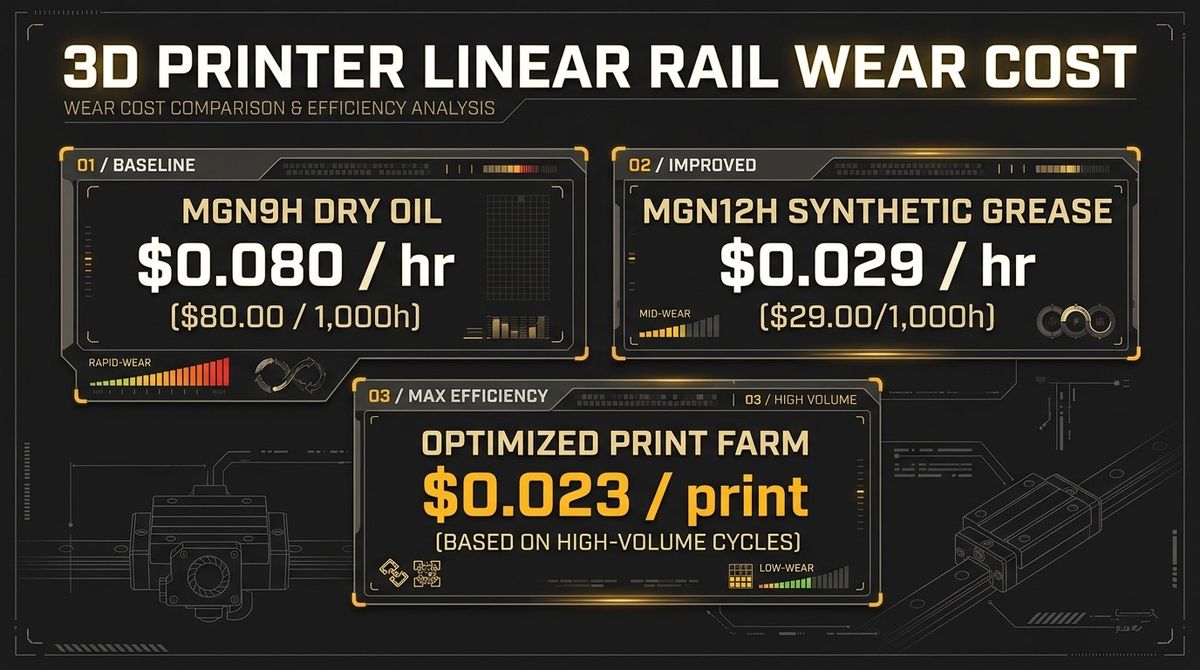
- Hourly Rail Depreciation Equation: Amortizing a $140 3-axis MGN rail rebuild plus 2.0 hours of gantry squaring labor ($60) over a neglected 2,500-hour lifespan costs $0.080/hour, whereas proper 800-hour relubrication drops total motion cost to $0.023/hour.
- Grease Selection Rule: Always use NLGI Grade 1 or Grade 2 lithium-complex or synthetic PAO grease (such as Mobilith SHC 100 or Super Lube 21030) with zero solid PTFE/MoS2/graphite additives that jam 1.5 mm recirculating ball return tubes.
1. ISO 281 Linear Rail Fatigue Life Formula: Converting Kilometers to Print Hours
Unlike rotary ball bearings rated in millions of revolutions, miniature profile linear guides (MGN9 and MGN12) specify their Basic Dynamic Load Rating (\( C_{\text{dyn}} \)) based on a standard reference travel distance of \( 50\text{ km} \) (\( 50{,}000\text{ meters} \)). Accounting for thermal chamber derating (\( f_T \)), high-acceleration vibration shock (\( f_w \)), and lubrication film integrity (\( f_{\text{lube}} \)), the modified L10 fatigue life in hours (\( L_{10h} \)) is:
- \( C_{\text{dyn}} \) = Manufacturer dynamic load rating (e.g., \( 2{,}550\text{ N} \) for an MGN9H carriage or \( 3{,}720\text{ N} \) for an MGN12H carriage).
- \( P_{\text{eq}} \) = Equivalent dynamic load combining toolhead weight, umbilical drag, and belt preload + inertial acceleration forces (\( M_{\text{gantry}} \cdot a_{\text{max}} \)).
- \( v_{\text{avg}} \) = Time-weighted average print + travel speed in meters per second (typically \( 0.18\text{ to }0.25\text{ m/s} \) on a high-speed CoreXY printer).
- \( f_w \) = High-jerk reversal impact factor (\( 1.5\text{ to }2.2 \) for \( 15{,}000+\text{ mm/s}^2 \) CoreXY input-shaper printing).
- \( f_{\text{lube}} \) = Lubrication film factor (\( 1.0 \) for clean 800-hour relubrication vs \( 0.35 \) for dry/dust-fouled tracks).
Notice the cubic exponent: when polymer dust and dried factory shipping oil reduce the lubrication factor \( f_{\text{lube}} \) to \( 0.63 \), the cubic relationship (\( 0.63^3 = 0.250 \)) cuts total linear rail lifespan by 75%! At an average print velocity of \( v_{\text{avg}} = 0.22\text{ m/s} \), a printer travels \( 0.22 \times 3600 = 792\text{ meters per hour} \)—covering nearly 635 kilometers (394 miles) of linear travel every 800 print hours.
2. The Master Linear Rail Wear & Maintenance Cost Formula
To include motion-system wear accurately in your print farm quoting model, calculate the Amortized Linear Rail Cost per 1,000 Print Hours (\( C_{\text{rail/1000h}} \)) by summing the hardware replacement cost of the X/Y rails (\( P_{\text{rails}} \)), total preventive relubrication consumables + labor over the rail lifespan (\( N_{\text{lube}} \cdot C_{\text{lube}} \)), and full gantry-rebuild alignment labor (\( T_{\text{rebuild}} \cdot R_{\text{labor}} \)):
Let us compare two real-world print farm maintenance regimes on a CoreXY workstation running 5,000 hours per year (where an X + 2Y genuine HIWIN MGN rail set costs \( P_{\text{rails}} = \$140.00 \), a full 2-hour gantry rebuild + input-shaper recalibration costs \( T_{\text{rebuild}} \cdot R_{\text{labor}} = \$60.00 \), and a 15-minute syringe relubrication costs \( C_{\text{lube}} = \$7.50 \) in technician time and grease):
- Scenario A — Run-to-Failure Neglect (No relubrication in 65°C chamber, \( L_{10h} = 2{,}500\text{ hrs} \)): The rails develop gritty ball-track notch wear and input-shaper ringing after 2,500 hours (twice a year). Cost per 1,000 hours in USD: \( (140.00 + 0 + 60.00) / 2.5 = \mathbf{80.00\text{ per 1,000 hrs}} \) ($0.080/hr, or $400/year per printer!).
- Scenario B — 800-Hour Preventive Relubrication (\( N_{\text{lube}} = 12\text{ cycles} \), \( L_{10h} = 10{,}000\text{ hrs} \)): Flushing and greasing the carriages every 800 hours extends rail life to 10,000 hours (2 full years of 24/7 printing). Cost per 1,000 hours in USD: \( (140.00 + 90.00 + 60.00) / 10.0 = \mathbf{29.00\text{ per 1,000 hrs}} \) ($0.029/hr, saving $255/year per printer while eliminating layer-shift scrap).
3. Linear Rail Size, Lubricant & Lifespan Benchmark Matrix
Compare standard 3D printer linear rail profiles, dynamic load ratings, and thermal grease limits below:
| Rail Profile & Lube Regime | Dynamic Rating (\(C_{\text{dyn}}\)) | Chamber Temp Limit | Relube Interval | Expected Life (\(L_{10h}\)) | Amortized Cost / 1,000h |
|---|---|---|---|---|---|
| MGN9H (Factory Light Oil Only) | 2,550 N | < 40°C (Evaporates) | None (Run Dry) | 1,800 to 2,500 hrs | $80.00 / 1,000 hrs |
| MGN9H (Lithium EP1/EP2 Grease) | 2,550 N | Up to 55°C | Every 600 hrs | 7,500 to 9,000 hrs | $34.50 / 1,000 hrs |
| MGN12H (Mobilith SHC 100 Synthetic) | 3,720 N | Up to 80°C+ Chamber | Every 800 hrs | 10,000 to 12,500 hrs | $24.00 to $29.00 / 1,000 hrs |
| MGN12H (With PTFE/MoS2 Powder — AVOID) | 3,720 N | Clogs Return Tubes | Fails Prematurely | < 1,500 hrs (Skidding) | $133.00+ / 1,000 hrs |
4. Why Solid PTFE, Graphite, and MoS2 Greases Destroy Miniature MGN Carriages
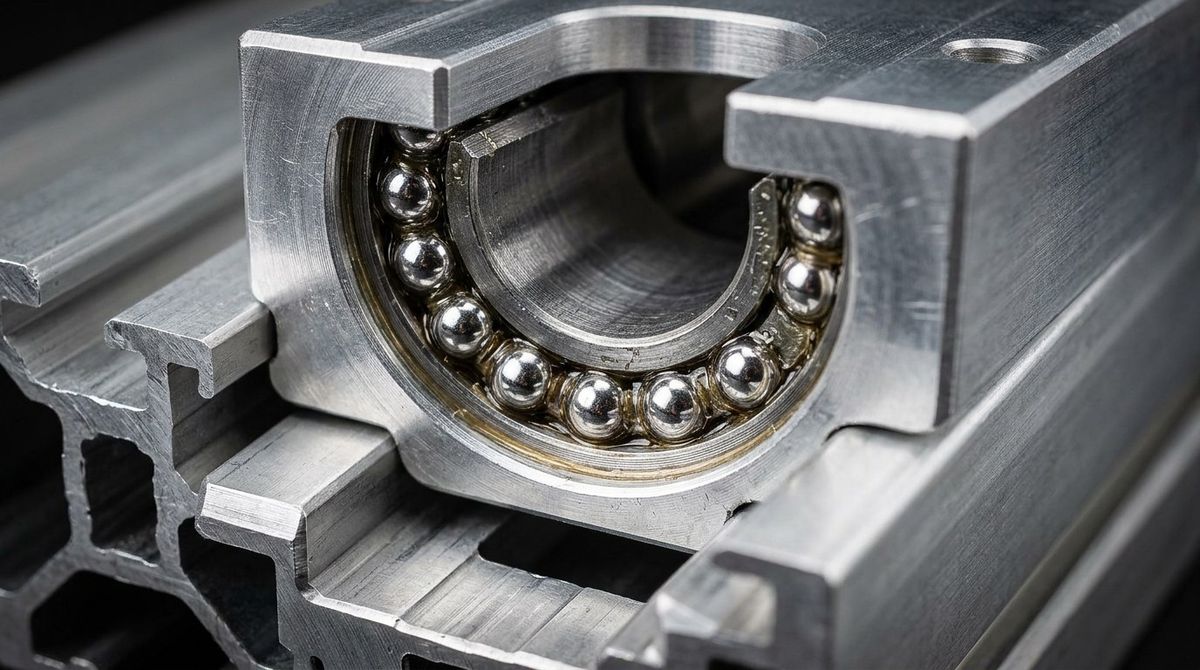
A frequent mistake discussed in r/VoronCoreXY build logs is lubricating miniature MGN9 or MGN12 rails with heavy automotive molybdenum disulfide (MoS2) grease, graphite paste, or thick PTFE-powder-loaded paste. Inside an MGN9 carriage, the steel balls measure just \( 1.588\text{ mm} \) (1/16 inch) in diameter and recirculate through tiny molded plastic end-cap return channels with clearances under 50 microns. Solid particulate additives pack into the plastic turnaround elbows over thousands of short strokes, blocking ball recirculation and forcing the steel balls to skid rather than roll—carving flat spots into the hardened rail within weeks. Always select a pure homogeneous synthetic PAO or lithium-complex grease (NLGI 1 or 2) with zero solid fillers.
5. Frequently Asked Questions (FAQ)
Do brand-new HIWIN or LDO linear rails come pre-greased from the factory?
Usually no. Most linear rails ship coated in a thin rust-preventative preservative oil (such as Cosmoline or light machine oil) that is not a high-load bearing lubricant. Before installing a new rail, flush the carriage with 99% Isopropyl Alcohol, dry thoroughly, and pack the ball tracks with NLGI 1/2 grease.
How can I tell if my 3D printer's X or Y linear rail bearing is worn out without removing it?
Run an automated input-shaper resonance sweep (accelerometer PSD graph). When an MGN carriage develops ball-track spalling or preload loss, the clean single resonance peak splits into a jagged double peak accompanied by high-frequency background noise and vertical fine artifacts (VFAs) on glossy walls.
How do I grease an MGN12H carriage without sliding the block off the rail and losing the steel balls?
Never slide an MGN carriage off its steel rail without a plastic keeper arbor! Instead, back out one of the M3 mounting screws on the top or end of the carriage, inject 0.3 mL of grease through the lube port or directly into the upper ball-track groove using a blunt 18-gauge syringe tip, and jog the toolhead 200 mm back and forth 10 times.
6. Standard Operating Verification & Audit Checklist
Before locking in your final configuration or production parameters for 3d printer linear rail bearing wear cost formula, execute this five-point verification protocol across your workspace and accounting records to ensure repeatable field performance:
- Carriage Preload & Ball-Track Flush: Flush factory shipping preservative oil from every new MGN9H/MGN12H carriage using 99% IPA and pack with homogeneous NLGI Grade 1/2 synthetic PAO grease before mounting.
- Heated Chamber Thermal Derating Check: Log enclosure temperatures at the X/Y gantry level; if chamber temperatures exceed 55°C during ABS/ASA/PC runs, switch from standard lithium soap to high-temp Mobilith SHC 100.
- 800-Hour Preventive Syringe Relubrication: Schedule a 15-minute syringe relubrication every 800 print hours (~635 km of travel) and verify zero solid PTFE/MoS2 additives are used.
- Input-Shaper PSD Vibration Audit: Run a Klipper accelerometer resonance sweep every 1,500 hours to detect twin-peak ball-track spalling before layer shifts ruin multi-day production jobs.
- Print Farm Hourly Cost Ledger Update: Enter your verified $0.029/hr to $0.080/hr linear motion depreciation rate into the 3D Print Cost Estimator below for accurate B2B quoting.
Model Your Exact Parameters & Tolerances
Run your custom numbers through our interactive engineering and financial calculator to verify your setup in real time.