3D Printer Filament Desiccant Regeneration Cost Formula: Oven vs. Dehydrator Thermodynamics
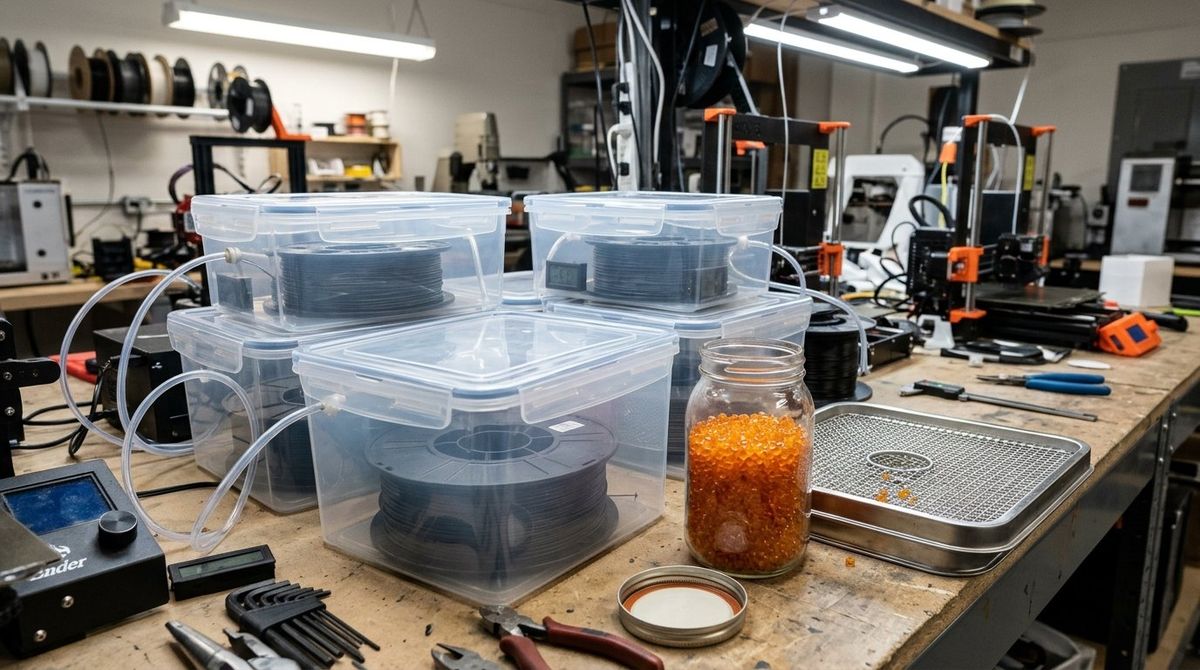
Maintaining relative humidity below \( 10\% \text{ RH} \) inside multi-spool filament dry boxes, Bambu Lab AMS units, and commercial print farm storage cabinets relies on bulk orange-to-green indicating silica gel desiccant \( \left( \text{SiO}_2 \right) \). Because high-performance engineering polymers—such as Nylon PA6-CF \( \left( \$65\text{/kg} \right) \), Polycarbonate \( \left( \text{PC} \right) \), TPU, and PETG—absorb atmospheric moisture within hours, print farms routinely cycle through \( 1{,}000\text{ g} \) \( \left( 1.0\text{ kg} \right) \) batches of saturated silica gel every two to four weeks. However, regenerating saturated desiccant beads in a full-size \( 2{,}200\text{ W} \) kitchen convection oven consumes \( 5.50\text{ kWh} \) \( \left( \$0.99\text{/cycle} \right) \), whereas a dedicated \( 350\text{ W} \) food dehydrator or filament dryer consumes just \( 1.05\text{ kWh} \) \( \left( \$0.19\text{/cycle} \right) \)—an \( 80.8\% \) energy cost reduction. This thermodynamic guide derives the exact desorption energy equation, electrical cost formula, and payback period vs. buying disposable desiccant packets.
The Desiccant Regeneration Electrical Cost Formula
The total electrical cost \( C_{\text{regen}} \) to thermally desorb bound water vapor from a batch of saturated silica gel is governed by heater rated power \( P_{\text{rated}} \) (in kilowatts), duty cycle \( \delta_{\text{PID}} \) once target temperature is reached, total cycle duration \( t_{\text{cycle}} \) (in hours), and local utility electricity rate \( R_{\text{elec}} \) (in \( \$\text{/kWh} \)):
\[ E_{\text{cycle}} = P_{\text{avg}} \times t_{\text{cycle}} = \left( P_{\text{rated}} \times \delta_{\text{PID}} \right) \times t_{\text{cycle}} \] \[ C_{\text{regen}} = E_{\text{cycle}} \times R_{\text{elec}} \]To normalize this expense per kilogram of dry desiccant produced \( \left( m_{\text{dry}} \text{ in kg} \right) \) or per gram of water desorbed \( \left( \Delta m_{\text{H}_2\text{O}} \right) \), divide by the batch mass:
\[ c_{\text{per\_kg}} = \frac{P_{\text{avg}} \times t_{\text{cycle}} \times R_{\text{elec}}}{m_{\text{dry}}} \]Thermodynamic Enthalpy of Water Desorption from Silica Gel
Standard Type A fine-pore indicating silica gel absorbs up to \( 30\% \) to \( 35\% \) of its dry weight in water at equilibrium saturation. When a \( 1{,}000\text{ g} \) \( \left( 1.0\text{ kg} \right) \) dry batch of orange silica beads turns dark green inside your filament cabinet at \( 30\% \) moisture uptake, its wet mass on a digital scale reads \( 1{,}300\text{ g} \), holding exactly \( \Delta m_{\text{H}_2\text{O}} = 300\text{ g} \) \( \left( 0.30\text{ kg} \right) \) of adsorbed water.
Desorbing that \( 0.30\text{ kg} \) of water requires supplying both sensible heat (warming the \( 1.0\text{ kg} \) silica matrix with specific heat \( c_{p,\text{SiO}_2} \approx 0.92\text{ kJ/kg}\cdot\text{K} \) and \( 0.30\text{ kg} \) trapped water with \( c_{p,\text{H}_2\text{O}} = 4.184\text{ kJ/kg}\cdot\text{K} \) from \( 20^\circ\text{C} \) to \( 110^\circ\text{C} \), so \( \Delta T = 90\text{ K} \)) and the latent heat of desorption \( h_{\text{desorb}} \approx 2{,}750\text{ kJ/kg} \) (higher than pure boiling water's \( 2{,}260\text{ kJ/kg} \) due to capillary van der Waals binding inside the \( 2.4\text{ nm} \) pores):
\[ Q_{\text{theoretical}} = \left[ \left( m_{\text{SiO}_2} c_{p,\text{SiO}_2} + m_{\text{H}_2\text{O}} c_{p,\text{H}_2\text{O}} \right) \Delta T \right] + \left( m_{\text{H}_2\text{O}} \times h_{\text{desorb}} \right) \] \[ Q_{\text{theoretical}} = \left[ \left( 1.0 \times 0.92 + 0.30 \times 4.184 \right) \times 90 \right] + \left( 0.30 \times 2{,}750 \right) = 195.8\text{ kJ} + 825.0\text{ kJ} = 1{,}020.8\text{ kJ} \approx 0.284\text{ kWh} \]While the pure thermodynamic floor to drive \( 300\text{ g} \) of water out of \( 1{,}000\text{ g} \) of silica gel is only \( 0.284\text{ kWh} \), real-world appliance efficiency depends heavily on thermal mass and exhaust airflow volume.
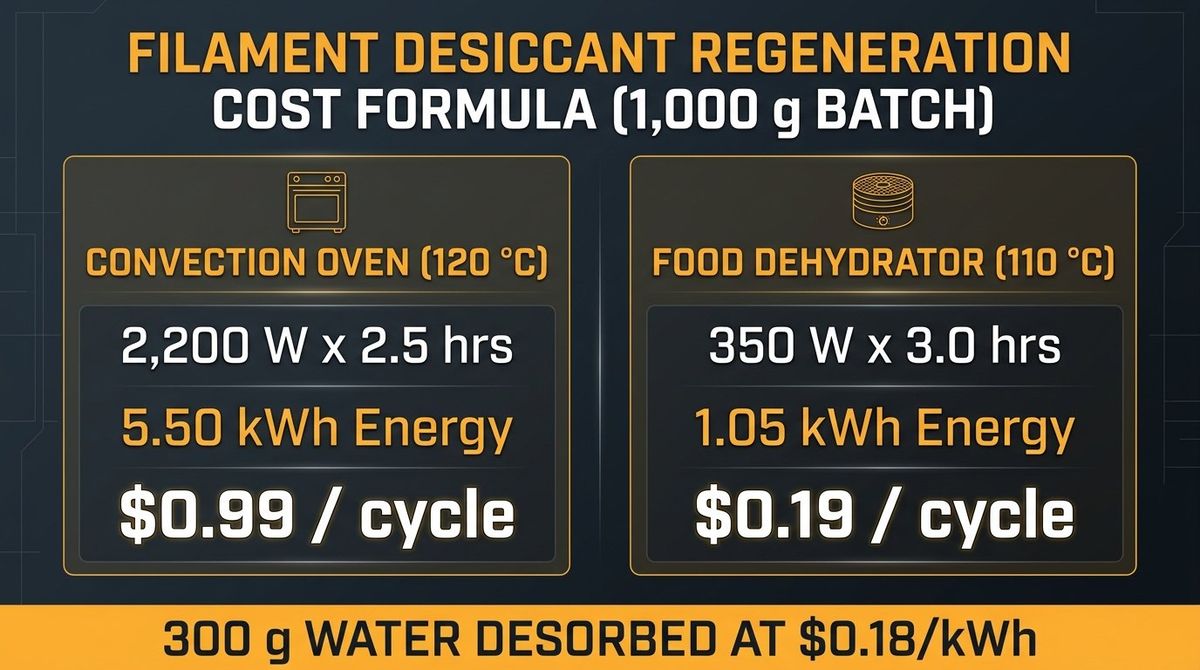
Worked Appliance Comparison: $0.99 Kitchen Oven vs. $0.19 Food Dehydrator
Using a standard residential/commercial electricity tariff of \( R_{\text{elec}} = \$0.18\text{/kWh} \), let us compare regenerating a \( 1{,}000\text{ g} \) batch of silica gel across both heating appliances:
- Method A — Household Convection Oven (\( 2{,}200\text{ W} \) Average Draw for \( 2.5\text{ hrs} \) at \( 120^\circ\text{C} \)):
Heating a \( 140\text{ L} \) steel oven cavity, heavy cast grates, and baking sheet to \( 120^\circ\text{C} \) draws an average of \( 2.20\text{ kW} \) over a \( 2.5\text{ hr} \) cycle:
\[ E_{\text{oven}} = 2.20\text{ kW} \times 2.5\text{ hrs} = 5.50\text{ kWh} \] \[ C_{\text{oven}} = 5.50\text{ kWh} \times \$0.18\text{/kWh} = \$0.99\text{/cycle} \] - Method B — Dedicated Food Dehydrator (\( 350\text{ W} \) Average Draw for \( 3.0\text{ hrs} \) at \( 110^\circ\text{C} \)):
A forced-air countertop dehydrator blows low-humidity air directly through mesh trays holding a thin \( 10\text{ mm} \) bed of beads at \( 110^\circ\text{C} \) while drawing \( 0.35\text{ kW} \) over \( 3.0\text{ hrs} \):
\[ E_{\text{dehydrator}} = 0.35\text{ kW} \times 3.0\text{ hrs} = 1.05\text{ kWh} \] \[ C_{\text{dehydrator}} = 1.05\text{ kWh} \times \$0.18\text{/kWh} = \$0.189 \approx \$0.19\text{/cycle} \]
Switching from a kitchen oven to a dedicated \( \$34 \) to \( \$45 \) dehydrator saves \( 4.45\text{ kWh} \) and \( \$0.80\text{/cycle} \) (\( 80.8\% \) lower energy cost), while also keeping cobalt-free indicating beads out of food-prep ovens and preventing localized overheating above \( 130^\circ\text{C} \) that permanently destroys the organic methyl violet indicator dye.
Complete Desiccant Regeneration & Replacement Comparison Table
| Regeneration / Supply Method | Power & Cycle Time | Energy per \( 1.0\text{ kg} \) Batch | Cost per Cycle \( \left( \$0.18\text{/kWh} \right) \) | Annual Cost (26 Bi-Weekly Cycles) |
|---|---|---|---|---|
| Dedicated Food Dehydrator (\( 110^\circ\text{C} \)) | \( 350\text{ W} \times 3.0\text{ hrs} \) | \( 1.05\text{ kWh} \) | \( \$0.19\text{/cycle} \) | \( \$4.94\text{/yr} \) (plus \( \$16 \) initial bead bulk) |
| Heated Printer Bed + Box (\( 90^\circ\text{C} \)) | \( 220\text{ W} \times 6.0\text{ hrs} \) | \( 1.32\text{ kWh} \) | \( \$0.24\text{/cycle} \) | \( \$6.24\text{/yr} \) (ties up printer for \( 6\text{ hrs} \)) |
| Kitchen Convection Oven (\( 120^\circ\text{C} \)) | \( 2{,}200\text{ W} \times 2.5\text{ hrs} \) | \( 5.50\text{ kWh} \) | \( \$0.99\text{/cycle} \) | \( \$25.74\text{/yr} \) |
| Buying Disposable Packets (No Regen) | N/A (Single-use) | \( 0\text{ kWh} \) | \( \$16.00\text{/kg} \) | \( \$416.00\text{/yr} \) (saves \( \$411\text{/yr} \) by regenerating) |
Two-Bowl Gravimetric Scale Check (800.0 g Tare Verification)
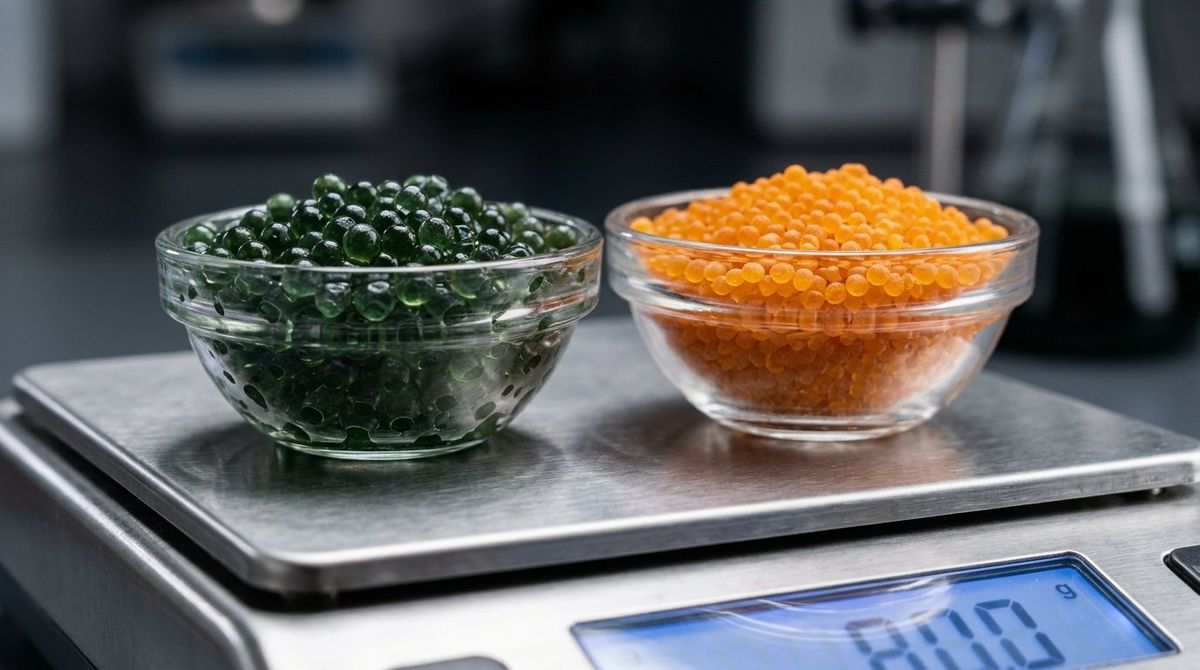
In addition to weighing a full \( 1{,}000\text{ g} \) bulk canister (which scales from \( 1{,}300\text{ g} \) wet down to \( 1{,}000\text{ g} \) dry as \( 300\text{ g} \) of water desorbs), operators running smaller dual-spool dry boxes frequently place two paired glass bowls on a laboratory scale—such as a \( 430.0\text{ g} \) saturated green sample alongside a \( 370.0\text{ g} \) regenerated orange reference sample totaling \( 800.0\text{ g} \) on the digital readout—to verify complete color and mass transition before sealing the beads inside airtight PTFE-gasketed spool chambers. Regardless of batch size, the \( 350\text{ W} \) food dehydrator at \( 110^\circ\text{C} \) (\( 1.05\text{ kWh} \), \( \$0.19\text{/cycle} \)) consistently outperforms a \( 2{,}200\text{ W} \) convection oven (\( 5.50\text{ kWh} \), \( \$0.99\text{/cycle} \)) by \( 80.8\% \).