3D Printer Extruder Drive Gear Tooth Wear and Filament Grinding Scrap Cost Formula: 5 Calculations
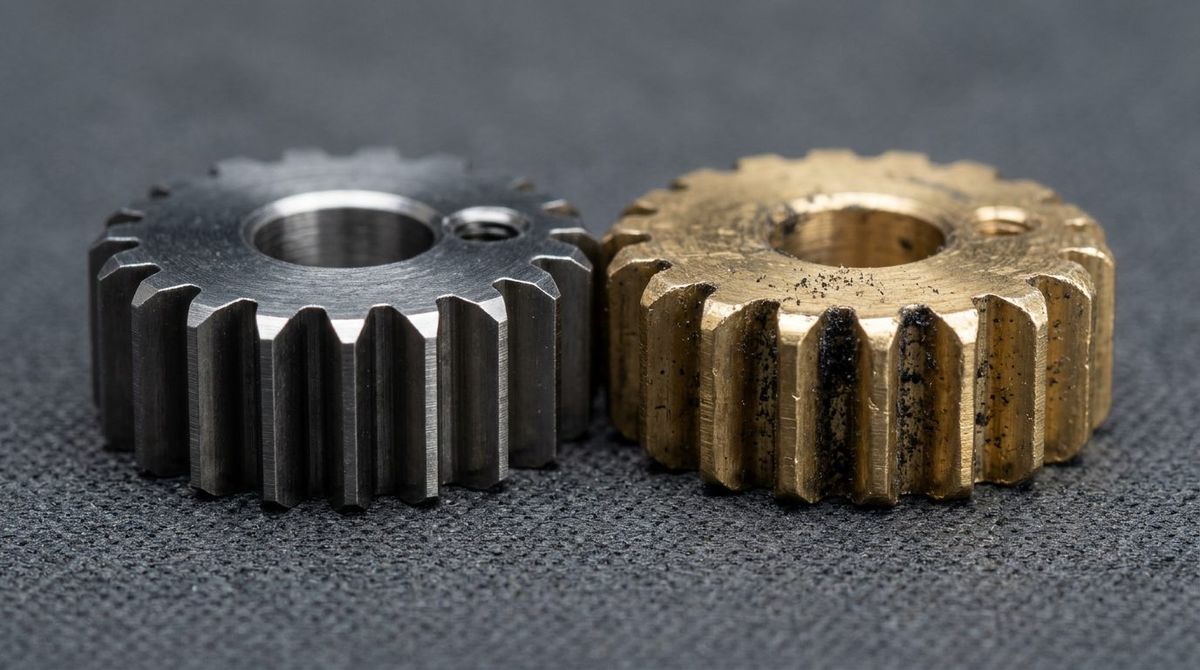
In commercial 3D print farms and high-output job shops, extruder drive gears are subjected to severe continuous mechanical stress. While operators frequently monitor nozzle wear and bed leveling tolerances, extruder drive gear degradation remains one of the most overlooked causes of intermittent under-extrusion, inconsistent layer line stacking, and catastrophic mid-print filament grinding. When printing abrasive engineering composites—such as carbon fiber, glass fiber, or metal-filled polymers—the sharp microscopic fibers steadily abrade the hardened steel teeth of dual-drive hobbed gears, blunting their biting profile and reducing filament grip traction.
As drive gear teeth lose their geometric sharpness, the volumetric feeding rate falls below slicer commands. Eventually, the drive motor stalls or chews a semi-circular divot into the stationary filament, completely halting material deposition while the machine continues moving for hours. In an industrial production run, a single extruder failure can scrap a \$120 composite part and waste 18 hours of machine time. Below, we establish the mathematical framework to calculate gear tooth wear rates, volumetric slippage under-extrusion, scrap part financial loss, and optimal preventive maintenance replacement intervals.
Core Engineering Cost Takeaways:
- Volumetric Slippage Rate: \(S_{\text{vol}} = 1 - \frac{V_{\text{actual}}}{V_{\text{commanded}}}\), measuring the percentage drop in extruded volume caused by gear tooth bite loss.
- Wear Rate Decay: Abrasive composite filaments cause drive gear tooth height decay following Archard's Wear Law: \(h_{\text{tooth}}(t) = h_0 - \frac{k_w \cdot F_N \cdot L}{H_{\text{gear}}}\).
- Scrap Loss Equation: Total financial loss per failed print incorporates raw filament material cost, wasted electrical energy, and unrecovered machine hourly overhead: \(C_{\text{scrap}} = M_{\text{part}} \cdot P_{\text{kg}} + t_{\text{run}} \cdot (R_{\text{elec}} + R_{\text{deprec}})\).
- Preventive ROI Threshold: Replacing a \$35 hardened steel gear set after 600 hours of composite printing yields an ROI exceeding 450% by eliminating a single mid-print failure on high-value parts.
1. Calculation 1: Volumetric Feeding Slippage and Under-Extrusion Rate
When dual-drive extruder gears are new, their sharp hardened teeth bite deeply into the thermoplastic filament sheath, achieving positive displacement with virtually zero mechanical slip. As the gear teeth wear down, contact friction transitions from mechanical interlock to sliding friction. We quantify the volumetric feeding slippage rate \(S_{\text{vol}}\) by comparing actual extruded filament mass against commanded slicer volume:
\[ S_{\text{vol}} = 1 - \left( \frac{M_{\text{actual}}}{\rho_{\text{filament}} \times V_{\text{commanded}}} \right) \]Where \(M_{\text{actual}}\) is measured extruded part mass in grams, \(\rho_{\text{filament}}\) is raw material density in \(\text{g/cm}^3\), and \(V_{\text{commanded}}\) is slicer calculated volume in \(\text{cm}^3\). For an engineering component sliced for \(V_{\text{commanded}} = 250.0\text{ cm}^3\) of PA12 CF (\(\rho = 1.05\text{ g/cm}^3\)), the theoretical target weight is:
\[ M_{\text{target}} = 250.0\text{ cm}^3 \times 1.05\text{ g/cm}^3 = 262.50\text{ grams} \]If worn extruder drive gears deliver an actual printed part mass of only \(M_{\text{actual}} = 241.50\text{ grams}\), we compute the net volumetric slippage:
\[ S_{\text{vol}} = 1 - \left( \frac{241.50}{262.50} \right) = 1 - 0.9200 = 8.00\% \]An 8% volumetric deficit leads to internal infill delamination, weak inter-layer shear strength, and porous outer shell walls that cause parts to fail structural quality control inspections.
2. Calculation 2: Archard's Wear Law and Tooth Height Decay
The rate at which abrasive filament fibers wear down extruder gear teeth is governed by Archard's Classic Wear Equation. We model the reduction in gear tooth penetration depth \(\Delta h_{\text{tooth}}\) over cumulative print time \(t\) as a function of normal clamping force \(F_N\), linear filament extrusion distance \(L\), and gear metallurgy hardness \(H_{\text{gear}}\):
\[ \Delta h_{\text{tooth}} = \frac{k_w \cdot F_N \cdot L}{H_{\text{gear}}} \]Where \(k_w\) is the dimensionless wear coefficient of the filament-metal interface, and \(H_{\text{gear}}\) is the Vickers hardness of the gear material. Table 1 compares the relative hardness ratings and empirical service lifetimes of common extruder drive gear materials when processing 20% chopped carbon fiber filament:
| Gear Material | Vickers Hardness (HV) | Wear Coefficient \(k_w\) | Mean Time Before Failure (MTBF) | Relative Wear Resistance |
|---|---|---|---|---|
| Standard Brass / Stainless Steel | 180 – 220 HV | \(4.8 \times 10^{-4}\) | 60 – 120 print hours | 1.0× (Severe rapid wear) |
| Hardened Tool Steel (A2 / D2) | 700 – 850 HV | \(1.1 \times 10^{-4}\) | 600 – 900 print hours | 4.2× (Standard industrial) |
| Tungsten Carbide / DLC Coated | 1,800 – 2,400 HV | \(0.2 \times 10^{-4}\) | 2,500 – 4,000+ print hours | 11.5× (Elite high-output farm) |
3. Calculation 3: Scrap Part Loss Cost Formula
When worn drive gears slip beyond the critical traction threshold, the motor grinds the filament flat, creating an air gap that halts extrusion mid-print. In a professional manufacturing environment, the financial cost of a scrapped print \(C_{\text{scrap}}\) is far greater than just the cost of wasted filament. We formulate total scrap loss across material, energy, and unrecovered machine overhead:
\[ C_{\text{scrap}} = \left( M_{\text{waste}} \times P_{\text{kg}} \right) + t_{\text{elapsed}} \times \left( P_{\text{kWh}} \times \bar{W}_{\text{kW}} + R_{\text{deprec}} + R_{\text{labor}} \right) \]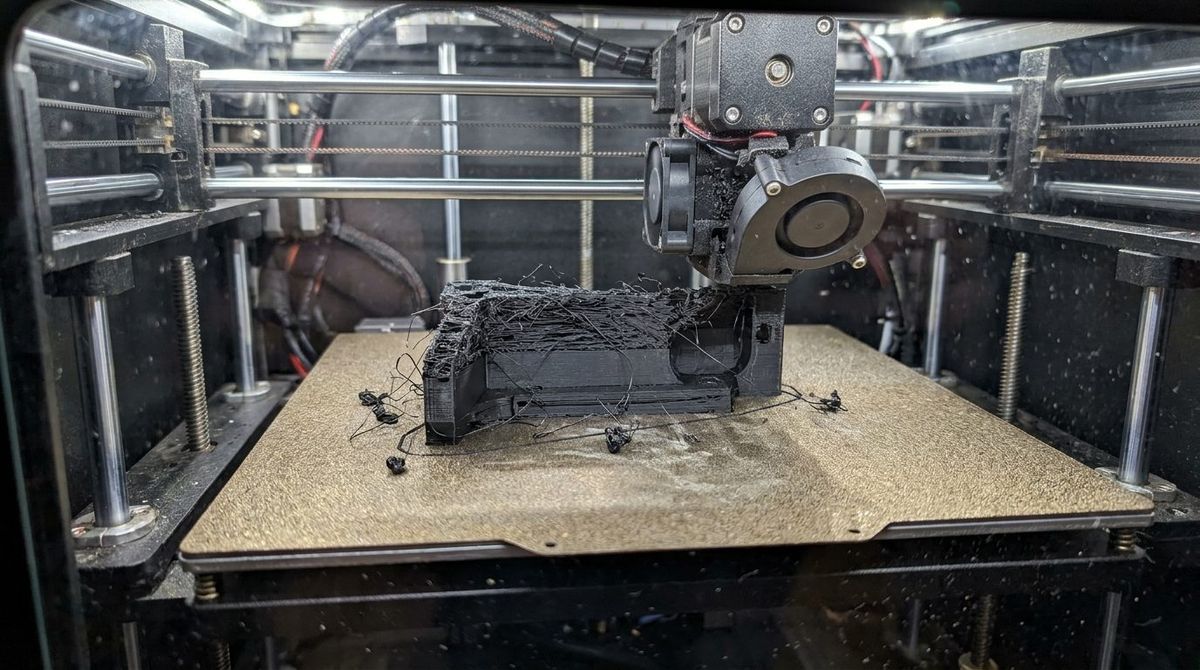
Consider a functional drone arm printed in Carbon Fiber PEEK on an industrial machine. The print fails at hour 14 of an 18-hour cycle, having consumed \(M_{\text{waste}} = 0.45\text{ kg}\) of filament costing \(P_{\text{kg}} = \$220\text{/kg}\). The machine draws \(\bar{W} = 0.65\text{ kW}\) at an electricity rate of \(P_{\text{kWh}} = \$0.16\text{/kWh}\), with machine depreciation of \(R_{\text{deprec}} = \$4.50\text{/hr}\) and technician setup allocation of \(R_{\text{labor}} = \$3.00\text{/hr}\). We compute total scrap cost:
\[ C_{\text{material}} = 0.45\text{ kg} \times \$220\text{/kg} = \$99.00 \] \[ C_{\text{machine\_time}} = 14\text{ hrs} \times (\$0.104 + \$4.50 + \$3.00) = 14 \times \$7.604 = \$106.46 \] \[ C_{\text{scrap}} = \$99.00 + \$106.46 = \$205.46 \]A single extruder grinding failure on this part wipes out \$205.46 in working capital—nearly six times the replacement cost of a brand new hardened drive gear assembly.
4. Calculation 4: Filament Grinding Critical Torque Threshold
Filament grinding occurs when the resisting backpressure force \(F_{\text{backpressure}}\) inside the hotend exceeds the maximum frictional feeding force \(F_{\text{feed, max}}\) exerted by the hobbed gear teeth:
\[ F_{\text{feed, max}} = 2 \cdot \mu_{\text{eff}} \cdot F_{\text{clamp}} \]Where \(\mu_{\text{eff}}\) is the effective traction coefficient between the gear teeth and polymer, and \(F_{\text{clamp}}\) is the spring tension clamping force. For sharp hardened gears, \(\mu_{\text{eff}} \approx 0.65\). As the teeth blunt from abrasive wear, \(\mu_{\text{eff}}\) drops to \(0.22\). If hotend melt pressure spikes (from a cold nozzle, foreign particulate, or speed acceleration), \(F_{\text{backpressure}} > F_{\text{feed, max}}\). The teeth instantly lose traction, strip the filament cylinder, and rotate freely in air.
5. Calculation 5: Preventive Maintenance Replacement ROI
Rather than running extruder drive gears until catastrophic failure occurs, print farms must implement predictive replacement cycles. We calculate the Return on Investment (\(ROI_{\text{pm}}\)) of replacing drive gears on a scheduled preventative cycle \(T_{\text{replace}}\) versus running to failure:
\[ ROI_{\text{pm}} = \left( \frac{(P_{\text{fail}} \times C_{\text{scrap, avg}}) - C_{\text{gear}}}{C_{\text{gear}}} \right) \times 100\% \]Where \(P_{\text{fail}}\) is the empirical probability of a filament grinding failure occurring during the gear's degradation window (typically \(65\%\) between 600 and 1,000 hours of composite printing), \(C_{\text{scrap, avg}}\) is average scrap loss (\$180), and \(C_{\text{gear}}\) is the cost of a premium hardened steel gear set (\$35.00):
\[ ROI_{\text{pm}} = \left( \frac{(0.65 \times \$180.00) - \$35.00}{\$35.00} \right) \times 100\% = \left( \frac{\$117.00 - \$35.00}{\$35.00} \right) \times 100\% = +234.29\% \]Replacing drive gears preventatively delivers an immediate 234% return on investment by mitigating production scrap. To calculate full machine depreciation schedules, job shop hourly pricing, and filament drying overhead, access our calculators at 3D Print Cost Estimator.
Master Your 3D Print Farm Unit Economics and Failure Salvage
Calculate exact filament waste, electricity draw, machine depreciation, and preventive maintenance ROI at 3D Print Cost Estimator.
Open the 3D Print Cost Estimator