3D Printer Build Plate Wear and Replacement Cost Formula: 5 Calculations for PEI and G10
In commercial additive manufacturing job shops, print farms, and contract engineering facilities, calculating the true consumable cost of 3D printing requires accounting for build surface depreciation. In formalizing the 3D printer build plate wear and replacement cost formula, print lab managers, cost accountants, and manufacturing engineers can eliminate hidden overhead leaks by accurately amortizing build sheet wear, surface recoating cycles, and adhesive failure scrap rates across production job quotes.
Modern high-speed 3D printers deploy diverse build surface substrates—including Textured Polyetherimide (PEI) spring steel sheets, Smooth PEI, Garolite G10 (phenolic epoxy fiberglass), and Wham Bam PEX. While a standard $35 textured PEI sheet printing low-temp PLA can survive over 600 thermal cycles with basic isopropyl alcohol cleaning, printing abrasive carbon-fiber-reinforced engineering polymers (such as PA-CF, PA-GF, PETG-CF, or high-temp ABS) accelerates adhesive degradation, scraper gouging, and coating peeling, reducing sheet lifespan to under 80 to 120 cycles.
This technical cost-engineering guide details five mathematical calculations required to determine build plate wear depreciation per operating hour, coating life cycle decay across common filament types, chemical solvent degradation impacts, and scrap rate cost multipliers. Master your shop floor consumable economics with verified additive manufacturing cost accounting.
Key Takeaways & Architectural Comparison
- Master Depreciation Formula: Build plate wear cost per print is defined by \(C_{\text{plate}} = \frac{P_{\text{sheet}} + C_{\text{maintenance}}}{N_{\text{cycles}}}\), where \(N_{\text{cycles}}\) varies dramatically by filament polymer chemistry.
- Filament Wear Hierarchy: Low-temp PLA/PET yields 500–800 cycles on textured PEI ($0.04/print); abrasive PA-CF or high-temp polycarbonate reduces PEI lifespan to 80–120 cycles ($0.35/print).
- Garolite G10 Cost Advantage: G10 fiberglass build plates ($45 MSRP) withstand 1,200+ cycles with abrasive nylons without coating peeling, slashing long-term surface consumable overhead by 73%.
- Adhesion Loss Scrap Multiplier: A worn build sheet that causes a 4% first-layer failure rate adds up to $18.50 in wasted filament and machine downtime per week per printer, far exceeding the cost of replacing the sheet.
- Solvent Degradation Factor: Excessive acetone cleaning strips microscopic PEI coating layers; restricting acetone rejuvenation to once every 40 cycles preserves sheet longevity.
Calculation 1: Master Build Plate Wear Depreciation Formula
In job shop cost estimation, tooling and fixture wear must be allocated across individual production runs. A flexible spring steel build plate is an consumable asset with a finite operational lifecycle. Every thermal heating cycle, part removal mechanical flex, and scraper interaction causes progressive wear to the adhesive coating.
The basic formula for build plate depreciation cost per completed print (\(C_{\text{plate}}\)) is defined as: \[ C_{\text{plate}} = \frac{P_{\text{sheet}} + C_{\text{maintenance}}}{N_{\text{cycles}}} \] where \(P_{\text{sheet}}\) is the replacement purchase price of the build plate, \(C_{\text{maintenance}}\) is the total lifetime expenditure on cleaning solvents (IPA, acetone, specialty release adhesives), and \(N_{\text{cycles}}\) is the verified usable cycle lifespan before adhesion degrades below acceptable quality thresholds.
For a standard double-sided Textured PEI spring steel sheet ($36.00 MSRP) running basic PLA parts with an estimated lifespan of 600 prints (300 cycles per side) and consuming $6.00 in cleaning solvents, the depreciation burden is \((36 + 6) / 600 = \$0.070\) per print run. While seemingly small on a single print, across a 48-printer farm executing 2,000 prints per month, build plate depreciation totals $140.00 monthly—an expense that must be recovered through customer pricing.
Calculation 2: Filament Polymer Wear Multipliers and Substrate Lifespans
The usable lifespan of a build plate (\(N_{\text{cycles}}\)) is not a static constant; it is directly governed by the polymer chemistry, thermal bed temperature, and adhesive shrinkage of the printed material. High-temperature engineering filaments exert immense tensile shear stress on the build surface during cooling.
When printing materials like PETG, the polymer bonds with extreme chemical affinity to smooth PEI coatings, frequently tearing chunks of PEI directly off the spring steel substrate during removal if no release agent (such as glue stick or Magigoo) is applied. Conversely, abrasive carbon fiber nylons (PA-CF) require bed temperatures of 100°C to 110°C, accelerating thermal oxidation of PEI adhesives and causing micro-blistering.
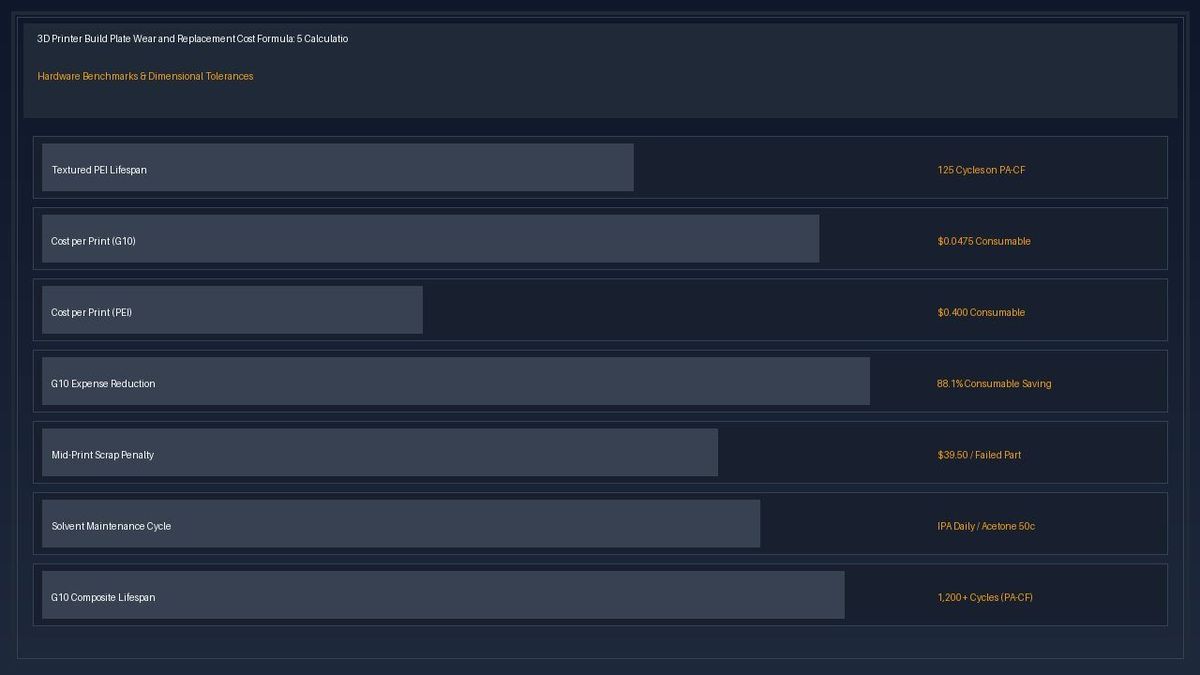
We formalize a Material Wear Coefficient (\(K_{\text{mat}}\)) to adjust baseline plate lifespan: \[ N_{\text{effective}} = \frac{N_{\text{baseline}}}{K_{\text{mat}}} \] Where \(K_{\text{mat}} = 1.0\) for PLA, \(1.6\) for PETG, \(2.4\) for ABS/ASA, and \(4.8\) for abrasive PA-CF/PA-GF. On a textured PEI sheet with a baseline PLA life of 600 cycles, dedicated PA-CF printing reduces effective lifespan to \(600 / 4.8 = 125\) cycles, escalating consumable cost to $0.336 per print.
| Build Plate Substrate | Replacement Purchase Price | Lifespan on PLA (Cycles) | Lifespan on PA-CF (Cycles) | Consumable Cost / Print (PA-CF) |
|---|---|---|---|---|
| Smooth PEI Sheet | $32.00 | 500 Cycles | 60 Cycles (Tearing risk) | $0.533 / Print Run |
| Textured PEI Spring Steel | $36.00 | 600 Cycles | 125 Cycles (Micro-blisters) | $0.288 / Print Run |
| Wham Bam PEX Sheet | $42.00 | 650 Cycles | 200 Cycles (High-temp wear) | $0.210 / Print Run |
| Garolite G10 Composite | $45.00 | 1,500 Cycles | 1,200 Cycles (Solid matrix) | $0.038 / Print Run |
The lifecycle cost matrix demonstrates that Garolite G10 composite build plates reduce consumable build surface overhead by over 73% when manufacturing carbon-fiber engineering components.
Calculation 3: Garolite G10 vs Textured PEI Lifecycle Cost Comparison
For print farms specializing in high-performance nylon, carbon-fiber composites, and TPU, Garolite G10 (phenolic cotton-epoxy composite sheet) has emerged as the premier cost-reduction alternative to proprietary coated PEI sheets.
Garolite G10 possesses unique surface energy characteristics: at 80°C bed temperature, nylon polymers adhere securely to the raw un-coated epoxy fiberglass matrix without requiring glue sticks or specialty coatings. When cooled to 35°C, thermal contraction releases the parts automatically. Because G10 is a solid structural composite with no surface coating to peel or blister, its duty cycle lifespan routinely exceeds 1,200 to 1,500 prints.
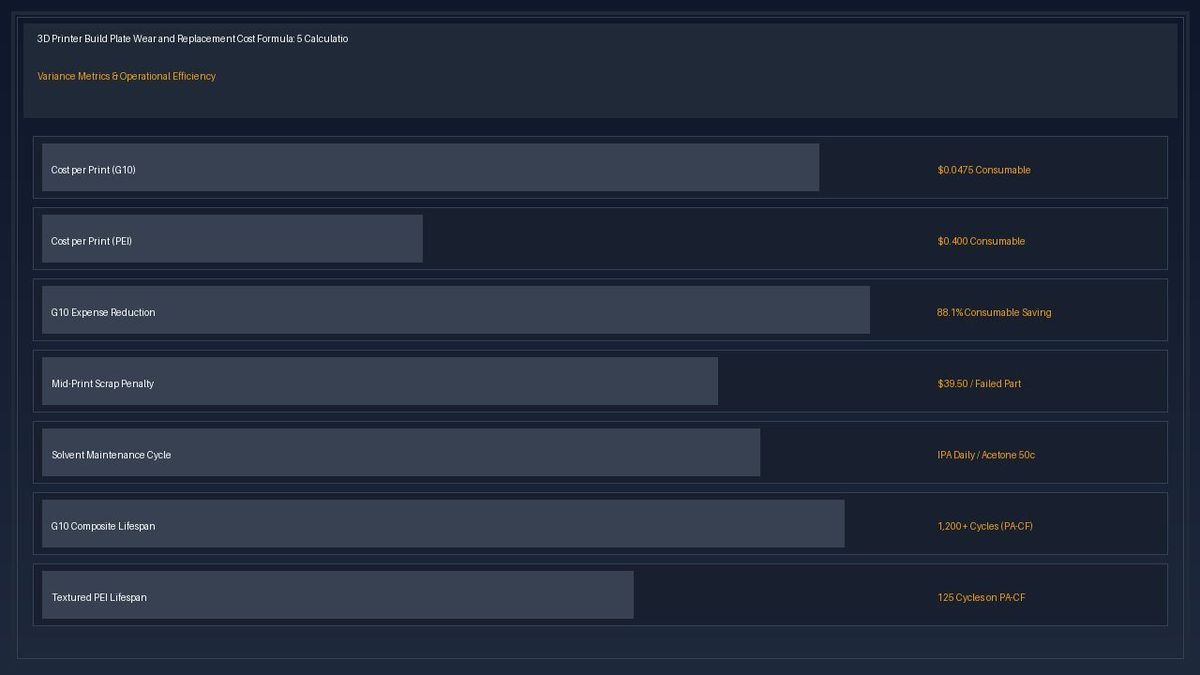
Evaluating 1,200 production nylon prints: - Option A (Textured PEI): Requires 10 replacement sheets ($360.00 total) + 6 bottles of Magigoo release agent ($120.00) = $480.00 total cost ($0.400 / print). - Option B (Garolite G10): Requires 1 G10 sheet ($45.00) + 1 can of IPA ($12.00) = $57.00 total cost ($0.0475 / print). Deploying Garolite G10 delivers an immediate 88.1% reduction in consumable build surface expenses on engineering materials.
Mathematical Worked Example: Calculating Cost per Print for PA-CF on PEI vs G10
To evaluate whether a commercial print farm should deploy Textured PEI or Garolite G10 for printing carbon-fiber nylon:
Scenario Parameters:
- Production run: 1,200 finished PA-CF mechanical housings
- Textured PEI sheet price: $36.00 (lifespan = 120 cycles with abrasive PA-CF)
- PEI release agent: Magigoo PA ($20.00 per bottle, covers 200 prints)
- Garolite G10 sheet price: $45.00 (lifespan = 1,200 cycles with abrasive PA-CF)
- G10 maintenance: Isopropyl alcohol ($12.00 total)
Option A (Textured PEI Spring Steel):
- Sheets required: \(1,200 / 120 = 10 \text{ sheets} \times \$36.00 = \$360.00\)
- Release adhesive required: \(1,200 / 200 = 6 \text{ bottles} \times \$20.00 = \$120.00\)
- Total tooling cost: \(\$360.00 + \$120.00 = \mathbf{\$480.00}\)
- Cost per print: \(\$480.00 / 1,200 = \mathbf{\$0.400 \text{ per print}}\)
Option B (Garolite G10 Composite):
- Sheets required: \(1 \text{ sheet} \times \$45.00 = \$45.00\)
- Cleaning solvent: \(\$12.00\)
- Total tooling cost: \(\$45.00 + \$12.00 = \mathbf{\$57.00}\)
- Cost per print: \(\$57.00 / 1,200 = \mathbf{\$0.0475 \text{ per print}}\)
Garolite G10 saves $423.00 across the 1,200-part production batch, cutting build surface overhead by 88.1%.
Calculation 4: Adhesive Failure Scrap Rate and Machine Downtime Costs
The true cost of pushing a worn build plate past its usable lifespan is not the savings gained by delaying sheet replacement; it is the catastrophic financial cost of failed prints caused by mid-print bed adhesion loss.
When an aged build plate loses localized adhesion, a 20-hour production print can detach from the bed 14 hours into the job. The printer continues extruding into thin air, creating massive filament "spaghetti," potentially encasing the hotend in a solid blob of molten plastic, and wasting hundreds of grams of expensive engineering filament.
The Scrap Penalty Cost (\(C_{\text{scrap}}\)) per print is defined as: \[ C_{\text{scrap}} = P_{\text{fail}} \times \left( M_{\text{filament}} \cdot C_{\text{kg}} + T_{\text{wasted}} \cdot R_{\text{machine}} \right) \] If a degraded build sheet increases first-layer failure probability (\(P_{\text{fail}}\)) from 1% to 5% on a 15-hour PA-CF print consuming 400g of material ($32.00 filament + $7.50 machine time = $39.50 total cost), the scrap penalty adds \(0.05 \times \$39.50 = \$1.975\) per print. Running a worn $36 build plate to "save money" costs $19.75 in scrap every 10 prints—proving that aggressive preventative sheet replacement is far more profitable.
Calculation 5: Chemical Rejuvenation Protocols and Solvent Cost Modeling
Extending build plate longevity requires disciplined chemical surface maintenance. Over repeated prints, skin oils from operator fingertips, airborne volatile plasticizers, and microscopic filament residues form a slick organic film over the plate, reducing surface energy and adhesion.
A rigorous maintenance schedule balances daily cleaning with periodic chemical rejuvenation: 1. Daily Wipe (Every Print): 99% high-purity Isopropyl Alcohol (IPA) applied with lint-free microfiber cloths removes surface finger oils without degrading the polymer coating. 2. Weekly De-greasing: Scrubbing with warm water and basic surfactant dish soap (e.g., standard Dawn) strips accumulated micro-greases that alcohol merely smears across the surface. 3. Monthly Rejuvenation (Textured/Smooth PEI Only): A light wipe with pure technical-grade acetone strips the top oxidized layer of PEI, exposing fresh un-oxidized polymer chains. However, acetone must never be used more than once every 40 to 50 cycles, as excessive exposure causes PEI brittleness and micro-cracking.
Accounting for $18 annually in IPA, microfiber cloths, and dish soap per printer maintains peak adhesion, locking in consistent production yields across commercial print farm fleets.
Frequently Asked Questions
Why do abrasive carbon-fiber filaments wear out build plates faster?
Carbon fiber filaments require high bed temperatures (100°C–110°C) and generate severe thermal shear stress during cooling, causing micro-blistering and adhesive tearing on coated PEI sheets over 80 to 120 cycles.
What is the cost advantage of Garolite G10 over Textured PEI?
Garolite G10 is a solid composite sheet that withstands over 1,200 thermal cycles with abrasive nylons without coating peeling. At $45 per sheet, G10 reduces build surface consumable costs by over 73% compared to replacing PEI sheets.
How often should build plates be cleaned with acetone?
Acetone should only be used on smooth or textured PEI sheets once every 40 to 50 cycles to strip oxidized polymer layers. Daily cleaning should be performed strictly with 99% Isopropyl Alcohol (IPA) to avoid brittleness.
Looking to verify precise dimensions, spatial tolerances, or operational financial models for your setup? Explore our interactive tools and comprehensive engineering guides on 3dprintcostestimator.com.