3D Print Threaded Heat-Set Insert and Hardware Assembly Cost Formula: 5 Job-Shop Pricing Rules
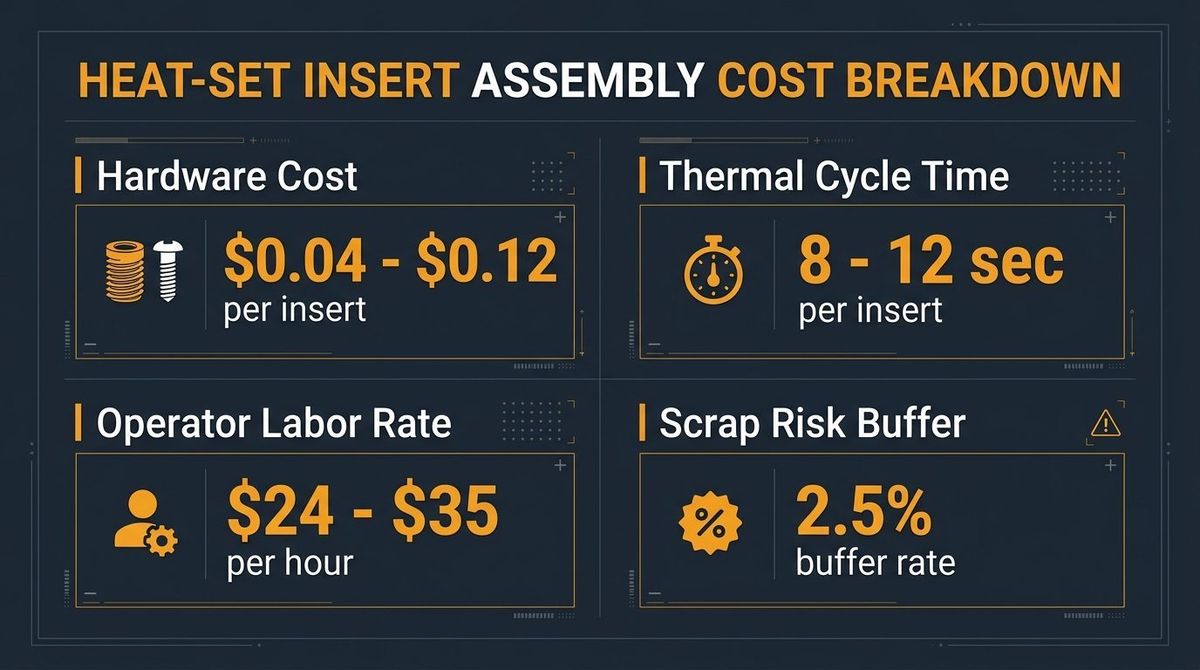
Commercial 3D print farms and additive contract manufacturers rarely ship raw plastic parts alone; functional enclosures, robotics brackets, and industrial jigs almost always require knurled brass threaded heat-set inserts (\(M2, M3, M4, M5,\) or \(1/4\text{"-}20\)) so end users can torque machine screws repeatedly without stripping thermoplastic threads. Yet over \(70\%\) of print shops severely underprice secondary hardware installation by charging only the raw $0.05 cost of the brass insert while ignoring thermal press warmup, part fixture orientation, per-boss dwell time, and late-stage melt-scrap risk. Using our 3D print heat set insert cost formula, you can price secondary hardware assembly accurately across prototype and 500-unit production runs.
Why is late-stage heat-set insert scrap so dangerous to your profit margin? Because when an operator over-presses a \(230^\circ\text{C}\) soldering tip at a crooked angle on the 12th boss of a 14-hour Carbon-Fiber Nylon print, the entire finished print—along with its machine time, electricity, filament, and the first 11 installed inserts—must be thrown into the scrap bin. You can plug your exact filament weight, machine hourly rate, and post-processing labor directly into our 3D Print Cost Estimator & Production Quote Calculator.
Quick Answer — Threaded Heat-Set Insert Pricing Formula:
- True Per-Insert Installed Cost: Installing \(N_{\text{ins}} = 8\) brass \(M3 \times 5.7\,\text{mm}\) inserts in a 25-unit batch costs $0.17 to $0.24 per insert ($1.36–$1.92 per part)—more than 3.5x the raw $0.05 hardware cost once operator press time, warmup amortization, and a \(2\%\) scrap multiplier are included.
- Standard Thermal Press Cycle Time (\(t_{\text{press}}\)): Averages \(9.5\,\text{seconds per boss}\) (\(3.5\,\text{s}\) pick-and-place + \(4.0\,\text{s}\) thermal melt stroke + \(2.0\,\text{s}\) solidification hold and inspect).
- Boss Wall Slicer Rule: Adding 4 perimeter walls around insert bores adds \(3\text{–}7\,\text{grams}\) of filament and \(4\text{–}9\,\text{minutes}\) of print time, which must be captured in the base print quote.
1. The Complete Heat-Set Insert Assembly Cost Formula
To calculate the true fully-burdened assembly cost per part (\(C_{\text{insert,part}}\)) across a production batch of \(B\) identical parts, each requiring \(N_{\text{ins}}\) threaded inserts distributed across \(N_{\text{axes}}\) distinct part orientations (requiring fixture flips), we sum four cost components: landed hardware cost, amortized setup/warmup labor, active pressing & inspection labor, and the late-stage part scrap risk premium:
Where each variable is defined as:
- \(N_{\text{ins}}\) = Total number of heat-set inserts per printed part.
- \(c_{\text{unit}}\) = Landed unit price per brass insert (typically $0.04–$0.08 for standard \(M3\); $0.12–$0.22 for lead-free stainless or \(M5/M6\) heavy-duty inserts).
- \(f_{\text{loss}}\) = Bench drop/loss factor (standard \(0.03\), or \(3\%\)).
- \(T_{\text{setup}}\) = Batch thermal iron warmup, tip swap, temperature calibration, and workholding jig setup time (typically \(300\,\text{seconds}\) / \(5\,\text{minutes}\)).
- \(t_{\text{pick}}, t_{\text{melt}}, t_{\text{inspect}}\) = Per-insert tweezers placement (\(3.5\,\text{s}\)), vertical press melt stroke (\(4.0\,\text{s}\)), and flushness/thread-clear inspection (\(2.0\,\text{s}\)), totaling \(9.5\,\text{s}\) per boss.
- \(t_{\text{flip}}\) = Re-fixturing time when rotating the part to press inserts on perpendicular side faces (\(6.0\,\text{s}\) per axis flip).
- \(R_{\text{labor}}\) = Fully burdened shop technician hourly rate ($28.00/hr baseline).
- \(p_{\text{scrap}}\) = Probability of ruining the printed part during thermal pressing (\(0.015\) to \(0.025\), or \(1.5\%\text{–}2.5\%\)).
- \(C_{\text{base\_print}}\) = Full manufacturing cost of the raw 3D printed part prior to insert installation.
2. Worked Job-Shop Calculation: Single Prototype vs. 50-Unit Batch
Suppose a robotics client orders a PETG-CF sensor housing whose base print cost is \(C_{\text{base\_print}} = \$14.50\). Each housing requires \(N_{\text{ins}} = 10\) standard \(M3 \times 5.7\,\text{mm}\) brass inserts (\(c_{\text{unit}} = \$0.06\), \(f_{\text{loss}} = 0.03\)) installed across \(N_{\text{axes}} = 3\) faces (\(2\) fixture flips per part, \(t_{\text{flip}} = 6.0\,\text{s}\)). Shop labor is \(R_{\text{labor}} = \$30.00/\text{hr}\), setup time is \(T_{\text{setup}} = 300\,\text{s}\), press depreciation is \(C_{\text{press,wear}} = \$0.05/\text{part}\), and scrap risk is \(p_{\text{scrap}} = 0.02\) (\(2\%\)):
- Hardware Cost Per Part (\(C_{\text{hw}}\)): \[ C_{\text{hw}} = 10 \times \$0.06 \times 1.03 = \mathbf{\$0.618} \]
- Case A — Single Prototype Order (\(B = 1\) unit): \[ T_{\text{assy,1}} = \frac{300\,\text{s}}{1} + 10(9.5\,\text{s}) + 2(6.0\,\text{s}) = 300 + 95 + 12 = 407\,\text{seconds} \quad (6.78\,\text{mins}) \] \[ C_{\text{labor,1}} = \left(\frac{407}{3600}\right) \times \$30.00 = \$3.392 \] \[ C_{\text{insert,1}} = (\$0.618 + \$3.392 + \$0.05) + 0.02(\$14.50 + \$0.618 + \$3.392) = \$4.06 + \$0.37 = \mathbf{\$4.43\,\text{per part}} \quad (\mathbf{\$0.44/\text{insert}}) \]
- Case B — 50-Unit Production Batch (\(B = 50\) units): \[ T_{\text{assy,50}} = \frac{300\,\text{s}}{50} + 95\,\text{s} + 12\,\text{s} = 6 + 95 + 12 = 113\,\text{seconds} \quad (1.88\,\text{mins}) \] \[ C_{\text{labor,50}} = \left(\frac{113}{3600}\right) \times \$30.00 = \$0.942 \] \[ C_{\text{insert,50}} = (\$0.618 + \$0.942 + \$0.05) + 0.02(\$14.50 + \$0.618 + \$0.942) = \$1.61 + \$0.32 = \mathbf{\$1.93\,\text{per part}} \quad (\mathbf{\$0.19/\text{insert}}) \]
Notice how the 5-minute thermal press warmup and tip swap adds $2.50 of pure labor to a single prototype ($0.44/insert total), whereas across a 50-unit batch the installed cost drops to $0.19/insert.
3. Slicer Boss Wall Reinforcement & Hidden Filament Cost Math
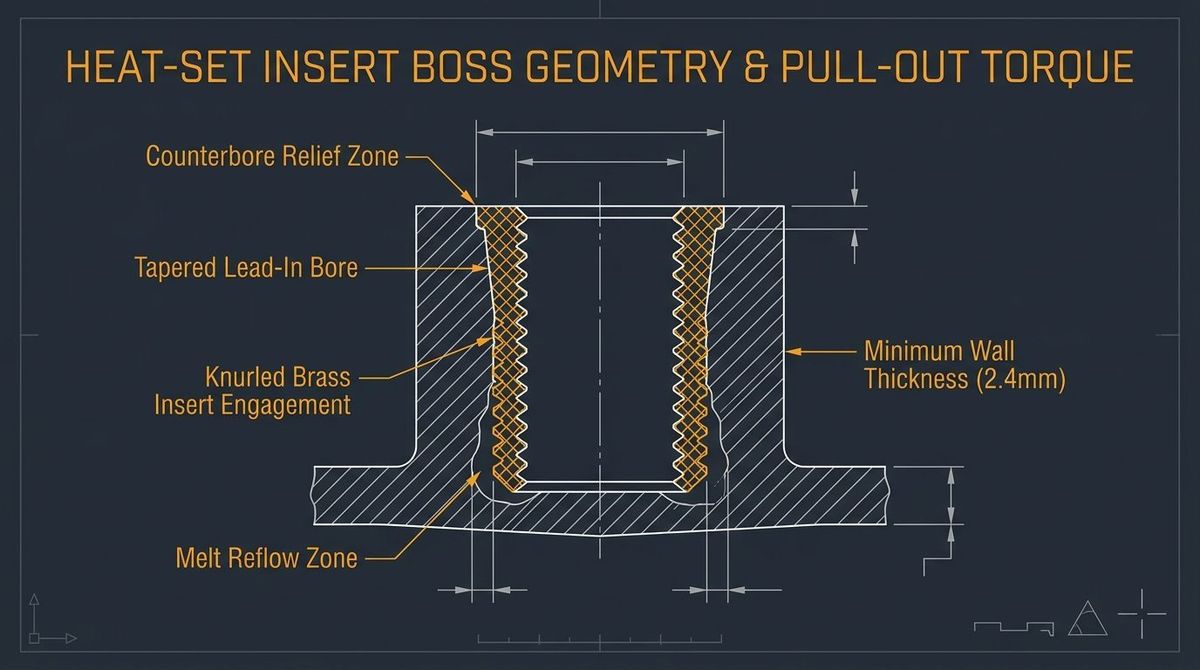
Standard 2-perimeter, 15% rectilinear infill slicer profiles fail catastrophically when pressing brass inserts: the heated knurls break through the thin inner perimeter wall and push molten plastic into hollow infill voids, reducing pull-out force from \(1,200\,\text{N}\) down to \(\lt 250\,\text{N}\). To achieve full pull-out and spin-out torque ratings, every insert boss requires a minimum radial wall thickness \(W_{\text{boss}} \ge 2.4\,\text{mm}\) (\(6\) perimeters with a \(0.4\,\text{mm}\) nozzle). The additional polymer mass (\(\Delta m_{\text{boss}}\)) required to reinforce \(N_{\text{ins}}\) bosses of outer diameter \(D_{\text{out}}\), bore diameter \(D_{\text{bore}}\), and depth \(L_{\text{bore}}\) in a material of density \(\rho\) (vs. baseline infill fraction \(f_{\text{infill}}\)) is:
Using modifier cylinders in OrcaSlicer or PrusaSlicer to apply 6 perimeters locally around the insert bores (rather than across the entire part) saves \(18\text{–}30\%\) in total filament weight while guaranteeing solid knurl anchoring.
4. Thermal Press Temperature & Boss Dimension Reference Table
| Insert Thread Size | Standard Insert OD × Length | Recommended CAD Bore Diameter | Minimum Boss OD (\(6\) Walls) | Installed Cost Range (Batch 25+) |
|---|---|---|---|---|
| M2 × 0.4 | \(3.2\,\text{mm} \times 3.0\,\text{mm}\) | \(3.0\,\text{mm}\) (Tapered \(3.3\,\text{mm}\)) | \(7.2\,\text{mm}\) | $0.14 – $0.18 / insert |
| M2.5 × 0.45 | \(4.0\,\text{mm} \times 4.0\,\text{mm}\) | \(3.6\,\text{mm}\) (Tapered \(4.1\,\text{mm}\)) | \(8.4\,\text{mm}\) | $0.15 – $0.19 / insert |
| M3 × 0.5 (Standard) | \(4.6\,\text{mm} \times 5.7\,\text{mm}\) | \(4.0\,\text{mm}\) (Tapered \(4.7\,\text{mm}\)) | \(9.2\,\text{mm}\) | $0.17 – $0.24 / insert |
| M4 × 0.7 | \(6.3\,\text{mm} \times 8.1\,\text{mm}\) | \(5.6\,\text{mm}\) (Tapered \(6.4\,\text{mm}\)) | \(11.2\,\text{mm}\) | $0.22 – $0.31 / insert |
| M5 × 0.8 | \(7.1\,\text{mm} \times 9.5\,\text{mm}\) | \(6.4\,\text{mm}\) (Tapered \(7.2\,\text{mm}\)) | \(12.8\,\text{mm}\) | $0.26 – $0.38 / insert |
| M6 / 1/4"-20 | \(8.7\,\text{mm} \times 12.7\,\text{mm}\) | \(8.0\,\text{mm}\) (Tapered \(8.8\,\text{mm}\)) | \(15.0\,\text{mm}\) | $0.35 – $0.52 / insert |
For optimal polymer reflow without charring or sticking to the brass insert, set your Hakko FX-888D or Pinecil thermal press iron to nozzle print temperature plus \(10^\circ\text{C}\text{ to }15^\circ\text{C}\): \(215^\circ\text{C}\) for PLA, \(245^\circ\text{C}\) for PETG, \(265^\circ\text{C}\) for ABS/ASA, and \(285^\circ\text{C}\) for PA6/PA12 Carbon-Fiber Nylon.
5. Five Shop Rules to Eliminate Insert Pull-Out & Molten Thread Clogging
- Always Use Dedicated Shoulder Heat-Set Tips (Never Conical Soldering Tips): Standard conical soldering iron tips touch the internal female threads of the insert, wicking solder/oxide into the threads and tilting the insert off-axis. Use CNC-machined stepped brass or plated copper heat-set tips (\(M2\text{–}M6\)).
- Model a \(1.5\,\text{mm}\) Bottom Relief Bore Below the Insert: If a \(5.7\,\text{mm}\) long M3 insert is pressed into a blind hole only \(5.7\,\text{mm}\) deep, the displaced molten plastic has nowhere to flow except upward into the internal M3 threads! Always model the blind bore at least \(7.2\,\text{mm}\) deep (\(L_{\text{insert}} + 1.5\,\text{mm}\)).
- Stop Pressing \(0.5\,\text{mm}\) Proud and Flatten With a Cold Steel Block: Press the insert until the top rim sits \(0.5\,\text{mm}\) above the surface, withdraw the iron, and immediately press a flat aluminum or steel machinist block against the face for \(2\,\text{seconds}\) to lock the insert dead-flush and perpendicular.
- Charge a Tiered Setup Minimum ($5.00–$10.00) on Small Orders: Never absorb 5 minutes of iron warmup and tip swapping on a 1-piece or 2-piece order.
- Include Insert Count as a Line Item in Automated Customer Quotes: Separating base print cost from secondary hardware installation lets customers evaluate whether they want your shop to install the inserts or buy the raw prints and press them in-house.
Frequently Asked Questions
Why do my brass inserts spin out when the customer unscrews an M3 bolt with Blue Loctite?
Anaerobic threadlockers like Loctite 242/243 require up to \(3.5\,\text{N}\cdot\text{m}\) of breakaway torque, and if any liquid threadlocker wicks around the outside of the brass insert into ABS, PC, or PETG, it chemically crazes and cracks the amorphous polymer boss! Use nylon-patch locking screws instead of liquid Loctite on 3D printed bosses, or upgrade to opposite-diagonal helical knurled inserts (such as Ruthex or CNC Kitchen styles).
Are ultrasonic/heat-set tapered inserts stronger than straight-knurled cheap inserts?
Yes. Independent pull-out testing by CNC Kitchen demonstrates that tapered inserts with opposing diagonal knurl bands and a central undercut groove resist both axial pull-out (\(1,100\,\text{N}+\) in PETG/ASA) and rotational torque 2x to 3x better than straight-knurled generic inserts.
How much faster is a vertical arbor press fixture compared to freehand soldering iron pressing?
A linear-rail vertical heat-set press reduces per-boss installation time by roughly \(25\%\) (from \(12.5\,\text{s}\) down to \(9.5\,\text{s}\)) and cuts angular tilt scrap rates from \(4.5\%\) down to under \(0.8\%\).
Quote Your 3D Printed Parts & Hardware Assembly Accurately
Stop giving away post-processing labor and brass hardware for free. Calculate your exact filament, electricity, machine depreciation, and heat-set insert assembly margins using our 3D Print Cost Estimator & Job-Shop Pricing Calculator.