3D Print Support Material Waste & Post-Processing Labor Cost Formula: The Complete Commercial Quoting Guide (2026)
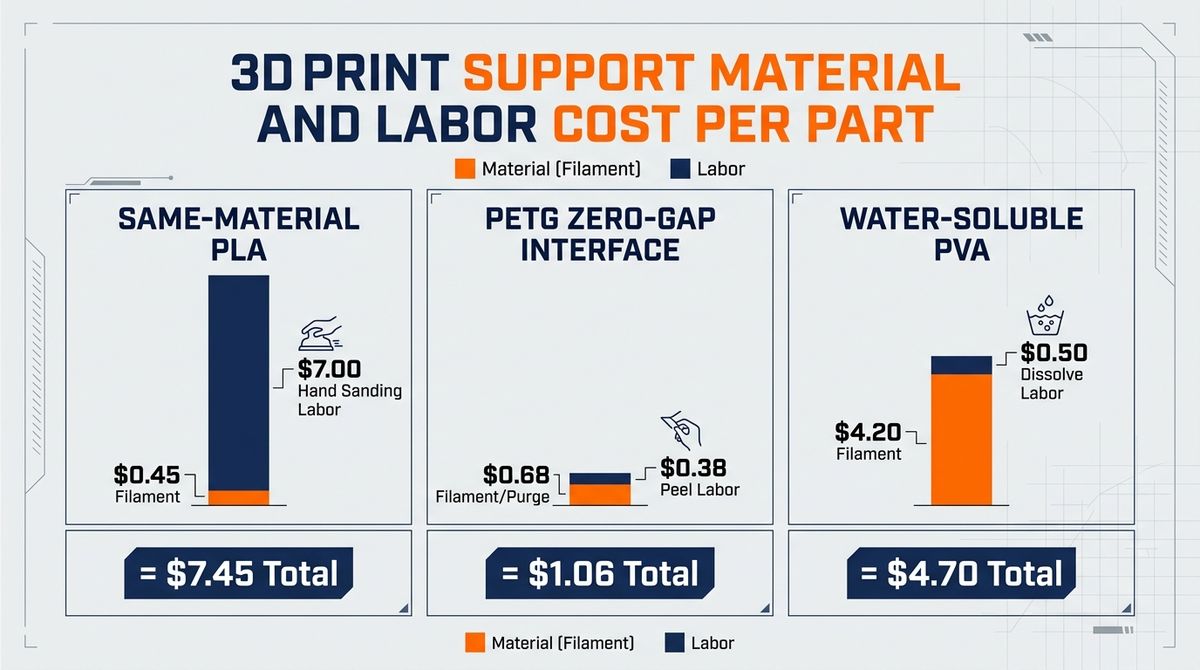
1. Why Slicer Filament Estimates Fail Commercial Print Farms
When you slice a complex mechanical bracket or miniature figurine in OrcaSlicer, Bambu Studio, or PrusaSlicer, the software outputs a clean summary: Model: 140g | Support: 42g | Total: 182g. Novice print farm operators plug 182 grams into a basic weight multiplier and assume the support structure is covered.
In reality, support structures trigger four distinct cost multipliers that standard per-gram calculators completely miss:
- Unrecoverable Support, Prime Tower, and Purge Chute Mass (\(M_{\text{waste}}\)): On single-nozzle multi-material systems, every support interface layer requires a filament retraction, cut, purge ("poop"), and prime-tower wipe.
- Extended Machine Occupation Time (\(\Delta t_{\text{machine}}\)): Printing support trees, slowing down for overhang perimeters (\(15\text{–}25\text{ mm/s}\)), and executing 50 to 300 filament swaps adds hours of machine depreciation and electricity.
- Direct Hands-On Technician Labor (\(t_{\text{labor}}\)): Pliers, flush cutters, deburring knives, dental picks, and heat-gun stress relief require high-cost human minutes that cannot be automated in standard breakaway workflows.
- Post-Processing Breakage Scrap Rate (\(P_{\text{scrap}}\)): Prising supports away from thin walls, snap hooks, or small pins breaks 3% to 8% of finished parts—forcing the farm to absorb 100% of the material and machine time of a reprint at the very last stage of production.
2. The Master Support & Post-Processing Cost Formula (\(C_{\text{support\_total}}\))
To protect your gross margin on every custom job entered into your 3D print quoting calculator, compute the full support surcharge using our four-part engineering equation:
$$C_{\text{support\_total}} = C_{\text{mat\_waste}} + C_{\text{machine\_delta}} + C_{\text{labor}} + C_{\text{scrap\_risk}}$$
Expanded into measurable shop-floor variables:
$$C_{\text{support\_total}} = \left[\frac{W_{\text{supp}} \cdot P_{\text{supp}} + (N_{\text{swaps}} \cdot W_{\text{purge}} + W_{\text{tower}}) \cdot P_{\text{interface}}}{1000}\right] + (\Delta t_{\text{print}} \cdot R_{\text{mach}}) + \left(\frac{t_{\text{remove}}}{60} \cdot R_{\text{labor}}\right) + (P_{\text{scrap}} \cdot C_{\text{base\_part}})$$
- \(W_{\text{supp}}\) & \(P_{\text{supp}}\): Weight of structural support body (g) and price per kg ($/kg) of the primary support filament.
- \(N_{\text{swaps}}\) & \(W_{\text{purge}}\): Number of multi-material filament changes and average purge + wipe weight per swap (typically \(0.45\text{g to }0.85\text{g}\) per swap).
- \(W_{\text{tower}}\) & \(P_{\text{interface}}\): Prime tower weight (g) and price per kg ($/kg) of the dedicated interface or soluble filament (e.g., $95/kg for PVA, $135/kg for BVOH, or $22/kg for PETG breakaway interface).
- \(\Delta t_{\text{print}}\) & \(R_{\text{mach}}\): Additional print time (hours) added by supports and filament swaps, multiplied by your hourly machine rate (typically $1.50 to $3.50/hr).
- \(t_{\text{remove}}\) & \(R_{\text{labor}}\): Active human technician minutes spent removing supports and sanding witness marks, multiplied by fully burdened shop labor rate (typically $24.00 to $36.00/hr, or $0.40 to $0.60/min).
- \(P_{\text{scrap}} \cdot C_{\text{base\_part}}\): Probability of breaking the part during support removal ($0.005$ to $0.08$) multiplied by the accumulated material and machine cost of the part.
3. Benchmarking the 4 Commercial Support Strategies (Worked Case Study)
Consider a commercial order for 50 custom robotics sensor housings printed in Tough PLA ($22/kg). Each housing weighs 110g net, takes 3.2 hours to print without overhangs, and features recessed mounting flanges and internal wire routing channels at 4 different heights (requiring 18 distinct interface layers, or 160 total support layers if printed top-to-bottom).
Let's compare the exact unit economics across all four shop methodologies assuming a $27.00/hr ($0.45/min) technician labor rate and a $2.00/hr machine rate:
| Support Strategy | Support + Purge + Tower Material Cost | Extra Machine Time Cost (\(\Delta t_{\text{print}}\)) | Hands-On Removal Labor ($0.45/min) | Scrap Risk Penalty (\(P_{\text{scrap}}\)) | Total Support Cost / Part (\(C_{\text{support\_total}}\)) |
|---|---|---|---|---|---|
| 1. Standard Same-Material Tree Supports (\(0.20\text{mm}\) Z-gap) | $0.77 (35g PLA @ $22/kg) | $0.90 (+0.45 hrs) | $4.95 (11 mins pliers + knife) | $0.46 (5.0% scrap risk) | $7.08 / unit |
| 2. AMS Full Soluble PVA (Single-Nozzle, 160 swaps) | $11.21 (30g PVA + 88g purge/tower @ $95/kg) | $5.60 (+2.80 hrs swap time) | $0.68 (1.5 mins tank rinse) | $0.05 (0.5% scrap risk) | $17.54 / unit (Unprofitable) |
| 3. AMS Zero-Z-Gap PETG Interface Only (18 swaps at roof) | $1.19 (32g PLA + 19g PETG purge/tower @ $22/kg) | $1.56 (+0.78 hrs) | $0.90 (2.0 mins clean pop-off) | $0.09 (1.0% scrap risk) | $3.74 / unit (Best Single-Nozzle ROI) |
| 4. Dual-Nozzle IDEX / Toolchanger PVA Interface (Zero purge) | $1.67 (28g PLA + 11g PVA interface @ $95/kg) | $1.04 (+0.52 hrs) | $0.45 (1.0 min warm water bath) | $0.02 (0.2% scrap risk) | $3.18 / unit (Best High-Volume ROI) |
4. The Dissimilar Support Interface Secret: PLA + PETG (\(Z_{\text{gap}} = 0\text{ mm}\))
As the table proves, running full water-soluble PVA or BVOH inside a single-nozzle multi-material unit (Bambu Lab AMS, Prusa MMU3, or Creality CFS) destroys profitability because purging expensive $95/kg filament across 160 layers costs $11.21 in material and adds nearly 3 hours of unpaid tool-change time.
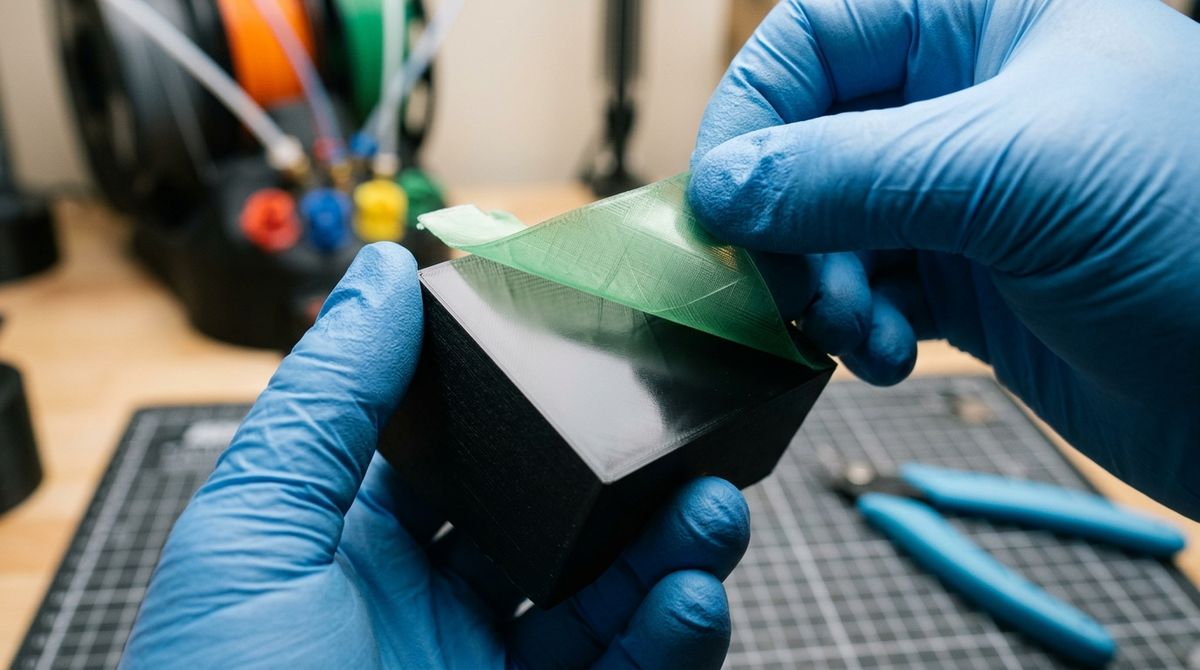
Instead, high-margin print farms configure their slicers for Support Interface-Only Mode with Dissimilar Polymers:
- For PLA Prints, Use PETG as the Support Interface (and Vice Versa): Because PLA and PETG do not chemically bond at standard extrusion temperatures, they peel apart cleanly like release tape.
- Exact Slicer Settings for Zero-Scarring Overhangs:
- Support Filament: Keep set to
Default (Base Material)so 95% of the support tree is printed rapidly with zero filament changes. - Support Interface Filament: Set to your dissimilar material slot (e.g., Slot 2: PETG).
- Top Interface Layers:
2 layers(0.40 mmtotal thickness). - Top Z-Distance (\(Z_{\text{gap}}\)):
0.00 mm(solid contact—eliminates drooping bridging strings completely). - Top Interface Spacing:
0.00 mm(100% solid rectilinear or concentric roof). - Flushing Volumes Multiplier: Increase the purge volume from PETG-back-to-PLA to \(600\text{–}800\text{ mm}^3\)! If even 1% residual PETG remains inside the nozzle when the printer resumes printing structural PLA model walls, layer adhesion at that Z-height will delaminate under load.
- Support Filament: Keep set to
5. Calculating Your Break-Even Labor Threshold (\(t_{\text{breakeven}}\))
When should your quoting team switch a customer job from standard breakaway tree supports to multi-material interface supports? Set the total cost of Strategy 1 equal to Strategy 3 and solve for technician removal minutes (\(t_{\text{breakeven}}\)):
$$t_{\text{breakeven}} = t_{\text{interface\_cleanup}} + \frac{60}{R_{\text{labor}}} \times \left[ (C_{\text{mat\_interface}} - C_{\text{mat\_std}}) + (\Delta t_{\text{swap}} \cdot R_{\text{mach}}) - (\Delta P_{\text{scrap}} \cdot C_{\text{base\_part}}) \right]$$
For a typical part with 15 to 25 interface swaps (\(\Delta C_{\text{mat}} + \Delta C_{\text{mach}} \approx \)1.08) at a $27/hr ($0.45/min) labor rate, \(t_{\text{breakeven}} = 4.2\text{ minutes}\). Any part that takes a technician more than 4 minutes and 12 seconds to clean by hand is cheaper—and dramatically cleaner—when printed with a zero-gap dissimilar interface.
6. Quoting Rules for Commercial 3D Print Shops
- Charge a 1.35x Surcharge on Support Grams: Because overhangs print at 30% to 50% of normal volumetric speed, always multiply slicer support gram weight by at least 1.35x to capture the hidden velocity slowdown.
- Create 3 Tiered Post-Processing Labor Checkboxes in Your Quote Form:
- Tier 0 (Customer Removes Supports): $0.00 labor fee, 0% scrap warranty on thin features after shipping.
- Tier 1 (External Breakaway Removal): +$2.50 flat fee per part (covers up to 5 minutes of flush-cutter cleanup).
- Tier 2 (Internal Cavities / Zero-Gap Dissimilar or Soluble Interface): +$5.50 to +$12.00 per part depending on swap count or ultrasonic water-bath cycle time.
- orient Flat Overhangs at a 5° to 10° Tilt When Using Single-Nozzle AMS: Wait—be careful here! While tilting a flat overhang reduces single-layer warping, tilting a flat horizontal roof across 40 Z-layers turns 2 filament swaps into 40 filament swaps on a single-nozzle AMS. Whenever using AMS interface-only mode, orient critical overhang faces perfectly parallel to the build plate so all interface extrusion occurs on the exact same 2 Z-layers!
Frequently Asked Questions
How much does 3D print support material add to the cost of a print?
In raw filament weight, supports typically add 15% to 35% to material cost. However, when accounting for slower overhang print speeds, multi-material purge waste, and manual technician removal labor ($0.40–$0.60/min), supports actually increase total commercial part cost by 40% to 110% unless optimized.
Why did my PLA print snap along the layer lines when using PETG as a support interface?
Layer delamination at the support roof height happens when residual PETG contaminates the nozzle after a filament swap. Increase your slicer's Flushing Volume from PETG to PLA to at least 650–800 mm³ and enable a prime tower so the hotend chamber is 100% purged of PETG before printing structural PLA walls.
Is water-soluble PVA worth it for a commercial 3D print farm?
Water-soluble PVA ($95/kg) or BVOH ($135/kg) is only cost-effective when run on a dual-extruder IDEX or multi-toolhead printer (such as a Prusa XL, UltiMaker S5/S7, or Snapmaker J1s) using interface-only mode, where it consumes just 5g to 15g per part with zero purge waste and eliminates manual labor inside blind internal channels.
Run the Interactive Calculator: Use our 3D Print Cost Estimator to model your exact parameters and tolerances in real time.