3D Print Post-Processing Sanding and Vapor Smoothing Cost Formula: Job Shop Pricing Guide
Accurately quoting commercial additive manufacturing projects requires mastering the 3d print post-processing sanding vapor smoothing cost formula to account for direct labor, consumable media, and equipment depreciation. While print slicing software calculates raw filament or resin consumption and machine runtime to the penny, manual post-processing and chemical vapor finishing frequently represent 40% to 70% of total job shop production costs. Underestimating surface finishing expenses turns high-volume production runs into financial losses.
Surface finishing requirements vary dramatically across engineering prototypes, medical anatomical models, and consumer-facing end-use components. A standard Fused Deposition Modeling (FDM) part printed in ABS, ASA, or PETG demands progressive wet sanding across four distinct abrasive grits to eliminate layer lines, followed by automated or solvent-based chemical vapor smoothing to achieve a non-porous, injection-molded surface finish. Establishing a repeatable, formula-driven pricing model protects service bureau profit margins while providing transparent, defensible customer quotes.
Post-Processing Economics Key Takeaways
- Finishing Labor Outweighs Material Cost: Manual sanding labor at $45 to $85 per shop hour regularly exceeds the raw plastic resin cost of an FDM build by a factor of four.
- Consumable Abrasive Burn Rate: Progressive grit sanding (120 to 1,000 grit) consumes an average of 1.5 to 3.0 abrasive sheets per square foot of complex geometry.
- Solvent Recovery Efficiency: Industrial closed-loop vapor smoothing systems recover 85% to 92% of solvent vapors, reducing consumable chemical expenses to under $1.20 per liter equivalent.
- Depreciation Amortization: High-end vapor finishing chambers ($15,000 to $65,000 CapEx) must be amortized across hourly operating cycles to prevent under-quoting commercial contracts.
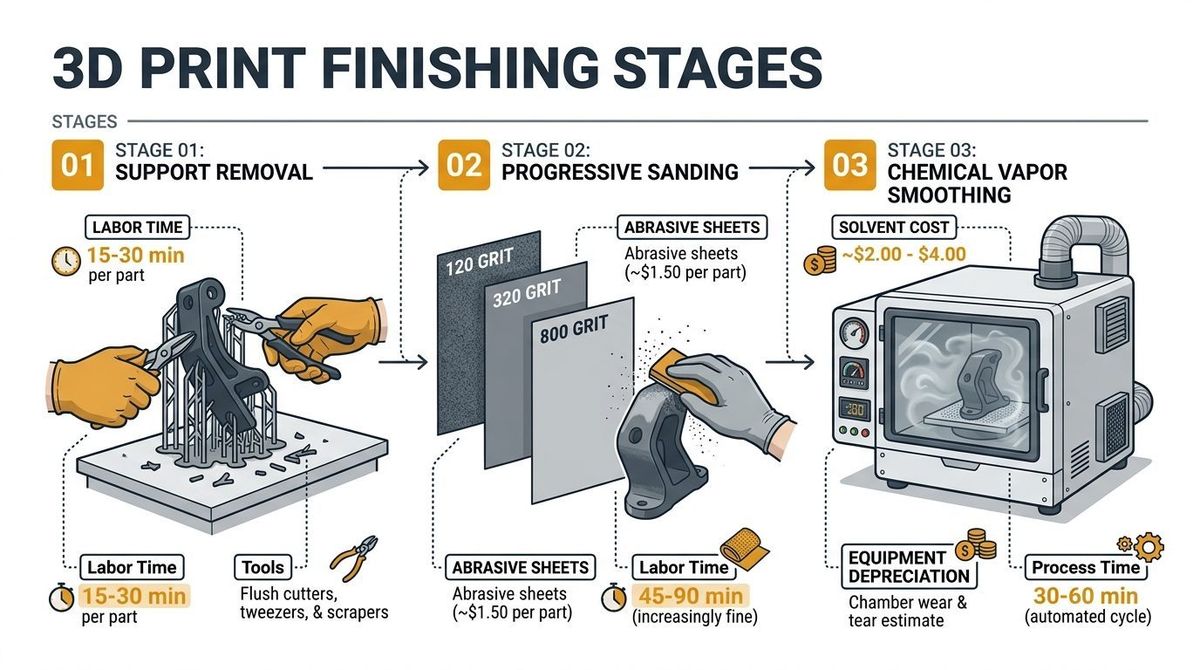
The Four Pillars of Additive Manufacturing Finishing Costs
To capture every financial input of surface finishing, job shop estimators structure post-processing costs into four discrete accounting buckets. Omitting any single category inflates unallocated shop overhead and erodes net margins.
Where \(C_{\text{labor}}\) represents direct touch labor, \(C_{\text{consumables}}\) accounts for sandpaper, solvents, and PPE, \(C_{\text{equipment\_deprec}}\) amortizes capital machinery, and \(C_{\text{energy\_overhead}}\) covers chamber heating, explosion-proof ventilation, and facility conditioning.
Calculating Direct Finishing Labor Costs
Manual surface preparation remains the most volatile variable in additive post-processing. Unlike the automated print phase, technician sanding velocity depends heavily on component geometry, surface curvature, deep internal pockets, and support structure interface scarring.
Where \(T\) represents touch time in fractional hours, and \(R_{\text{shop\_labor}}\) represents fully burdened shop labor (wages, payroll taxes, health insurance, and facility facility burden). Standard commercial rates range from $50.00 to $95.00 per hour depending on geographic market and ISO quality tier.
Surface Complexity Factor (\(K_{\text{complex}}\))
Flat prismatic surfaces allow motorized orbital or belt sanding, averaging 2.5 minutes per 10 square inches. In contrast, complex organic surfaces with lattice structures or enclosed channels require delicate manual detail scraping, inflating finishing time by a multiplier factor:
Where \(K_{\text{complex}} = 1.0\) for flat plates, \(1.8\) for gentle industrial enclosures, and \(3.2\) to \(4.5\) for intricate architectural or topological optimization components.
Abrasive Sandpaper and Consumables Formula
Progressive sanding of 3D printed thermoplastics typically transitions through 120-grit (support scar knockdown), 240-grit (layer line leveling), 400-grit (micro-scratch smoothing), and 800/1000-grit (wet pre-polish prep). Thermoplastics load silicon carbide abrasive paper rapidly due to frictional heating, limiting sheet lifespan.
On average, industrial job shops allocate $0.65 to $1.15 per premium waterproof silicon carbide sheet, with a consumption rate of 0.35 sheets per 100 square centimeters of part surface area per grit level.
Chemical Vapor Smoothing Economics: Acetone vs. IPA vs. Ethyl Acetate
Vapor smoothing exposes thermoplastic prints to aerosolized or boiled chemical solvent vapors (acetone for ABS/ASA, isopropanol for PVB, or cyclohexanone/ethyl acetate for PETG/TPU). The solvent partially liquefies the outer microscopic polymer boundary (10 to 30 microns depth), relying on surface tension to flatten ridges before rapid evacuation and curing.
In automated sealed chambers (such as PostProcess Technologies, AMT PostPro, or desktop automated units), solvent recovery systems recycle up to 90% of the active solvent, drastically reducing per-part chemical expense while ensuring regulatory OSHA environmental compliance.
Step-by-Step Worked Cost Calculation Example
A contract manufacturer receives a purchase order to post-process a production batch of 24 custom drone chassis enclosures 3D printed in ASA. Each enclosure measures 8.0 in \(\times\) 6.0 in \(\times\) 2.5 in with a total external surface area of 142 square inches (0.986 sq ft). The specification calls for 240/400 grit hand knockdown followed by automated closed-loop vapor smoothing.
- Shop Burdened Labor Rate (\(R_{\text{shop\_labor}}\)): $65.00 / hour
- Support Removal & Deburring Time: 6 minutes (0.10 hr) per part
- Dual-Stage Hand Sanding Time: 15 minutes (0.25 hr) per part
- Inspection, Masking & Racking: 4 minutes (0.067 hr) per part
- Abrasive Sheets: 2 sheets (240-grit) + 2 sheets (400-grit) at $0.85/sheet per part = $3.40
- Vapor Chamber CapEx: $28,000 amortized over 4,000 operational hours = $7.00 / hour
- Chamber Batch Cycle Time: 45 minutes (0.75 hr), capacity 12 parts per run
- Solvent Consumption: 0.8 liters acetone per cycle at $4.50/liter, 85% recovered = $0.54 net solvent cost per cycle
Step 1: Calculate direct labor cost per unit.
Step 2: Calculate consumables cost per unit.
Step 3: Calculate vapor smoothing batch costs allocated per unit.
Step 4: Total post-processing cost and baseline quote price (at 35% margin).
For the entire 24-unit batch, post-processing costs total $761.76, yielding a billable finishing line item of $1,171.92 before factoring in the initial print machine time.
Post-Processing Cost Benchmark Matrix
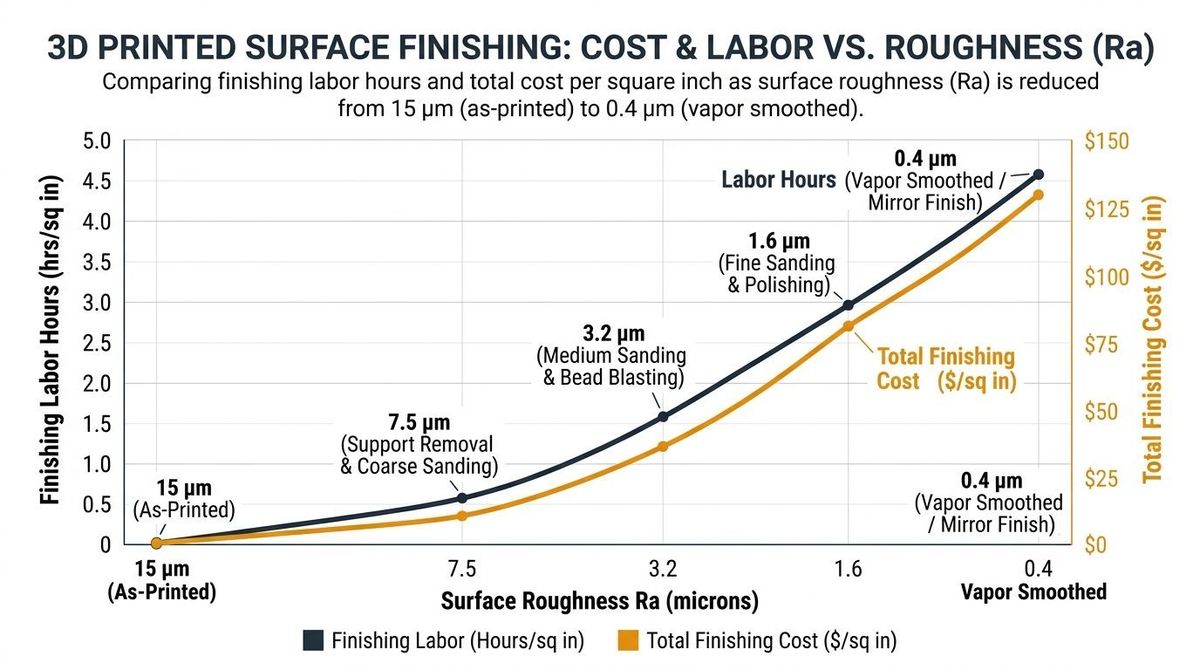
The comparative engineering table below outlines typical labor allocations, consumable burn rates, and finished surface roughness across common post-processing workflows.
| Finishing Tier | Process Description | Labor Time / Sq Ft | Consumable Cost / Sq Ft | Final Surface Roughness (\(Ra\)) | Target Application |
|---|---|---|---|---|---|
| Raw Support Knockdown | Scrape supports, wire brush, light deburr | 3 – 6 minutes | $0.40 – $0.80 | 12.0 – 18.0 \(\mu\)m | Internal brackets, hidden jigs |
| Utility Sanding (240 Grit) | Dry orbital + detail block sanding | 12 – 18 minutes | $1.80 – $2.60 | 6.0 – 9.0 \(\mu\)m | Fit check prototypes, tooling |
| Multi-Stage Wet Sanding | 240 to 800 wet sand + tac wipe | 25 – 45 minutes | $3.50 – $5.20 | 1.5 – 3.0 \(\mu\)m | Pre-paint, consumer appearance |
| Closed-Loop Vapor Smoothing | Quick deburr + automated chemical vapor | 4 – 8 minutes | $0.85 – $1.60 | 0.4 – 1.0 \(\mu\)m | Ducting, medical, watertight tanks |
| Hybrid Sand + Vapor Polish | 400-grit level + vapor chamber cycle | 18 – 30 minutes | $2.80 – $4.20 | 0.2 – 0.5 \(\mu\)m | Injection-mold production proxies |
Notice that automated closed-loop vapor smoothing reduces labor time by over 75% compared to multi-stage hand wet sanding while achieving an ultra-smooth sub-micron surface roughness (\(Ra < 1.0\ \mu\text{m}\)).
Common Job Shop Estimating Pitfalls
Avoiding margin erosion requires identifying secondary post-processing operations that frequently escape initial quotes:
- Masking Critical Tolerances: Chemical vapor smoothing causes polymer reflow that can round sharp knife-edges and swell tight female thread bosses by 20 to 50 microns. Estimators must budget 3 to 5 minutes of technician labor per part to insert silicone masking plugs before solvent exposure.
- Solvent Disposal and Compliance: Waste solvent contaminated with dissolved polymer sludge cannot be poured down municipal drains. Professional hazardous waste collection contracts add $150 to $400 per barrel, which must be absorbed into facility overhead.
- Geometry Creep and Warpage: Thin-walled components (under 1.2 mm) absorb solvent rapidly, causing structural sagging in heated vapor environments. Re-running warped parts doubles total production costs.
Frequently Asked Questions
Can PLA parts be cost-effectively vapor smoothed?
Standard PLA does not react safely with acetone or isopropanol. Smoothing PLA requires aggressive solvents such as ethyl acetate, tetrahydrofuran (THF), or dichloromethane, which require explosion-proof containment and expensive vapor recovery ventilation, making multi-stage sanding or high-build primer coating more cost-effective for PLA.
How does batch nesting in a vapor chamber reduce unit cost?
Automated vapor smoothing chambers consume nearly the same electrical energy and solvent volume regardless of whether 2 parts or 20 parts are loaded. Racking parts at maximum volumetric density spreads the fixed $5.00 to $9.00 cycle cost across more units, driving down finishing cost per part.
Does vapor smoothing weaken mechanical part strength?
Vapor smoothing slightly reduces tensile yield strength (typically 3% to 7%) due to plasticization of the outer boundary, but it significantly improves elongation at break and impact resistance by fusing inter-layer micro-fissures that act as stress concentrators.
How do I factor sandpaper grit breakdown into recurring pricing?
Track abrasive paper consumption on standard job tickets over 30 days. Divide total abrasive invoices by total billable finished square footage to establish an empirical shop-wide consumable surcharge per square foot.
Calculate Your Exact 3D Printing Production Costs
Streamline your contract manufacturing quotes and eliminate finishing estimation guesswork. Use our dedicated additive cost modeling engines at 3D Print Cost Estimator to simulate machine runtime, material consumption, and post-processing economics in a single unified dashboard.