3D Print Farm Rack Space and Floor Overhead Allocation Formula: 5 Production Cost Calculations
In operating a commercial 3D printing farm or industrial additive manufacturing job shop, facility rent, floor space utilization, and vertical rack racking overhead represent critical indirect operational expenses that are frequently miscalculated or ignored. In calculating the 3D print farm rack space and floor overhead allocation formula, print farm managers and contract manufacturers must apply precise square-footage cost accounting to allocate real estate lease costs, electrical distribution infrastructure, and HVAC thermal conditioning across hundreds of machine operating hours.
Commercial print farms utilizing arrays of 24 to 96+ high-speed 3D printers (such as Bambu Lab X1C/P1S, Prusa MK4/CORE One, or industrial Formlabs units) require structured heavy-duty shelving racks, dedicated operator walkways, automated filament staging zones, and heavy thermal ventilation. If a farm manager only accounts for raw filament weight and machine electricity, facility overhead absorption is neglected—resulting in underpriced commercial contracts and masked operational losses.
This technical cost-engineering guide formalizes five mathematical formulas for calculating physical floor footprint density, vertical rack tier multipliers, shared facility overhead allocation per machine hour, HVAC thermal cooling load cost factors, and machine utilization break-even thresholds. Master your shop floor economics with verified additive manufacturing cost accounting.
Key Takeaways & Architectural Comparison
- Floor Footprint Allocation: True footprint accounting mandates adding a 150% operator walkway and maintenance buffer to the raw rack base footprint.
- Vertical Density Multiplier: Deploying 4-tier vertical shelving racks reduces the physical facility lease cost per printer by 75% compared to single-tier workbenches.
- Master Overhead Allocation Formula: Facility overhead per printer-hour is defined by \(C_{overhead} = \frac{A_{allocated} \cdot R_{sqft\_lease} + C_{facility\_fixed}}{N_{printers} \cdot H_{annual\_operating} \cdot U_{utilization}}\).
- HVAC Thermal Load Factor: Each active 3D printer dissipates 80W to 250W of continuous thermal heat; commercial AC conditioning adds $0.035 to $0.065 per operating hour in summer cooling loads.
- Break-Even Utilization Threshold: Commercial print farm overhead absorption requires a minimum machine utilization rate of 68% (5,950 hours annually per printer) to achieve target 45% gross operating margins.
Formula 1: Effective Floor Footprint Allocation and Walkway Geometry
The first fundamental error in print farm financial modeling is calculating facility rent based solely on the physical exterior dimensions of the shelving rack. A standard heavy-duty industrial teardrop pallet rack or commercial wire shelving unit measuring 48 inches wide by 24 inches deep occupies a raw base footprint of 8.0 square feet. However, a functional print farm cannot operate with racks placed edge-to-edge.
To allow operators to safely swap build plates, load 10kg filament spools, execute nozzle maintenance, and access rear electrical outlets and network switches, every rack requires dedicated aisle clearance. Industrial ergonomics standards dictate a minimum aisle width of 36 inches between opposing racks, plus 30 inches of end-cap buffer for fire egress and material cart movement.
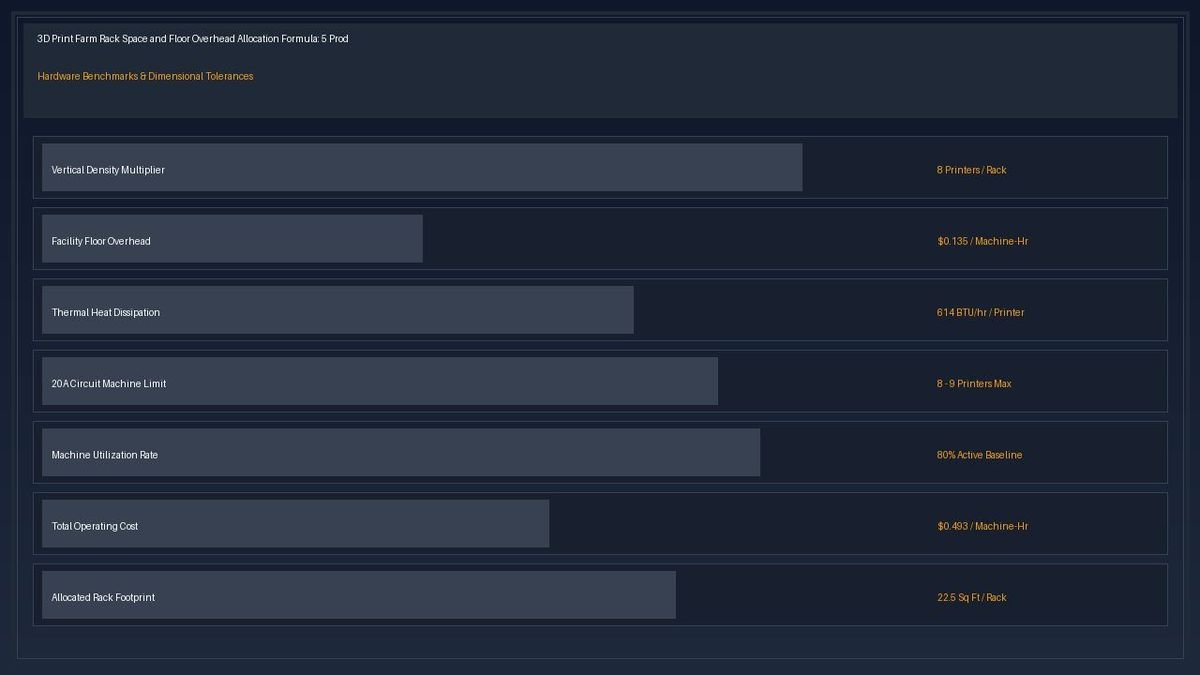
Consequently, the true allocated floor footprint per rack (\(A_{rack\_allocated}\)) is calculated by adding half of the adjacent aisle width to both the front and rear dimensions: \(A_{rack\_allocated} = (W_{rack} + W_{clearance}) \times (D_{rack} + D_{aisle})\). For a standard 4ft x 2ft rack with a 3ft aisle, the allocated footprint becomes \(4.5 \times 5.0 = 22.5\) square feet—nearly triple the raw rack footprint. Calculating real estate overhead without aisle buffers severely understates facility costs.
Formula 2: Vertical Rack Tier Scaling and Machine Density Multipliers
Because commercial warehouse and light-industrial commercial leases are priced per square foot of floor space (typically $18.00 to $32.00 per sq ft annually in urban manufacturing clusters), maximizing vertical ceiling volume is the primary lever for reducing overhead per part.
Let \(N_{tiers}\) represent the number of vertical shelving tiers installed on a rack, and let \(N_{per\_tier}\) represent the number of printers accommodated per shelf. On a heavy-duty 48-inch wide rack with a 10-foot ceiling height, operators can install 4 vertical tiers, each housing two mid-format enclosed printers (such as Bambu Lab X1C or Prusa CORE One), yielding \(N_{rack} = 4 \times 2 = 8\) active machines per rack.
The effective floor area allocated per individual printer (\(A_{printer}\)) is calculated by dividing the total allocated rack footprint by total machine capacity: \(A_{printer} = A_{rack\_allocated} / N_{rack}\). With an allocated rack footprint of 22.5 square feet housing 8 printers, each machine absorbs exactly 2.81 square feet of facility floor space. Compared to a single-tier desktop workbench requiring 8.0 sq ft per machine, 4-tier vertical racking reduces physical real estate overhead by 64.8%.
| Farm Configuration | Total Active Printers | Allocated Rack Footprint | Monthly Lease Overhead | Overhead Cost / Printer-Hr |
|---|---|---|---|---|
| Starter Pilot Farm | 12 Printers (2 Racks) | 45.0 Sq Ft | $950.00 / Month | $0.135 / Printer-Hour |
| Medium Production Farm | 24 Printers (3 Racks) | 67.5 Sq Ft | $1,850.00 / Month | $0.131 / Printer-Hour |
| Commercial Hub Farm | 48 Printers (6 Racks) | 135.0 Sq Ft | $3,800.00 / Month | $0.135 / Printer-Hour |
| Industrial Factory Farm | 96 Printers (12 Racks) | 270.0 Sq Ft | $7,200.00 / Month | $0.128 / Printer-Hour |
The allocation metrics show that with 4-tier vertical shelving racks, facility floor overhead stabilizes between $0.128 and $0.135 per operating machine-hour across commercial production volumes at 80% active machine utilization.
Formula 3: Shared Facility Overhead Allocation per Printer Operating Hour
Fixed facility overhead encompasses building rent, property taxes, commercial insurance, high-speed fiber internet, security monitoring, shop lighting, and administrative software subscriptions. To apply these indirect costs to individual customer print quotes, they must be converted into a standardized hourly overhead rate per printer (\(C_{overhead\_hr}\)).
Let \(C_{facility\_monthly}\) represent total monthly facility fixed costs. Let \(N_{total}\) represent the total number of installed printers in the farm. Let \(H_{avail\_monthly}\) represent the total available hours per month (730 hours for 24/7 operations), and let \(U\) represent the farm's active machine utilization percentage (the ratio of active printing hours to total available hours).
The mathematical allocation formula is defined as: \[ C_{overhead\_hr} = \frac{C_{facility\_monthly}}{N_{total} \times 730 \times U} \] In a 48-printer commercial farm with a monthly facility overhead of $3,800 operating at an 80% utilization rate (\(U = 0.80\)), total productive monthly machine hours equal \(48 \times 730 \times 0.80 = 28,032\) hours. Dividing $3,800 by 28,032 hours yields an overhead burden of exactly $0.1355 per printer-hour. If utilization drops to 40%, the overhead burden doubles to $0.271 per machine-hour, eroding profit margins on fixed-price manufacturing contracts.
Mathematical Worked Formula: Calculating Fully Absorbed Cost per Machine Hour
To determine the fully absorbed hourly operating cost for a 48-printer production farm:
Step 1: Input Parameters
- Monthly warehouse lease & utilities: $3,800.00 / month
- Total active printers: 48 units
- Monthly hours: 730 hours
- Average machine utilization rate: \(U = 80\%\) (0.80)
- Productive machine hours: \(48 \times 730 \times 0.80 = 28,032\) machine-hours/month
Step 2: Calculate Hourly Facility Floor Overhead
\[
C_{\text{overhead}} = \frac{\$3,800.00}{28,032 \text{ hrs}} = \$0.1355 \text{ per printer-hour}
\]
Step 3: Integrate Direct Operational Costs
- Hardware amortization ($1,450 / 6,000 hrs): $0.2417 / hr
- Electricity draw (180W at $0.16/kWh): $0.0288 / hr
- HVAC thermal conditioning load: $0.0070 / hr
- Maintenance, nozzle & build plate wear: $0.0800 / hr
\[
R_{\text{total}} = 0.1355 + 0.2417 + 0.0288 + 0.0070 + 0.0800 = \mathbf{\$0.4930 \text{ per printer-hour}}
\]
For a 12-hour print job, baseline machine overhead costs exactly $5.92 before raw filament material and operator labor are applied.
Formula 4: HVAC Thermal Load Dissipation and Climate Control Power Costs
Modern high-speed 3D printers convert nearly 95% of their electrical power input into ambient heat energy through heated build plates, extruder heater blocks, stepper motor friction, and internal power supplies. In an enclosed facility operating 48 printers simultaneously, the cumulative thermal heat dissipation is massive.
An enclosed engineering printer consuming an average of 180 Watts of electrical power generates approximately 614 BTU/hr of thermal energy (\(1 \text{ Watt} = 3.412 \text{ BTU/hr}\)). A 48-machine print farm therefore generates \(48 \times 614 = 29,472 \text{ BTU/hr}\) of continuous thermal load—equivalent to a 2.5-ton commercial air conditioning requirement simply to maintain a stable 72°F (22°C) room ambient.
Commercial air conditioning efficiency is measured by the Seasonal Energy Efficiency Ratio (SEER). The additional electrical cost to extract this heat is calculated by: \[ C_{HVAC\_hr} = \frac{\text{Total BTU/hr}}{\text{SEER} \times 1000} \times \text{Utility Rate (\$/kWh)} \] With a commercial AC unit rated at 14 SEER operating at a commercial utility rate of $0.16/kWh, cooling the 48-machine farm adds \((29,472 / 14,000) \times \$0.16 = \$0.337\) per hour in facility cooling costs, or approximately $0.007 per printer-hour. During hot summer months, neglecting HVAC thermal extraction costs leads to room overheating, stepper motor thermal runaway, and unexpected utility bills.
Formula 5: Electrical Distribution Infrastructure and Circuit Load Safety Margins
Deploying dozens of 3D printers onto standard commercial wiring presents severe electrical fire risks if circuit branch capacities and continuous load deratings are miscalculated. Under the National Electrical Code (NEC Article 210), continuous commercial loads (loads operating continuously for 3 hours or more) must not exceed 80% of the branch circuit's rated breaker capacity.
A standard 20-Amp, 120-Volt commercial branch circuit provides a maximum nominal capacity of 2,400 Watts. Applying the mandatory 80% continuous load safety factor limits safe operational capacity to 1,920 Watts. During initial bed heat-up, a single high-speed printer can surge to 400–600 Watts for 4 minutes before settling into a 150–200 Watt steady-state running draw.
To prevent catastrophic inrush current breaker trips when multiple printers power on simultaneously following an outage, no more than 8 to 9 printers should be allocated to a single 20A branch circuit. Furthermore, commercial farms must invest in staggered startup relays and heavy-duty Power Distribution Units (PDUs) with branch circuit metering to monitor real-time phase balance and amp draw across all phases.
Formula 6: Break-Even Machine Utilization and Total Cost Integration
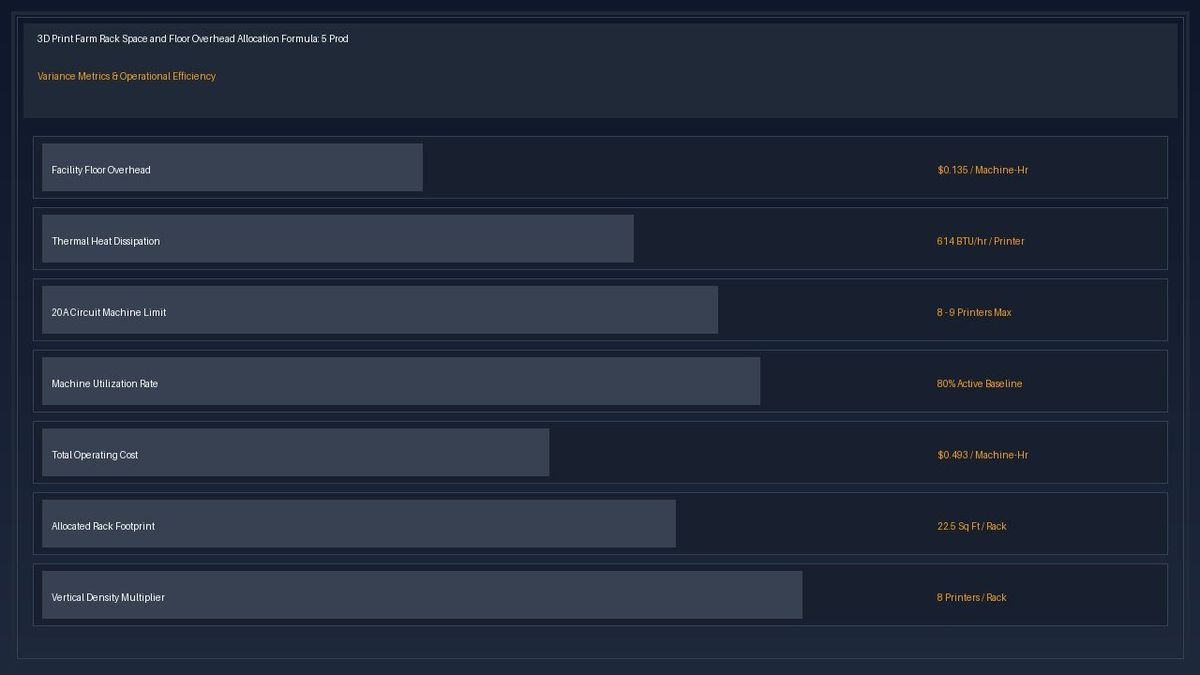
Integrating facility floor overhead, vertical rack depreciation, machine hardware amortization, electricity, and operator labor produces the comprehensive hourly job-shop cost rate. The master hourly operating cost per machine (\(R_{machine\_total}\)) is formulated as: \[ R_{machine\_total} = R_{hardware\_deprec} + R_{floor\_overhead} + R_{electricity} + R_{HVAC} + R_{maintenance} \] For a typical 48-printer commercial farm utilizing Bambu Lab X1-Carbon printers ($1,450 hardware cost amortized over 6,000 operating hours = $0.242/hr; floor overhead at $0.136/hr; electrical power at $0.029/hr; HVAC cooling at $0.007/hr; and wear consumables at $0.080/hr), the total baseline operating cost is $0.494 per printer-hour before raw filament and labor.
Understanding this fully absorbed cost floor ensures that when pricing commercial jobs (e.g., charging $3.50 to $6.00 per machine-hour plus filament markups), contract quotations guarantee healthy operating margins regardless of seasonal lease fluctuations.
Frequently Asked Questions
Why must operator walkways be included in 3D print farm floor overhead?
Shelving racks cannot operate edge-to-edge. Operators require 36-inch aisle clearance between racks to safely access build plates, load filament spools, execute machine maintenance, and meet commercial fire safety egress codes.
How many printers can be safely powered on a standard 20A commercial circuit?
Under the NEC 80% continuous commercial load rule, a 20A/120V circuit can support a maximum continuous load of 1,920 Watts. Enclosed high-speed printers drawing 180W running power should be limited to 8 or 9 machines per 20A circuit to prevent breaker trips.
What is the impact of summer heat on print farm operating costs?
Each active 3D printer dissipates approximately 600 BTU/hr of thermal energy. In a 48-machine farm, commercial air conditioning adds approximately $0.34 per hour in electrical cooling costs to maintain optimal 72°F ambient temperatures.
Looking to verify precise dimensions, spatial tolerances, or operational financial models for your setup? Explore our interactive tools and comprehensive engineering guides on 3dprintcostestimator.com.