The Master 3D Print Cost Formula: How to Calculate Profitable Filament, Electricity, and Depreciation Rates
Mastering the exact 3D print cost formula is the single most critical factor determining whether your additive manufacturing operation thrives or quietly bleeds cash. Most makers on Etsy and local print shop owners calculate custom job quotes purely on raw filament weight, completely ignoring electricity tariffs, nozzle depreciation, slicing labor, and multi-color purge waste.
Key Takeaways: - Filament Weight Is Only ~30% of True Cost: Relying solely on spool price guarantees selling custom jobs at an unconscious net loss once overhead is factored in. - Depreciation & Electricity Matter: CoreXY machines running at high bed temperatures draw measurable kilowatt-hours while wearing down $600+ capital hardware. - Margin vs. Markup: Always calculate your final retail selling price using net profit margin division rather than simple percentage multiplication.
The Master 3D Print Cost Formula Explained
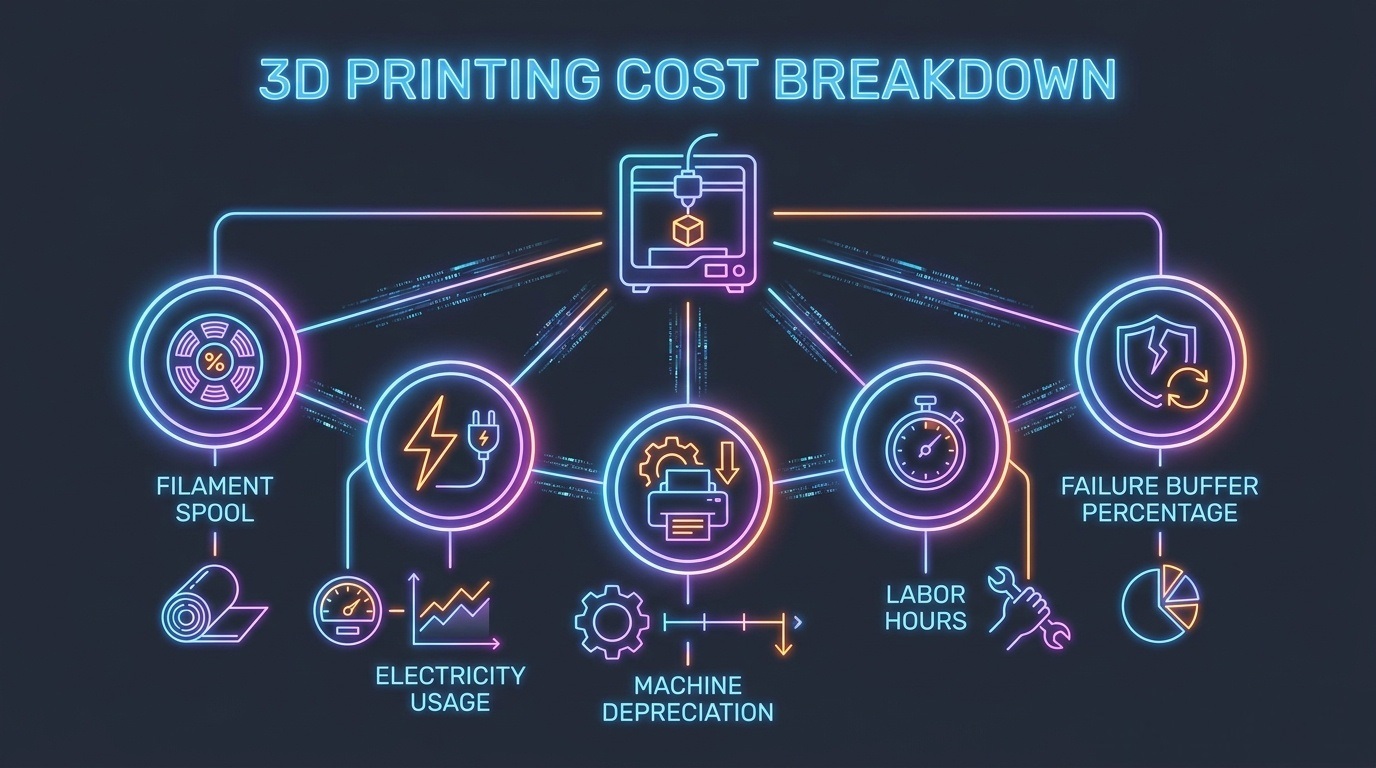
To establish an authoritative and scalable pricing model, every custom job must account for direct materials, utility consumption, asset depreciation, hands-on labor, and an inevitable failure risk buffer.
Here is the exact mathematical baseline used by commercial additive manufacturing services to guarantee profitability on every print bed run:
Master 3D Print Cost Formula: $$\text{Total Print Cost} = (\text{Filament Weight in kg} \times \text{Cost per kg}) + (\text{Print Time in Hours} \times \text{Machine kW} \times \text{Electricity Rate per kWh}) + (\text{Print Time in Hours} \times \text{Depreciation Rate per Hour}) + (\text{Labor Hours} \times \text{Hourly Wage}) + \text{Failure Buffer (15\%)}$$
Retail Selling Price Formula: $$\text{Retail Selling Price} = \frac{\text{Total Print Cost}}{1 - \text{Desired Profit Margin \%}}$$
Understanding each component of the 3D print cost formula ensures you never undercharge for complex geometries or extended print durations.
- Direct Filament Material Cost: Calculate the exact mass of filament consumed in kilograms (including support structures and brim material) multiplied by the purchase price of your spool.
- Electrical Energy Draw: Multiply total printer active run hours by average machine power consumption in kilowatts, then multiply by your local utility's kilowatt-hour tariff rate. You can check average regional electricity tariffs via official published industrial data at the U.S. Energy Information Administration.
- Machine Equipment Depreciation: Amortize the original purchase cost of your 3D printer across its estimated operational lifespan in hours to account for long-term wear and tear.
- Labor & Slicing Preparation: Quantify hands-on time spent preparing CAD models, setting slicing parameters, cleaning build plates, and removing support materials.
- Failure & Multi-Color Waste Buffer: Add a standard 15% contingency risk buffer to cover bed adhesion failures, filament moisture pops, and multi-color flush waste.
Step-by-Step Numerical Walkthrough: 150g Dragon Worked Example
To demonstrate how the formula works in practice, let's analyze a real-world production job. We will evaluate a 150g articulated dragon printed in PLA on a $600 CoreXY printer with a 6-hour print time.
Job Parameters & Assumptions
- Model Weight: 150 grams (0.150 kg) of PLA filament.
- Spool Cost: $20.00 per 1 kg spool.
- Printer Hardware: $600 CoreXY machine with an estimated 2,500-hour operational lifespan.
- Power Draw: 150 Watts (0.15 kW) average power consumption during active printing.
- Utility Rate: $0.16 per kWh residential/commercial power tariff.
- Labor: 15 minutes (0.25 hours) spent slicing, prepping the PEI plate, and removing supports at a target labor rate of $20.00/hour.
| Cost Component | Calculation Formula | Item Cost ($) |
|---|---|---|
| Filament Material | \(0.150 \text{ kg} \times \$20.00/\text{kg}\) | $3.00 |
| Electricity Draw | \(0.15 \text{ kW} \times 6 \text{ hrs} \times \$0.16/\text{kWh}\) | $0.14 |
| Machine Depreciation | \(6 \text{ hrs} \times (\$600 / 2,500 \text{ hrs})\) | $1.44 |
| Hands-On Labor | \(0.25 \text{ hrs} \times \$20.00/\text{hr}\) | $5.00 |
| Subtotal Base Cost | \(\text{Material} + \text{Power} + \text{Depreciation} + \text{Labor}\) | $9.58 |
| 15% Failure/Purge Buffer | \(\$9.58 \times 1.15\) | $11.02 |
True Production Cost vs. Wholesale & Retail Pricing
With a true calculated production cost of $11.02, we can now derive sustainable wholesale (40% profit margin) and retail (65% profit margin) price points. Notice how dividing by the inverse margin percentage protects your bottom line compared to simple markup multipliers.
| Pricing Tier | Target Profit Margin | Calculation Formula | Final Selling Price | Net Profit per Unit |
|---|---|---|---|---|
| Wholesale Price | 40% Margin | \(\$11.02 / (1 - 0.40)\) | $18.37 | $7.35 |
| Retail Price | 65% Margin | \(\$11.02 / (1 - 0.65)\) | $31.49 | $20.47 |
If this maker had priced the dragon based only on filament weight ($3.00 x 3 = $9.00), they would have sold the print for less than the actual $11.02 break-even production cost!
Hidden Cost Variables and Edge Cases
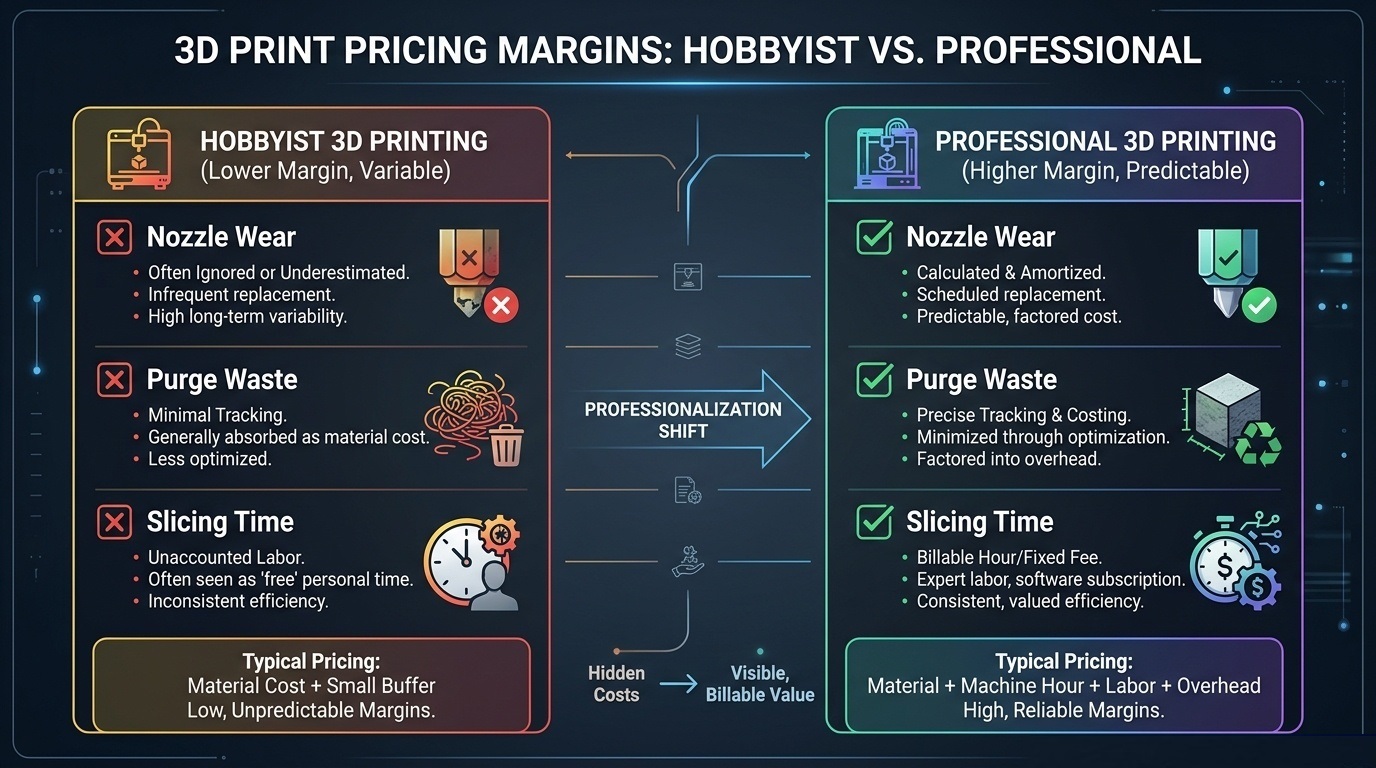
Running a profitable 3D printing service requires anticipating invisible material loss and component degradation. Ignoring these hidden edge cases rapidly turns theoretical margins into real cash deficits.
Multi-Color AMS Purge Waste
Modern Automatic Material Systems (AMS) generate substantial purge material ("poop" flushes) and purge towers when switching colors on single-nozzle toolheads. On multi-color prints with hundreds of color changes, purge waste can easily add 30% to 50% extra filament mass beyond what slicer estimates show for the model itself.
Consumable Hardware Wear & Tear
Build plates and hotend components degrade continuously over time and must be amortized into your hourly operation costs: - Brass Nozzles: Cost ~$2.00 with a 500-hour functional life ($0.004/hour). - Hardened Steel Nozzles: Cost ~$25.00 with a 3,000-hour life ($0.0083/hour) for abrasive carbon fiber/glow filaments. - Textured PEI Build Plates: Cost ~$30.00 with a 1,500-hour adhesive life ($0.02/hour).
3D Print Cost Checklist for Profitable Pricing
Follow this actionable checklist before issuing any custom job quote to ensure full cost recovery and profit protection:
- Weigh finished prints and support structures to verify slicer mass estimates.
- Record exact active print hours from hardware telemetry logs.
- Log local utility tariff adjustments (peak vs. off-peak kWh rates).
- Calculate machine hourly depreciation based on total original purchase price divided by expected lifespan.
- Track exact hands-on setup, CAD adjustment, and post-processing minutes.
- Factor in multi-color flush ratios for AMS print jobs.
- Apply a minimum 15% risk buffer for failure rates and consumable nozzle wear.
Free 3D Print Pricing Calculator Tool
Don't waste time running manual kilowatt and depreciation math for every custom order. Enter your print time and filament grams into our free 3D Print Cost Estimator above for instant retail, wholesale, and breakeven rates.
Frequently Asked Questions (FAQ)
How much electricity does an enclosed 3D printer actually use per hour?
An enclosed CoreXY 3D printer consumes roughly 350W to 500W during initial bed warm-up, but settles down to an average power draw of 100W to 180W per hour during continuous PLA/PETG printing. At an average utility rate of $0.16/kWh, running an enclosed printer costs approximately $0.02 to $0.03 per active hour.
What is a fair hourly rate to charge for 3D printer design and slicing time?
Professional 3D print service providers typically charge between $20.00 and $45.00 per hour for basic slicing, file setup, and support placement. Advanced CAD modeling, mesh repair, and reverse engineering services should be billed at $50.00 to $100.00+ per hour depending on technical expertise.
What profit margin do successful 3D printing businesses aim for?
Successful additive manufacturing businesses target a minimum 50% to 65% net profit margin on direct-to-consumer retail orders on platforms like Etsy. For large-volume wholesale B2B contracts, print shops usually operate on a 35% to 45% profit margin to maintain competitive bulk pricing while securing strong cash flow.