3D Print Annealing Oven Electricity and Dimensional Shrinkage Cost Formula: 5 Print Farm Calculations
When commercial 3D print farms and engineering job shops produce end-use functional brackets, under-hood automotive ducts, and autoclaved medical jigs in semi-crystalline polymers—such as PA6-CF, PA12-CF, PPA-CF, PET-CF, PPS-CF, and HT-PLA—thermal post-annealing in a forced-convection oven is mandatory. Proper thermal annealing reorganizes amorphous polymer chains into dense crystalline lamellae, boosting Heat Deflection Temperature (HDT at \(0.45\text{ MPa}\)) from \(85^{\circ}\text{C}\) to over \(195^{\circ}\text{C}\) while increasing flexural modulus and interlayer Z-bond strength by \(20\%\text{ to } 35\%\).
However, most print farm operators price annealed parts by adding an arbitrary \(\$2.00\) surcharge—completely ignoring the 3-phase thermodynamics of a \(6\text{-to-}10\text{-hour}\) oven cycle, silica sand ballast packing labor, oven capital amortization, and the scrap risk of anisotropic XY shrinkage and Z-axis expansion. This guide derives the five exact engineering and financial formulas required to price post-annealed 3D prints profitably, cross-linked with our Interactive 3D Print Cost & Margin Estimator.
Quick Answer & Print Farm Annealing Benchmarks:
- 3-Stage Oven Electricity Formula: Total annealing energy \(E_{\text{anneal}} = P_{\text{oven}} \cdot \left( t_{\text{ramp}} \cdot d_{\text{ramp}} + t_{\text{soak}} \cdot d_{\text{soak}} + t_{\text{cool}} \cdot d_{\text{fan}} \right)\). A standard \(1{,}200\text{W}\) forced-convection oven running a \(100^{\circ}\text{C}\), \(6\text{-hour}\) PA6-CF cycle consumes \(2.52\text{ kWh}\) (\(\$0.45\text{ to }\$0.76\) per batch).
- Anisotropic Slicer Scaling Formula: To hit tight \(\pm 0.15\text{ mm}\) bolt-hole tolerances after annealing, pre-scale each axis in OrcaSlicer or Bambu Studio by \(S_i = \frac{100\%}{1 + \alpha_i}\).
- True Per-Part Annealing Cost: Once you factor in oven amortization, silica sand packing/de-dusting labor, and dimensional tolerance scrap reserve (\(r_{\text{scrap}}\)), true post-annealing cost ranges from \(\$1.85\text{ to }\$6.40\text{ per part}\).
1. Three-Stage Forced-Convection Oven Thermodynamics & kWh Cost Formula
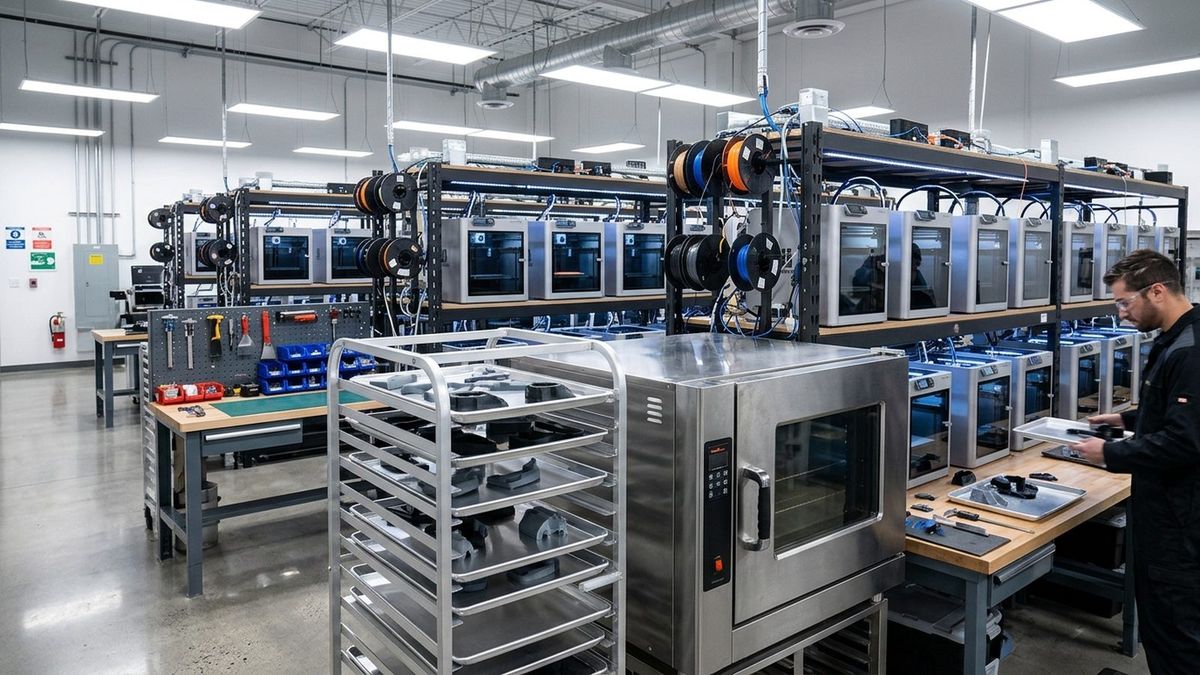
Unlike a household toaster oven whose uninsulated sheet-metal walls and radiant elements create \(\pm 18^{\circ}\text{C}\) hot spots that warp 3D prints, a commercial PID-controlled forced-convection laboratory oven (such as a Memmert UF Series or Across International FO Series rated at \(P_{\text{oven}} = 1.2\text{ kW}\text{ to } 1.6\text{ kW}\)) executes annealing across three distinct electrical duty-cycle phases:
- Phase 1 —Controlled Thermal Ramp (\(t_{\text{ramp}}\)): Heating from ambient (\(22^{\circ}\text{C}\)) to target soak temperature \(T_{\text{soak}}\) (\(90^{\circ}\text{C}\text{ to } 130^{\circ}\text{C}\)) at \(1.5^{\circ}\text{C/min}\) with heater duty cycle \(d_{\text{ramp}} \approx 0.75\).
- Phase 2 — Isothermal Crystallization Soak (\(t_{\text{soak}}\)): Holding \(T_{\text{soak}}\) for \(4\text{ to } 8\text{ hours}\) above the polymer's glass transition temperature \(T_g\) (and below melting point \(T_m\)) with PID maintenance duty cycle \(d_{\text{soak}} \approx 0.28\).
- Phase 3 — Slow In-Chamber Cool-Down (\(t_{\text{cool}}\)): Heaters off (\(0\text{ W}\)), circulation fan running (\(d_{\text{fan}} \approx 0.05\)) for \(3\text{ to } 4\text{ hours}\) until chamber temperature drops below \(35^{\circ}\text{C}\) to prevent differential thermal contraction warping.
The total electrical energy \(E_{\text{anneal}}\) (in kWh) and batch electricity cost \(C_{\text{elec}}\) at utility tariff \(R_{\text{kWh}}\) are:
\[ E_{\text{anneal}} = P_{\text{oven}} \cdot \left( t_{\text{ramp}} \cdot d_{\text{ramp}} + t_{\text{soak}} \cdot d_{\text{soak}} + t_{\text{cool}} \cdot d_{\text{fan}} \right) \] \[ C_{\text{elec}} = E_{\text{anneal}} \cdot R_{\text{kWh}} \]Worked Calculation (6-Hour PA6-CF Cycle at \(100^{\circ}\text{C}\) in a \(1.2\text{ kW}\) Oven, \(R_{\text{kWh}} = \$0.18/\text{kWh}\)): With \(t_{\text{ramp}} = 0.5\text{ hr}\) (\(d_{\text{ramp}} = 0.75\)), \(t_{\text{soak}} = 6.0\text{ hr}\) (\(d_{\text{soak}} = 0.28\)), and \(t_{\text{cool}} = 3.0\text{ hr}\) (\(d_{\text{fan}} = 0.05\)):
\[ E_{\text{anneal}} = 1.2\text{ kW} \times \left( 0.5 \times 0.75 + 6.0 \times 0.28 + 3.0 \times 0.05 \right) = 1.2 \times (0.375 + 1.680 + 0.150) = 1.2 \times 2.205 = 2.646\text{ kWh} \] \[ C_{\text{elec}} = 2.646\text{ kWh} \times \$0.18/\text{kWh} = \$0.48\text{ per oven batch} \]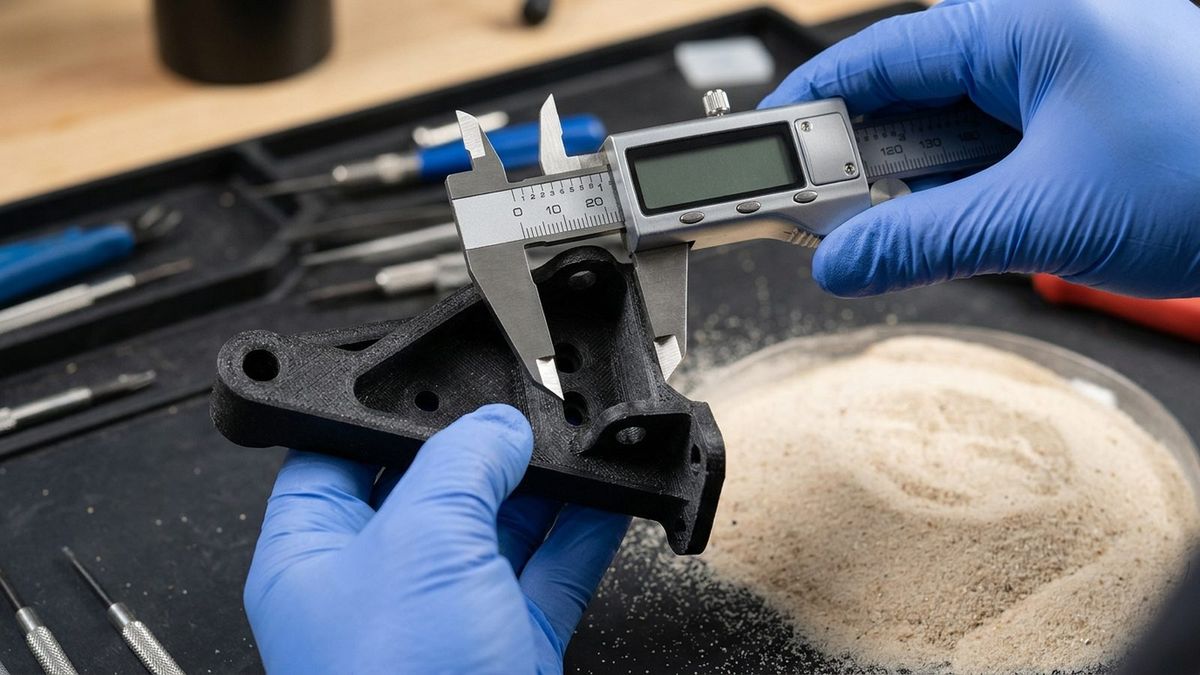
2. Anisotropic XY Shrinkage vs. Z-Axis Expansion Compensation Math
During Fused Deposition Modeling (FDM), molten polymer strands are stretched horizontally along the XY nozzle vector and rapidly quenched below \(T_g\), freezing tensile residual stresses into the XY plane while compressing layer interfaces along the vertical Z-axis. When heated above \(T_g\) during oven annealing, those frozen stresses relax anisotropically: the part shrinks along X and Y (\(\alpha_{XY} < 0\)) while expanding along Z (\(\alpha_Z > 0\)).
If a customer drawing specifies a target post-annealed dimension \(L_{\text{target},i}\) along axis \(i \in \{X, Y, Z\}\) and your empirical material shrinkage/expansion coefficient is \(\alpha_i = \frac{L_{\text{annealed},i} - L_{\text{printed},i}}{L_{\text{printed},i}}\), the exact slicer pre-scaling factor \(S_i\) (in percent) is:
\[ L_{\text{printed},i} = \frac{L_{\text{target},i}}{1 + \alpha_i} \implies S_i = \left( \frac{1}{1 + \alpha_i} \right) \times 100\% \]For example, when annealing unfilled HT-PLA with \(\alpha_{XY} = -0.022\) (\(-2.20\%\) XY contraction) and \(\alpha_Z = +0.013\) (\(+1.30\%\) Z expansion):
\[ S_{XY} = \left( \frac{1}{1 - 0.022} \right) \times 100\% = 102.25\%, \qquad S_Z = \left( \frac{1}{1 + 0.013} \right) \times 100\% = 98.72\% \]By contrast, short carbon-fiber reinforcement (\(15\%\text{ to } 20\%\) chopped carbon fiber in Polymaker Fiberon PA6-CF20 or Bambu PAHT-CF) mechanically pins the polymer matrix along the extrusion direction, slashing XY shrinkage from \(-2.20\%\) down to just \(-0.18\%\text{ to }-0.28\%\) (\(S_{XY} = 100.22\%\)).
3. Polymer Annealing Temperature, Soak Time & Shrinkage Reference Table
| Polymer Grade | Glass Transition (\(T_g\)) | Oven Soak Temp & Time | XY Shrinkage (\(\alpha_{XY}\)) | Z Expansion (\(\alpha_Z\)) | Slicer Scale (\(X/Y \mid Z\)) | Post-Anneal HDT (\(0.45\text{ MPa}\)) |
|---|---|---|---|---|---|---|
| HT-PLA / Pro PLA | \(60^{\circ}\text{C}\) | \(95^{\circ}\text{C}\) for \(2.0\text{ hr}\) (Sand Packed) | \(-2.20\%\) | \(+1.30\%\) | \(102.25\% \mid 98.72\%\) | \(145^{\circ}\text{C}\) (up from \(58^{\circ}\text{C}\)) |
| Neat Unfilled PA6 / PA12 | \(48\text{–}55^{\circ}\text{C}\) | \(90^{\circ}\text{C}\) for \(6.0\text{ hr}\) + \(3\text{h}\) cool | \(-1.65\%\) | \(+0.85\%\) | \(101.68\% \mid 99.16\%\) | \(160^{\circ}\text{C}\) (up from \(75^{\circ}\text{C}\)) |
| PA6-CF20 / PA12-CF15 | \(55\text{–}62^{\circ}\text{C}\) | \(100^{\circ}\text{C}\) for \(6.0\text{ hr}\) + \(3\text{h}\) cool | \(-0.24\%\) | \(+0.15\%\) | \(100.24\% \mid 99.85\%\) | \(205^{\circ}\text{C}\) (up from \(95^{\circ}\text{C}\)) |
| PET-CF17 / PPA-CF | \(78\text{–}90^{\circ}\text{C}\) | \(115^{\circ}\text{C}\) for \(6.0\text{ hr}\) + \(3\text{h}\) cool | \(-0.18\%\) | \(+0.10\%\) | \(100.18\% \mid 99.90\%\) | \(225^{\circ}\text{C}\) (up from \(115^{\circ}\text{C}\)) |
| PPS-CF10 (High-Temp) | \(90^{\circ}\text{C}\) | \(130^{\circ}\text{C}\) for \(8.0\text{ hr}\) + \(4\text{h}\) cool | \(-0.12\%\) | \(+0.08\%\) | \(100.12\% \mid 99.92\%\) | \(260^{\circ}\text{C}+\) (Flame Retardant) |
4. Master Per-Part Post-Annealing Cost Formula (Labor, Media & Scrap Risk)
When quoting a batch of \(N_{\text{batch}}\) parts annealed simultaneously in an oven tray, the complete post-processing cost per part \(C_{\text{anneal,part}}\) combines four cost centers:
- Oven Electricity (\(C_{\text{elec}}\)) & Hourly Oven Depreciation (\(R_{\text{oven}} = C_{\text{purchase}} / H_{\text{life}}\)): Typically \(\$850 / 8{,}000\text{ hr} = \$0.11/\text{hr}\) across total cycle duration \(t_{\text{total}} = t_{\text{ramp}} + t_{\text{soak}} + t_{\text{cool}}\).
- Ballast Media & Moisture Conditioning (\(C_{\text{media}}\)): Kiln-dried \(80\text{-mesh}\) silica sand or aluminum oxide powder replacement (\(\$0.35\text{/batch}\) for unfilled polymers requiring overhang support) plus distilled water bath conditioning.
- Technician Handling Labor (\(C_{\text{labor}}\)): Time \(t_{\text{labor}}\) (in hours) spent packing parts in sand or racking on aluminum plates, ultrasonic/compressed-air de-dusting, and post-anneal caliper QC at shop labor rate \(W_{\text{hr}}\) (\(\$32/\text{hr}\)).
- Dimensional Tolerance Scrap Multiplier (\(\frac{1}{1 - r_{\text{scrap}}}\)): Accounting for the probability \(r_{\text{scrap}}\) that a part warps outside customer GD&T limits during annealing, which forces a reprint of the base part cost \(C_{\text{print}}\).
Worked Print Farm Example: Suppose you anneal a batch of \(N_{\text{batch}} = 8\) PA6-CF brackets (\(C_{\text{print}} = \$18.50\text{/part}\), \(r_{\text{scrap}} = 3\% = 0.03\)) across a \(t_{\text{total}} = 9.5\text{ hr}\) cycle (\(C_{\text{elec}} = \$0.48\), \(C_{\text{media}} = \$0.20\)) with \(t_{\text{labor}} = 0.25\text{ hr}\) (\(15\text{ mins}\) total tray loading and caliper QC at \(\$32/\text{hr} = \$8.00\)):
\[ C_{\text{anneal,part}} = \frac{\$0.48 + (9.5 \times \$0.11) + \$0.20 + \$8.00}{8} + \$18.50 \times \left(\frac{0.03}{0.97}\right) \] \[ C_{\text{anneal,part}} = \frac{\$9.725}{8} + \$0.572 = \$1.22 + \$0.57 = \$1.79\text{ per part (Batch of 8)} \]However, if a customer orders a single rush prototype (\(N_{\text{batch}} = 1\)) in unfilled HT-PLA requiring \(20\text{ minutes}\) of silica sand packing (\(t_{\text{labor}} = 0.33\text{ hr}\)) and carrying a \(10\%\) warp risk (\(r_{\text{scrap}} = 0.10\)), the true annealing cost jumps to \(\$14.12\) for that single part—proving why minimum batch oven setup fees (\(\$15\text{ to }\$25\)) are essential for job-shop profitability.
Price Your Filament, Chamber Heating & Post-Annealing Jobs Accurately
Input your filament weight, print time, oven wattage, and technician labor rate into our interactive 3D Print Cost Calculator to generate instant customer quotes with protected profit margins.
Open the 3D Print Cost & Margin Calculator →